Buddhism Guide
  • Buddhism Guide
Home | Buddhism | Page 7
Category:

Buddhism

Upadana
Buddhism

Upadana

by Sergei March 11, 2019
written by Sergei

Upadana — meaning, origin and common depictions in Buddhist art and ritual, explained with concise examples.

UpadanaThe Sanskrit word Upadana has the following meanings:

Buddhism

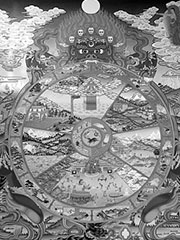
Upadana translated from Sanskrit means clinging or grasping and refers to the ninth link in the twelve-linked chain of Dependent Origination (Pratitya-samutpada).

Upadana and Trsna are seen as the two primary causes of suffering (Dukkha) in Samsara.

Upadana (Clinging) is dependent on Trsna (Craving) as a condition before it can exist.

“With Craving as condition, Clinging arises”.

Upadana (Clinging) is also the prevailing condition for the next condition in the chain, Becoming (Bhavana).

“With Clinging as condition, Becoming arises.”

Hinduism

Upadana means material basis or cause.
March 11, 2019 0 comments
0 FacebookTwitterPinterestEmail
Udanavarga
Buddhism

Udanavarga

by Sergei March 11, 2019
written by Sergei

Udanavarga — overview of meaning, background and key points, with links to related topics for context.

UdanavargaThe Udanavarga is a Sanskrit Buddhist text which is similar to the Dhammapada, containing many of the same verses. The Tibetan Buddhist canon contains two recensions of it, which are traditionally said to have been compiled by Dharmatrata.

The Udanavarga has around nine hundred and fifty verses in thirty-three chapters, whereas the most common version of the Dhammapada, the Pali, has only four hundred and twenty-three verses.

March 11, 2019 0 comments
0 FacebookTwitterPinterestEmail
慈济基金会
Buddhism

Tzu Chi

by Sergei March 11, 2019
written by Sergei

Tzu Chi — overview of meaning, background and key points, with links to related topics for context.

慈济基金会The Tzu Chi Foundation (Hanyu Pinyin: Cí Jì, Wade-Giles: Tz’u Chi, Simplified Chinese: 慈济基金会, Traditional Chinese: 慈濟基金會) is one of the two largest Buddhist organizations in Taiwan (the other being Fo Guang Shan). Tzu Chi was founded by Master Cheng Yen (1993 Nobel Peace Prize nominee), a nun, on April 14, 1966 in Hualien, Taiwan, after she was inspired by her master and mentor, the late Venerable Master Yin Shun (significant proponent of Humanistic Buddhism) with the great expectation of: “work for Buddhism and for all sentient beings”. The society started as a group of thirty housewives who saved a small amount of money each day, and has grown to have over 4.5 million members worldwide today.

Whereas many Buddhist societies focus on personal enlightenment and meditation, Tzu Chi focuses on community service and outreach (especially medical, educational, and disaster relief). Tzu Chi maintains a small number of nuns, and conducts its mission via an international network of volunteers. The volunteers are easily recognized by their uniforms (navy blue shirt with a ship imposed on a lotus flower as a logo on the left breast; white pants, shoes and socks; and a black belt with the same lotus ship logo as a clasp). Tzu Chi has many suborganizations, of which the Tzu Chi Collegiate Youth Association (慈濟大專青年聯誼會) being one of the most prominent. With chapters at universities worldwide, Tzu Chi Youth allows the university student to be involved with Tzu Chi’s work on both local and international levels. Tzu Chi remains a non-profit organization and has built many hospitals and schools worldwide, including a comprehensive education system within Taiwan spanning from kindergarten through university and medical school.

The organization was heavily criticized in the early 1990s for spending much of its focus in relief efforts outside of Taiwan, but criticism ended after the 921 earthquake, when the organization was able to draw on its logistics experience to provide disaster relief. In contrast to the official government efforts to deal with the disaster, which were considered uncoordinated and haphazard, Tzu-Chi was widely praised for its efforts.

March 11, 2019 0 comments
0 FacebookTwitterPinterestEmail
Two Truths
Buddhism

Two Truths Doctrine

by Sergei March 11, 2019
written by Sergei

Two Truths — overview of meaning, background and key points, with links to related topics for context.

Two TruthsThe two truths doctrine in Buddhism differentiates between two levels of truth in Buddhist discourse, a low, or commonsense truth, and a high, or “ultimate” truth or between a relative and an absolute truth. It is used to avoid confusion between doctrinally accurate statements about the true nature of reality (e.g., there is no “self”) and practical statements that make reference to things that, while not expressing the true nature of reality, are necessary in order to communicate easily and help people achieve enlightenment (e.g., talking to a student about “himself” or “herself”). While this division, particularly when referred to as the “satya-dvaya”, is often associated with the Madhyamaka school, its history is quite extensive. Casual readers of Buddhist thought have often used the ideas of the two truths to erroneously identify Buddhism as being Transcendental in nature, and thereby identify its doctrines with Plato or Kant.

Canonical use

Two pairs of terms are used in the Tipitaka. One pair is nītattha (Pali; Sanskrit: nītārtha, “of plain or clear meaning” (Monier-Williams)) and neyyattha (Pali; Sanskrit: neyartha, “(a word or sentence) having a sense that can only be guessed” (Monier-Williams)). These terms were used to identify texts or statements that either did or did not require additional interpretation in order to be made clear and/or non-contradictory and/or doctrinally accurate in a strict sense; a nītārtha required no explanation, while a neyyartha text might mislead some people unless properly explained. (McCagney, 82)

There are these two who misrepresent the Tathagata. Which two? He who represents a Sutta of indirect meaning as a Sutta of direct meaning and he who represents a Sutta of direct meaning as a Sutta of indirect meaning.
— Anguttara Nikaya I:60 (Jayatilleke, 361, in McCagney, 82)

The other pair is samuti (Pali; Sanskrit: saṃvṛti, “covering, concealing..dissimulation, hypocrisy” (Monier-Williams)) and paramattha (Pali; Sanskrit: paramārtha, “ultimate”). These are used to distinguish conventional or common-sense language, as used in metaphors or for convenience’s sake, from language used to express higher truths directly.

The term vohāra (Pali; Sanskrit: vyavahāra, “common practice, convention, custom” is also used in more or less the same sense as samuti.

In the canon, the distinction is not made between a lower truth and a higher truth, but rather between two kinds of expressions of the same truth, which must be interpreted differently. Thus a phrase or passage, or a whole sutta, might be classed as neyyattha or samuti or vohāra, but it is not regarded at this stage as expressing or conveying a different level of truth.

There is a canonical assertion that “truth is one” that might be held to conflict with a systematic assertion that there is a bifold distinction of truths.

Theravāda commentarial tradition

The Theravādin commentators expanded on these categories and began applying them not only to expressions but to the truth then expressed.

The Awakened One, the best of teachers, spoke of two truths, conventional and higher; no third is ascertained; a conventional statement is true because of convention and a higher statement is true as disclosing the true characteristics of events.
— Khathāvatthu Aṭṭha kathǎ (Jayatilleke, 363, in McCagney, 84)

Further developments in Nikaya Buddhism

The Prajnāptivāda school took up the paramārtha/saṃvṛti distinction, and extended the concept to dharmas (metaphysical-phenomenological constituents), distinguishing those which are tattva (real) from those which are purely conceptual, i.e., ultimately nonexistent, “prajnāpti”.

Madhyamaka

The distinction between two truths (satyadvayavibhaga) is of great importance for the Madhyamaka school, as it forms a cornerstone of their beliefs; in Nāgārjuna‘s Mūlamadhyamakakārika, for example, it is used to defend the identification of pratītyasamutpāda with śūnyatā.

The Buddha’s teaching of the dharma relied on two truths,
The common truth of the world (lokasaṃvṛtisatya) and what is ultimately true (paramārthasatya).
They who do not know the division of the two truths
Do not know the deep reality of the Buddha’s instructions.
The ultimate is not taught without resorting to the conventional (vyavahāra);
Without having gotten to the ultimate (paramārtha), nirvana cannot be approached.
— MMK 24:8-10

See also

  • Dialetheism
  • Upaya

References

  • McCagney, Nancy. The Philosophy of Openness. Rowman and Litlefield, 1997
  • Keown, Damien. Dictionary of Buddhism. Oxford University Press, 2003
  • Monier-Williams, Monier. Sanskrit-English Dictionary
  • Gethin, Rupert. Foundations of Buddhism. pp. 207, 235-245
  • Jayatilleke, K.N. Early Buddhist Theory of Knowledge. George Allen and Unwin, 1963
March 11, 2019 0 comments
0 FacebookTwitterPinterestEmail
Two Truths Doctrine
Buddhism

Two Truths Doctrine

by Sergei March 11, 2019
written by Sergei

Two Truths Doctrine — overview of meaning, background and key points, with links to related topics for context.

Two Truths DoctrineThe two-truths doctrine is the belief that truth exists in conventional and ultimate forms, and that both forms are co-existant.

The doctrine is an especially important element of Buddhism and was first expressed in complete modern form by Nagarjuna, who based it on the Kaccāyanagotta Sutta.

In Buddhism, it is applied particularly to the doctrine of emptiness, in which objects are ultimately empty of essence, yet conventionally appear the contrary at any given moment in time, such that they neither exist nor do not exist.

In the Kaccāyanagotta Sutta, the Buddha, speaking to the monk Kaccayana Gotta on the topic of “right view”, says the following –

By and large, Kaccayana, this world is supported by a polarity, that of existence and non-existence. But when one sees the origination of the world as it actually is with right discernment, ‘non-existence’ with reference to the world does not occur to one. When one sees the cessation of the world as it actually is with right discernment, ‘existence’ with reference to the world does not occur to one.
March 11, 2019 0 comments
0 FacebookTwitterPinterestEmail
Twelve Nidanas
Buddhism

Twelve Nidanas

by Sergei March 11, 2019
written by Sergei

Twelve Nidanas — overview of meaning, background and key points, with links to related topics for context.

Twelve NidanasThe Twelve Nidanas (Pali: nidana– foundation, source or origin) are the application of the Buddhist concept of Pratitya-samutpada (dependent origination). The Twelve Nidanas are employed in the analysis of phenomena according to the principle of Pratitya-samutpada. The aim of the Twelve Nidanas analysis is to reveal the origins of phenomena, and the feedback loop of conditioning and causation that leads to suffering in current and future lives.

Summary

The basic principle of pratitya-samutpada and the Twelve Nidanas is to see the conditioned causal connection of each state that supports the next in the cycle of our lives as we suffer in Samsara. It is explained in detail in the Visuddhimagga of Buddhaghosa, the central text of the Mahavihara commentarial tradition.

The causal chain of analysis employed in this type of analysis appears to operate from the position that individual phenomena are caused or conditioned by only a single cause. This reflects not a blanket declaration by the Buddha Shakyamuni or the Theravada commentators that individual phenomena can have only a single cause, but rather a simplifying assumption employed to make the analytical technique more useful to the practitioner.

Like many of the techniques and theories contained in the Visuddhimagga and other commentarial works, the Twelve Nidana analysis was intended to be used as one of many techniques available to a student of meditation, and its form reflects both the needs and experiences of Buddhist meditation practitioners.

The chain of twelve phenomena leading to future births and suffering was variously presented by the Buddha; Buddhaghosa recounts four methods- working from ‘bottom to top’, working from the ‘middle to the top’, working from ‘top to bottom’, and working from the ‘middle to the source’ (Buddhaghosa compares the teaching of the Twelve Nidanas to a creeper vine that is seized and removed in one of four different ways). The first method begins with ignorance and proceeds to sickness, old age, and death. The second method begins with attachment and proceeds to birth. The third method begins with birth and proceeds back to ignorance. The fourth method begins with attachment and proceeds to ignorance.

The Twelve Nidana

Ignorance (Pali avijja; Skt. āvidyā; Tib. ma rik pa (ma rig pa))
Ignorance of Four Noble Truths, Three marks of existence, Five Skandhas, Karma, and Pratitya-Samutpada. This is the primary cause of Dukkha, suffering dissatisfaction, pain, unease, etc.
(Mental)Formations (Pali Sankhata/sankhara; Skt. samskāra; Tib. du che (‘du byed))
Mental Formations and Volitional Will. Mental constructs, based on a non-existent “I” or “Self”.
(Dualistic) Consciousness (Pali viññana; Skt. vijñāna; Tib. nam she (rnam par shes pa)
Various states of consciousness.
Name and Form (Pali namarupa; Skt. nāmarūpa; Tib. ming zuk (ming zgugs))
Nama the naming activity of the discursive mind and Rupa its attendant form, without which mind cannot exist.
Six Sense Gates (Pali Salayatana; Skt. sadāyatana; Tib. chem che (skey mched))
The six senses are eye/seeing, ear/hearing, nose/smelling, tongue/taste, skin/touch, mind/thought. Apart from the five senses which we are familiar with, in Buddhism, the sixth sense is the mind, and the object of mind is thought. Sadayatana refers specifically to the six sense organs.
Contact (Pali phassa; Skt. sparśa; Tib. rek pa (reg pa))
Contact between the eye and tree, between the ear and drum, nose and perfume, tongue and salt, skin and cut, mind and thought.
Sensation (Pali Vedana; Skt. vedanā; Tib. tsor wa (tshor ba))
Sensation refers to the quality of feeling. Is it pleasant, unpleasant or neutral? Swimming on a hot day – pleasant. Sharp stones under a bare foot – unpleasant. Bum on a chair – neutral.
Craving or Desire (Pali Tanha; Skt. trsnā; Tib. se pa (sred pa))
Desire is sometimes described as the cause of suffering : a constant dissatisfaction, frustration.
Attachment (Pali upadana; Skt. upādna; Tib. len pa (len pa))
Attachment of all kinds, to persons, to life, material comfort, pleasant sensations, to unpleasant sensations too. There is also attachment to beliefs, thoughts, ideas/ideologies. (Sometimes resulting in clashes, confrontations, fighting, or even wars).
Becoming (Pali bhava; Skt. bhāva; Tib. si pa (srid pa))
The steps or actions taken to recreate, that which was craved or desired in step eight above Tanha.
Birth (Pali jati; Skt. jāti; Tib. che wa (skyed pa))
Bearing fruit of the previous ten steps. That which was desired and conditioned now comes to be.
Aging (old age), decay and death (Pali jara-marana; Skt. jarāmarana; Tib. ga shi (rga shi))
That which is born, dies. All conditions, all experiences must end.

Notes

The above cycle is frequently seen as relating to “Lifetimes” which they do, but additionally and probably more relevantly they relate to all life experiences on a daily basis. Throughout the day we cycle through the conditioned states. The conditioned states give rise to pleasant and unpleasant, desirable and undesirable experiences. We crave the existence of such states, if they are pleasant or we crave their absence if they are unpleasant.;

Pāli

Skt = Sanskrit

Tib = Tibetan (pronunciation given first, with Wylie transliteration in parenthesis)

Twenty four types of conditions

Conditions, reason, source, génitor are described by the Visuddhimagga as the same. Conditioning an agent means to cause it, being taken as an object by it, to occur in the same time. The full list helps to consider many sorts of conditions as the causal condition is only one of them.Examples are explained to understand these conditions, but they are included in the next section in order not to repeat them.

Causal
Both a condition and a cause. Each condition responds to this principle to be both a condition and something else. Note that a cause does not transmit any “substance” – see Three marks of existence.
Object
An agent that helps another one by being its object. All that can be known can be an object condition.
Predominance
An agent that helps another one by mastering it.
Immediacy
An agent thats helps another one considering its immediacy.
Full immediacy
Same meaning as the immediacy condition.
Simultaneity
An agent that helps another one by appearing on the same time “as the lamp for the light”.
Reciprocity
Agents that help themselves and consolidate themselves are one for the others “reciprocity condition”.
Support
An agent that helps another one by being a basement for it.
Strong support
A strong basement.
Anteriority
An agent that helps another one by appearing before it.
Posteriority
A psychic agent that helps an older and physical one reenforcing it.
Repetition
A state of mind that conditions a following and similar state of mind.
Karma
An action that is an intentional effort.
Result
A serene state of mind helping another one to be serene.
Intake
The four “foods” : the food helps the body, but “psychic foods” helps associated factors.
Faculty
For example, the ocular faculty helps the ocular conscience.
Jhana
The jhanas are said to be associated with some characteristics : vitakka, vicara, piti, sukkha or on the contrary upekkha and ekkagata. Jhanas are conditioning these.
Way
The way to leave the samsara. Some factors are associated with this way.
Association
The four non-physical skandhas help themselves by being associated to the same object.
Dissociation
Physical and non-physical agents helping themselves by not being associated to the same object. For example, a calm state of mind helping some physical aspects to be – but not always to appear, as the dissociation condition can be anterior, posterior or simultaneous..
Existence
An agent helping another, similar one by making it strong.
Inexistence
Non-physical agents, ceasing, help another one to appear.
Disparition
Same as the inexistence condition.
Non-disparition
Same as the existence condition.

The whole description

This section considers which conditions apply to which part of the dependent origination.

Ignorance conditions creations, activities
Activities condition consciousness
Consciousness conditions body and mind
Body and mind condition the twelve domains
During rebirth, the four psychic aggregates condition the sixth domain as simultaneity, reciprocity, support, association, result, existence and non-disparition.
Twelve domains condition contact
The five physical domains condition the five physical contacts as support, anteriority, faculty, dissociation, existence and non-disparition. The mental domain conditions the mental contact as simultaneity, reciprocity, support, result, intake, faculty, association, existence and non-disparition. The visible domain conditions contact with the eye as object, anteriority, existence and non-disparition. The other exterior domains represent the same conditions : for example sound for the contact with the ear.
Contact conditions sensation
This description considers only the 32 sensations associated to resulting states. Contact with the eye, the nose, the ear, the mouth or the body conditions the sensations which are supported by the associated sensibilities as simultaneity, reciprocity, support, result, intake, association, existence and non-disparition.

Contact with the eye, nose, ear, mouth and body also conditions the other sensations as strong support.

Sensation conditions lust
The only case is the resulting and nice-to-have sensation conditioning craving as a strong support.
Desire conditions attachment
Sensorial lust conditions as strong support sensorial attachment. Sensorial lust conditions other attachments as simultaneity, reciprocity, support, association, existence, non-disparition and causal conditions.
Attachment condition becoming
Every attachment conditions every becoming. The four attachments condition pure physical becoming and non-physical becoming ( see dhyana and arupajhanas ) as strong support. Attachment conditions beneficial physical becoming as strong support. Attachment conditions pernicious becomings as simultaneity, reciprocity, support, association, existence, non-disparition and causal conditions.
Becoming conditions birth
Becoming conditions the birth as a karma and strong support condition.
And birth conditions sickness, old age and death
Birth conditions both old age, sickness, death, sorrow as an extreme strong support condition.

See also

  • Pratitya-samutpada, the concept of dependent origination
  • Samsara, the wheel of life
  • Dharma, the Buddha’s teaching
  • Abhidhamma, an analytical part of the Tripitaka, the Buddhist canon

References

  • Bhadantacariya Buddhaghosa, Bhikkhu Nanamoli (trans.), The Path of Purification, Seattle Pariyatti Publishing (Buddhist Publication Society), 1999. ISBN 1928706010. See Chapter XVII.
March 11, 2019 0 comments
0 FacebookTwitterPinterestEmail
Tulku Urgyen Rinpoche
Buddhism

Tulku

by Sergei March 11, 2019
written by Sergei

Tulku — overview of meaning, background and key points, with links to related topics for context.

Tulku Urgyen RinpocheIn Tibetan Buddhism, a tulku is the reincarnation of a lama or other spiritually significant figure. The most famous example is the Dalai Lama, who is said to be the reincarnation of the bodhisattva Avalokitesvara. Believers claim he has existed in 14 incarnations since 1391. The first recognized tulku in Tibet was the Karmapa (or more precisely, the second Karmapa, Karma Pakshi (1024-1283). The Karmapa, head of the Karma Kagyu school of Buddhism, is presently on his 17th incarnation.

Tibetologist Françoise Pommaret estimates there are presently approximately 500 tulkus found across Tibet, Bhutan, Northern India, Nepal, Mongolia, and the southwest provinces of China. At least one tulku, Steven Seagal, resides in North America . Female tulkus have been known to occur but are exceedingly uncommon.

Lineages of tulkus may be interlinked — for example the Panchen Lama traditionally recognizes the new incarnation of the Dalai Lama and vice versa. In most cases there is no such relationship, but in always the potential candidate is vetted by respected lamas, who often use tests such as checking if the child can recognize persons or artifacts from his previous life or answer questions only knowable by his former self.

As a tulku nears death, the people around him listen carefully for clues which may help in finding his reincarnation. Sometimes, a tulku will leave a prediction letter describing where they will be found. Prophecies, which may date forward or backward many generations, also play a role.

A list of notable tulku lineages

  • The Dalai Lamas
  • The Karmapas
  • The Panchen Lamas
  • The Shabdrungs
  • The Shamarpas
  • The Tai Situpas
  • The Trungpas

Etymology

The Tibetan word ‘sprul sku’ (Wylie transliteration) is also used to translate the Sanskrit word nirmanakaya, the third of the three bodies of a Buddha according to the trikaya or three-body doctrine.

March 11, 2019 0 comments
0 FacebookTwitterPinterestEmail
Thubten Kunga Center
Buddhism

Thubten Kunga Center

by Sergei March 11, 2019
written by Sergei

Thubten Kunga Center — overview of meaning, background and key points, with links to related topics for context.

Thubten Kunga CenterTubten Kunga Center (TKC), a member of the FPMT (Foundation for the Preservation of the Mahayana Tradition), is a non-profit organization, devoted to the transmission of the Mahayana Buddhist tradition and values through teaching, meditation, and community service. TKC provides integrated education through which people’s minds and hearts can be transformed into their highest potential for the benefit of others, inspired by an attitude of universal responsibility. TKC is committed to helping all beings develop their full potential of infinite wisdom and compassion. TKC is a Tibetan Buddhist Temple located in Deerfield Beach, Florida.

History

Tubten Kunga Center was founded in 1994 by Jacqueline Keeley at the request of Lama Zopa Rinpoche as part of the Foundation for the Preservation of the Mahayana Tradition, the international network of Tibetan Buddhist centers in the Gelugpa tradition founded by the Lama Thubten Yeshe and Lama Zopa Rinpoche.

Tubten Kunga Center has been blessed with Geshe Konchog Kyab as teacher since May of 2000. Geshe Konchog Kyab was born in 1961 in Sikkim in the Himalayan region of East India, where his parents had sought asylum after fleeing Tibet to escape the Chinese occupation in 1959. When he was 12 years old, Geshe Konchog joined the Sera-Je Monastery located in the Karnataka State of South India. The original Sera was one of the three Great Monasteries in Tibet. A few years after entering Sera-Je, Geshe Konchog became a Novice monk. He followed his teachings carefully by memorizing, studying and debating the five major texts of Tibetan Buddhism. When he was 22 years old, he took full ordination. In 1993, Geshe Konchog passed his Geshe Examination from Sera-Je Monastery University. The degree of Geshe is the highest monastery degree, equivalent to a Doctorate in Philosophy from Western Universities. After that, Geshe la went to Gyumed Tantric College studying the precepts of Tantra. In 1994, Geshe Konchog returned to Sera-Je Monastery where he taught his disciples. In 1996, he was elected as Discipline Master of Tehore Khamtsen House of Sera-Je, which has 1300 monks. In 1998, Geshe la left his Monastery and traveled to Switzerland, Germany and Austria for one year. Geshe La was invited to Tubten Kunga Center by Lama Zopa Rinpoche in 2000.

Address & phone:

201 SE 15th Terrace Suite 206
Deerfield Beach, FL 33441
954-421-6224

March 11, 2019 0 comments
0 FacebookTwitterPinterestEmail
Tsurphu Monastery
Buddhism

Tsurphu Monastery

by Sergei March 11, 2019
written by Sergei

Tsurphu Monastery — overview of meaning, background and key points, with links to related topics for context.

Tsurphu MonasteryTsurphu (mTshur phu) is the seat of the Karmapas in the Tolung area of Central Tibet in the Dowo Lung valley,70 km from Lhasa. It is 14000ft above sea level and built in the middle of the valley facing south with high mountains surrounding the monastery complex.It is a 300m square compex with walls up to 4m thick.Tsurphu was founded by the first Karmapa, Dusum Khyenpa in 1159 when he visited the site and laid the foundation for an establishment of a seat there by making offerings to the local protectors. In 1189 he revisited the site and founded his main seat there known as the “earthly abode of the sacred place of the heart (or Mind). The Monastery grew to hold 1000 monks. It was totally destroyed in 1966 by the Communist invasion and began to be rebuilt in 1980 by the 16th Karmapa, Rangjung Rikpai Dorje (1924-81). Building continued with the arrival of the 17th Karmapa, Ogyen Trinley Dorje, where he resided, until he escaped from Tibet to India in 2000. It has been the main seat of the Karmapas since and the most important monastery of the Karma Kagyu school of Tibetan Buddhism.

March 11, 2019 0 comments
0 FacebookTwitterPinterestEmail
Tsultrim Gyatso 10th Dalai Lama
Buddhism

Tsultrim Gyatso, 10th Dalai Lama

by Sergei March 11, 2019
written by Sergei

Tsultrim Gyatso — overview of meaning, background and key points, with links to related topics for context.

Tsultrim Gyatso 10th Dalai LamaTsultrim Gyatso (1816 – 1837) was the 10th Dalai Lama of Tibet.

The boy was one of six candidates for the reincarnation of the Ninth Dalai Lama, Lungtok Gyatso (ta la’i bla ma 09 lung rtogs rgya mtsho, 1805-1815). He was chosen as the best candidate by oracles and government officials, including the regent, Demo Ngawang Lobzang Tubten Jigme Gyatso (de mo ngag dbang blo bzang thub bstan ‘jigs med rgya mtsho, 1778-1819). Before the boy could be officially enthroned, however, the regent died. His replacement was Ngawang Jampel Tsultrim Gyatso (ngag dbang ‘jam dpal tshul khrims rgya mtsho, 1792-1862/64), the founder of Tsemonling (tshe smon gling) monastery and later the Seventy-third Ganden Tripa.

The Qing government insisted that the selection be confirmed by use of the Golden Urn, which was mandated by the Qianlong Emperor in 1793 as a way to both assert Qing authority in Tibet and to prevent Tibetan noble families from controlling the selection process. The Beijing government thus forced a delay in the confirmation process, and Tsultrim Gyatso, who had been brought to Lhasa in 1821, was not officially confirmed until 1822; whether or not the Urn was used remains a point of controversy in Tibetan history. According to Tibetan historians Tibetan officials allowed the amban announced that the Urn had been used to satisfy the Emperor, despite the reality that the Urn had not been employed. The enthronement took place on eighth day of the eighth month of the water-horse-year of the fourteenth sexagenary cycle, and was supervised by the regent.

During the first month of 1822 Tsultrim Gyatso was brought to Dewachen in Nyetang (snye thang bde ba chen) where the Seventh Panchen Lama, Lobzang Tenpai Nyima (paN chen bla ma 04 blo bzang dpal ldan bstan pa’i nyi ma, 1782-1853) cut his crown-hair and gave him the name Ngawang Lobzang Jampel Tsultrim Gyatso (ngag dbang blo bzang ‘jam dpal tshul khrims rgya mtsho). The following month the Panchen Lama him gave the vows of novice monk (sramanera).

A number of prominent lamas were appointed as his tutors, including the Seventieth Ganden Tripa, Ngawang Chopel, (dga’ ldan khri pa 70 ngag dbang chos ‘phel, 1760-1839); Ngawang Nyendrak, who had served as the Sixty-sixth Ganden Tripa (dga’ ldan khri pa 66 khri chen ngag dbang snyan grags, 1746-1824); Lobzang Trinle Namgyel (blo bzang ‘phrin las rnam rgyal, d.u.); and the Seventy-third Ganden Tripa, Trichen Ngawang Jampel Tsultrim Gyatso (dga’ ldan khri pa 73 khri chen ngag dbang ‘jam dpal tshul khrims rgya mtsho, 1792-1855).

In 1825, at the age of ten, Tsultrim Gyatso matriculated in Drepung Monastery to study sutra and tantra according to the Geluk curriculum. He likely received teachings at Ganden and Sera as well.

The Tenth Dalai Lama was placed in charge of the Tibetan state in 1830. That year, an iron-tiger year, a seven-year governmental review of agriculture and tax policy was completed, with a report issued known as the “Iron-Tiger Report.”

At the age of nineteen, in 1834, Tsultrim Gyatso met with the Fifth Kalkha Jetsun Dampa Lobzang Tsultrim Jigme Tenpai Gyeltsen (khal kha rje btsun dam pa 05 blo bzang tshul khrims ‘jigs med bstan pa’i rgyal mtshan, 1815-1841) and the king of Torgo (thor rgod rgyal po) of Mongolia and gave them teachings. At request of the king the Dalai Lama sent some senior monks to Torgo to help them in establishing a Kalacakra practice center.

That year an epidemic broke out in Lhasa and the Dalai Lama was confined to the Potala; when the Panchen Lama came to Lhasa to give him final ordination, he was forced to stay at Norbulingka save for during the ceremony itself. Nevertheless, Tsultrim Gyatso fell ill, and passed away several years later, in 1837. His body was installed in a golden reliquary called “The Supreme Ornament of the Three Realms” (gser gdung khams gsum rgyan mchog) in the Potala.

Despite passing at the young age of twenty-two, the Tenth Dalai Lama was said to have several disciples. These included Oro Zhabdrung Lobzang Tenpai Gyeltsen (o rod zhabs drung blo bzang bstan pa’i rgyal mtshan, b.1819); Kure Khenchen Ngawang Yeshe Tubten (khu re mkhan chen ngag dbang ye shes thub bstan, d.u.); the Ninth Tashak, Ngawang Lobzang Tenpai Gyeltsen (rta tshag 09 ngag dbang blo bzang bstan pa’i rgyal mtshan, 1811-1848), the Third Gyakar, Konchok Tenpai Gyeltsen (rgya dkar 03 dkon mchog bstan pa’i rgyal mtshan, 1794-1854); and the Seventh Peling Sungtrul of Bhutan, Pema Tendzin (pad gling gsung sprul 07 pad+ma bstan ‘dzin, 1819-1842).

Preceded by:
Lungtok Gyatso
Reincarnation of the Dalai Lama Succeeded by:
Khedrup Gyatso
March 11, 2019 0 comments
0 FacebookTwitterPinterestEmail
Tsongkhapa
Buddhism

Tsongkhapa

by Sergei March 11, 2019
written by Sergei

Tsongkhapa — overview of meaning, background and key points, with links to related topics for context.

TsongkhapaTsongkhapa (Wylie transliteration: Tsong-kha-pa) (1357 – 1419) , whose name means “The Man from Onion Valley”, was the founder of the Geluk (Dge-lugs) school of Tibetan Buddhism. He also known by his ordained name Lobsang Drakpa (Blo-bzang Grags-pa) or simply as “Je Rinpoche” (Rje Rin-bo-che).

His direct source of inspiration was the Kadampa (Bka’-gdams-pa) tradition, the legacy of Atiśa. Based on Tsongkhapa’s teaching, the two distinguishing characteristics of the Gelug tradition are:

  • the union of Sutra and Tantra, and
  • the emphasis on Vinaya (the moral code of discipline)

Early years

Born in Amdo province of Tibet during 1357, Tsongkhapa received full lay ordination at the age of three from the 4th Karmapa, Rolpey Dorje (Rol-pa’i Rdo-rje), and was entitled “Kunga Nyingpo” (Kun-dga’ Snying-po). At the age of seven he took a second set of vows from Chöjey Dhondup Rinchen (Chos-rje Don-‘grub Rin-chen) and was entitled “Lobsang Drakpa” (Slob-bsang Graks-pa). It was to his credit then, that at such an early age, he was able to receive the empowerments of Heruka Chakrasamvara, Hevajra, and Yamantaka, three of the most prominent wrathful deities of Tibetan Buddhism, as well as being able to recite a great many sutras, not the least of which was Expression of the Names of Manjushri. Additionally, he would go on to be a great student of the Buddhist Vinaya, the doctrine of behaviour, and even later the Six Yogas of Naropa, the Kalachakra Tantra, and the acclaimed practice of Mahamudra.

Tsongkhapa travelled extensively in search of knowledge and studied with more than 100 teachers of all the existing traditions all topics of the doctrine, including Dzogchen. In addition to his studies, he engaged in extensive meditation retreats. He is reputed to have performed millions of prostrations, mandala offerings and other forms of purification practice. Tsongkhapa had often visions of meditational deities and especially of Manjushri, with whom he could communicate directly to clarify difficult points of the scriptures.

As such an accomplished scholar and practitioner, he was therefore quite effective as a teacher in Tibetan Buddhism, and became a leading figure amongst his peers as well as his students. Most of his teachers became also his students, like Rendawa, Umapa, the Nyingma Lama Lhodrak and they taught and revered each other.

Tsongkhapa’s legacy

Tsongkhapa would go on to found the Geluk (Dge-lugs-pa) order, built on the foundations of the Kadampa (Bka’-gdams-pa) tradition, with an emphasis on the Vinaya and scholarly pursuits. He had studied at Sakya (Sa-skya), Kadam (Bka’-gdams) and Drikung-Kagyue monasteries, built up his knowledge, received many empowerments, and was one of the foremost authorities of Tibetan Buddhism at the time. Further, it is said that the Buddha Sakyamuni spoke of his coming as an emanation of the Bodhisattva Manjusri in the short verse from the Root Tantra of Manjushri:

“After I pass away
And my pure doctrine is absent,
You will appear as an ordinary being,
Performing the deeds of a Buddha
And establishing the Joyful Land, the great Protector,
In the Land of the Snows.”

Although Tsongkhapa would finally pass away in 1419 at the age of sixty, he left to the world 18 volumes of collected teachings, containing hundred of titles relating to all aspects of Buddhist teachings and which clarify some of the most difficult topics of sutrayana and mantrayana teachings. Major works among them are:

  • The Great Exposition of the Stages of the Path (Lam-rim chen-mo),
  • The Great Exposition of Tantras (sNgag-rim chenmo),
  • The Essence of Eloquence on the Interpretive and Definitive Teachings (Drnng-nges legs-bshad snying-po),
  • The Praise of Relativity (rTen-‘brel bstodpa),
  • The Clear Exposition of the Five Stages of Guhyasamaja (gSang-‘dus rim-lnga gsal-sgron) and
  • The Golden Rosary (gSer-phreng).

These scriptures are the prime source for the studies of the Gelugpa (Dge-lugs-pa) tradition and these and other teachings of Tsongkhapa endured into the modern age and are seen as a protection against misconceptions in Mahayana and Vajrayana Buddhism.

Tsongkhapa founded the monastery of Ganden in 1409, and it became his main seat. He had many students, among whom Gyaltsab Dharma Rinchen (1364-1431), Khedrub Gelek Pälsang (1385-1438) and Gyalwa Gendün Drup, the first Dalai Lama (1391-1474) were the most outstanding.

The annual Tibetan prayer festival Mönlam Chenmo (Great Prayer Festival) was established by Tsongkhapa and is seen as one of his Four Great Deeds. It celebrates the miraculous deeds of Buddha Shakyamuni.

March 11, 2019 0 comments
0 FacebookTwitterPinterestEmail
ཚངས་དབྱངས་རྒྱ་མཚོ
Buddhism

Tsangyang Gyatso, 6th Dalai Lama

by Sergei March 11, 2019
written by Sergei

Tsangyang Gyatso — overview of meaning, background and key points, with links to related topics for context.

ཚངས་དབྱངས་རྒྱ་མཚོTsangyang Gyatso, (Tibetan: ཚངས་དབྱངས་རྒྱ་མཚོ,Wylie transliteration: Tshang dbyang Rgya mtsho), (1683 – November 15 1706) was the sixth Dalai Lama. He was a Monpa by ethnicity.

Early life

Tsangyang was born in Tawang to Lama Tashi Tenzin of Urgeling, a descendant of the treasure revealer Pema Lingpa and Tsewang Lhamo, a Monpa girl hailing from a royal family of Bekhar Village.

The birth of Tsangyang had several legendary tales. His mother, Tsewang, had experienced a few miracles prior to the birth of Tsangyang Gyamtso. One day, within the first month of her pregnancy, she was husking paddy in the stone mortar. To her surprise, water started accumulating in the mortar. On another occasion, when Tsewang drank water at a near by place, milk started gushing out in place of water. Since then, this stream was known as Oma-Tsikang, literally known as milky water.

In the course of time, Tsewang gave birth to a boy who was named Sanje Tenzin, with Tsangyang’s grandfather and Nawang Norbu with his father. Due to this fact, legend said that he would not drink his mother’s milk from the day after their birth. One day, when his face began to swell from an infection, Tsangyang could hardly open his eye, two local diviners were summoned. They prescribed purifactory rite and said that his name should be changed to Ngawang Gyamtso.

His recovery was credited by the regent to the intervention of the Dalai Lama’s own guardian deity, Dorje Dakpa. The grandfather dreamt that the child was constantly being protected by heavenly beings. The mother dreamt, as she took a rest from her weaving, that a great company had arrived to take him off. His parental grandmother dreamt of two suns shining in the sky.

A party of lamas from Tibet came to Tawang 1697, after the fifth Dalai Lama, Lobsang Gyatso claimed that he will be the re-incarnation of the Dalai Lama upon his death. At that moment, Tsangyang was playing with his playmates at a place about a kilometer east of Urgelling Gompa. Upon hearing that his mother was shouting for his immediate return, he used his finger and wrote on a stone slab the words lama kheno (“God knows”). Miraculously, these words were inscribed on the slab and to this day, they can still be found on it.

Life as a Dalai Lama

As a Dalai Lama, Tsangyang had composed excellent works of songs and poems, but often went against the principles of the Gelug Sect of Tibetan Buddhism. For example, he decided to give his Getsul vow to the Panchen Lama Lobsang Yeshi Palsangpo at eighteen, instead of taking the usual Gelong.

The Panchhen Lama, who was the abbot of the Drepung, Sera, Ganden and other monasteries, and Prince Lhazang, the younger brother of the Po Gyalpo Wangyal, persuaded him not to do so.

Tsangyang Gyatso had always rejected life as a monk, although this did not mean the abdication of his position as the Dalai Lama. Wearing the clothes of a normal layman and preferring to walk than to ride a horse or use the state palanquin, Tsangyang only kept the temporal prerogatives of the Dalai Lama. He also visited the parks and spent nights in the streets of Lhasa, singing drunken songs and having amorous relations with girls. Tsangyang retreated to live in a tent in the park near the northern escarpment of Potala. Tsangyang finally gave up his discourses in public parks and places in 1702, which he was required to do so as part of his training.

Deposition and disappearence

In response to his uncivil lifestyle, Ligdan Khan declared him as a fraud and took to the Mongol camp at Lhalu, near Lhasa. On the June 28 1706, Ligdan deposed Tsangyang, and instated the Lama Ngwaang Yeshi Gyatso as the next Dalai Lama in 1707, claiming that he was the true rebirth of Lobsang Gyatso. However, the Gelukpa dignitaries rejected Lhazang Khan instatement of the Dalai Lama.

The deposition and exile of Dalai Lama Tsangyang Gyatso was the first time in the history of the Dalai Lama as the head of Tibet. Whilst being taken out of the country, Tsangyang died mysteriously at Gongganor, south of Kokonor, on November 15th, 1706, although rumours claimed he had escaped and lived in secrecy somewhere between China and Mongolia. The mysterious disappearance of Tsangyang Gyatso both shocked and saddened the Tibetans.

Tsangyang was succeeded by Kelsang Gyatso.

Miscellaneous

Upon the discovery of a new monkey species hanging in the forest of West Kameng, the Indian government has now created a new protected area in 2003, which is known as the Tsangyang Gyatso Biosphere Reserve.

Trivia

Tsangyang Gyatso is a subject in the Chinese new age singer Dadawa’s song “The Sixth Dalai Lama’s Love Song“.

Preceded by:
Lobsang Gyatso
Reincarnation of the Dalai Lama Succeeded by:
Kelzang Gyatso
March 11, 2019 0 comments
0 FacebookTwitterPinterestEmail
Chökyi Gyamtso
Buddhism

Trungpa Tulku

by Sergei March 11, 2019
written by Sergei

Trungpa Tulku — overview of meaning, background and key points, with links to related topics for context.

Chökyi GyamtsoThe Trungpa tülkus are a line of incarnate Tibetan lamas who traditionally head Surmang monastery (complex) in Kham (Eastern Tibet).

There have been twelve such tulkus thus far. Mahasiddha Trungmase was the teacher of the first Trungpa Tulku, Kunga Gyaltsen.

The Line of the Trungpa Tulkus

  1. Kunga Gyaltsen
  2. Kunga Zangpo
  3. Kung Oser
  4. Kunga Namgyal
  5. Tendrel Chögyal
  6. Lodro Tenphel
  7. Jampel Chögyal
  8. Gyurme Tenphel
  9. Karma Tenphel
  10. Chökyi Nyinche (1875 to 1938)
  11. Chökyi Gyamtso (Chogyam Trungpa Rinpoche), the XI Trungpa tulku, (1940 – April 4, 1987) was one of the most influential teachers of Buddhism in the west. He is the founder of Shambhala International.
  12. Chökyi Sengay (Sengye/Senge) (Choseng Trungpa Rinpoche), the XII Trungpa tulku (b. February 6, 1989). Chokyi Sengay is the present Trungpa tulku.
March 11, 2019 0 comments
0 FacebookTwitterPinterestEmail
팔만 대장경
Buddhism

Tripitaka Koreana

by Sergei March 11, 2019
written by Sergei

Tripitaka Koreana — short overview of Buddhism in this region: timeline, main traditions and notable sites.

팔만 대장경The Tripitaka Koreana (lit. Goryeo Tripitaka) or Palman Daejanggyeong (“Eighty-Thousand Tripitaka“) is a Korean collection of the Tripitaka (Buddhist scriptures), carved onto 81,340 wooden printing blocks in the 13th century. It is the world’s most comprehensive and oldest intact version of Buddhist canon in Chinese script, with no known errors in the 52,382,960 characters.

The work is stored in Haeinsa, a Buddhist temple in South Gyeongsang province, in South Korea.

The name “Goryeo Tripitaka” comes from “Goryeo”, the name of Korea from the 10th to the 14th centuries. It served as reference for the edition of the Taisho Shinshu Daizokyo.

The Tripitaka Koreana was first carved in 1087 when Goryeo was invaded by the Khitan in the Third Goryeo-Khitan War. The act of carving the woodblocks was considered to be a way of bringing about a change in fortune.

The original was destroyed during the Mongol invasions of Korea in 1232, when Goryeo’s capital was moved to Ganghwa Island during nearly three decades of Mongol attacks. King Gojong ordered the re-creation of the Tripitaka; the carving took 16 years, from 1236 to 1251. In 1398, it was moved to Haeinsa, where they have remained housed in four buildings.

The Tripitaka Koreana is the 32nd national treasure of Korea, and Haeinsa Temple Janggyeong Panjeon, the depository for Tripitaka Koreana, has been designated a UNESCO World Heritage Site .

See also

  • List of Korea-related topics
  • Buddhism in Korea Tripitaka Koreana
Tripitaka Koreana
Hangul: 팔만 대장경
also 고려 대장경
Hanja: 八萬大藏經
also 高麗大藏經
Revised Romanization: Palman Daejanggyeong
also Goryeo Daejanggyeong
McCune-Reischauer: P’alman Taejanggyŏng
also Koryŏ Taejanggyŏng
March 11, 2019 0 comments
0 FacebookTwitterPinterestEmail
Newer Posts
Older Posts

Must-Read

  • Meditation
  • Zen
  • Dhyāna
  • Buddhism by Country
  • History Of Buddhism
  • Greco-buddhism
  • Avatar
  • Koan
  • Buddha
  • Shambhala Buddhism
  • Dalai Lama
  • Fourteenth Dalai Lama
  • List Of Buddhists
  • Dzogchen
  • Buddhist Art
  • Buddhist Texts
  • Dharma Wheel
  • Mahayana

2016 - 2026 - Buddhism-Guide.com


Back To Top
Buddhism Guide
  • Buddhism Guide