Buddhism Guide
  • Buddhism Guide
Home | Buddhism | Page 4
Category:

Buddhism

Western Buddhism
Buddhism

Western Buddhism

by Sergei March 12, 2019
written by Sergei

Western Buddhism — overview of meaning, background and key points, with links to related topics for context.

Western BuddhismWestern Buddhism (or Modern Buddhism) is the practice of Buddhism in Europe and the Americas, especially in the United States. For the most part, Western Buddhism is identical to Buddhism in East Asia, borrowing Asian practicises such as the sangha and meditation (although most Asian Buddhist rituals are not borrowed). Usually, practicitioners do not see any reason to create a distinction between the śīla or enlightenment they aim for and the goals of Asian Buddhists. Western Buddhism, however, also has its roots in the Western concepts of freethought and secular humanism, which draws comparisons with Buddhism’s original rebellion from Hinduism rather than its established place as a state religion in many Asian countries today.

A feature of Buddhism in the West has been the emergence of groups which, even though they draw on traditional Buddhism, are in fact an attempt at creating a new style of Buddhist practice. Chögyam Trungpa’s Shambhala group is one example, and the Friends of the Western Buddhist Order founded by Sangharakshita is another.

There is a general distinction between Buddhism brought to the West by Asian immigrants, which may be Mahayana or a traditional East Asian mix, and Buddhism as practiced by converts, which is often Zen, Pure Land, Indian Vipassana or Tibetan Buddhism. Some Western Buddhists are actually non-denominational and accept teachings from a variety of different sects, which is far less frequent in Asia.

See also

  • Buddhism in the Americas
  • Buddhism in Argentina
  • Buddhism in Australia
  • Buddhism in Austria
  • Buddhism in Brazil
  • Buddhism in Canada
  • Buddhism in Croatia
  • Buddhism in Europe
  • Buddhism in France
  • Buddhism in Germany
  • Buddhism in New Zealand
  • Buddhism in Norway
  • Buddhism in Russia
  • Buddhism in Slovakia
  • Buddhism in Switzerland
  • Buddhism in the United Kingdom
  • Buddhism in the United States

References

  • Rick Fields, How the Swans came to the Lake, about history of Buddhism in America.
  • Helen Tworkov, Zen in America: Profiles of Five Teachers, San Francisco: North Point Press, 1989
March 12, 2019 0 comments
0 FacebookTwitterPinterestEmail
원효
Buddhism

Weonhyo

by Sergei March 12, 2019
written by Sergei

Weonhyo — overview of meaning, background and key points, with links to related topics for context.

원효Wonhyo (617 – 686) was one of the leading thinkers, writers and commentators of the Korean Buddhist tradition.

With his life spanning the end of the Three Kingdoms period and the beginning of the Unified Silla, Wonhyo played a vital role in the reception and assimilation of the broad range of doctrinal Buddhist streams that flowed into the Korean peninsula at the time. Wonhyo was most interested in, and affected by Tathāgatagarbha, Yogācāra and Hwaeom thought. However, in his extensive scholarly works, composed as commentaries and essays, he embraced the whole spectrum of the Buddhist teachings which were received in Korea, including such schools as Pure Land, Nirvana , Sanlun and Tiantai (Lotus Sūtra school).

He wrote commentaries on virtually all of the most influential Mahāyāna scriptures, altogether including over eighty works in over two hundred fascicles. Among his most influential works were the commentaries he wrote on the Awakening of Faith, Nirvana Sutra and Vajrasamādhi Sutra, along with his exposition on the meaning of the two hindrances, the ijangui. These were treated with utmost respect by leading Buddhist scholars in China and Japan, and served to help in placing the Awakening of Faith as the most influential text in the Korean tradition.

Wonhyo spent the earlier part of his career as a monk, but after a “consciousness-only” enlightenment experience, he left the priesthood and turned to the spreading of the Buddhadharma as a layman. Because of this aspect of his character, Wonhyo ended up becoming a popular folk hero in Korea. He was a colleague and friend of the influential Silla Hwaeom monk Uisang, and an important result of their combined works was the establishment of Hwaeom as the dominant stream of doctrinal thought on the Korean peninsula. Wonhyo’s twenty-three extant works are currently in the process of being translated into English as a joint project between Dongguk University and SUNY Stony Brook.

The International Taekwondo Federation pattern “Won-Hyo” is named in his honor.

Wonhyo
Hangul: 원효
Hanja: 元曉
Revised Romanization: Wonhyo
McCune-Reischauer: Wŏnhyo

See also

  • List of Korea-related topics
  • Korean Buddhism
March 12, 2019 0 comments
0 FacebookTwitterPinterestEmail
Wat Tham Krabok
Buddhism

Wat Tham Krabok

by Sergei March 12, 2019
written by Sergei

Wat Tham Krabok — overview of meaning, background and key points, with links to related topics for context.

Wat Tham KrabokWat Tham Krabok (วัดถ้ำกระบอก, literally Temple of the Bamboo Cave) is a Buddhist temple (wat) in Thailand, located in the Phra Phutthabat district of Saraburi Province.

The temple was first established as a monastery in 1958 by the Buddhist nun Mae Chee Boonruen. It was upgraded to temple status 17 years later, in 1975. The temple is majestic in its appearance, with gold pagodas marking its entrance.

Since the 1970s, the temple has hosted Hmong refugees in a camp on its grounds, mostly consisting of people who fled Laos following the end of the Vietnam War. The Hmong were United States war allies in the Secret War against the communist Pathet Lao, the Viet Cong and North Vietnam.

When several Thailand-based Hmong refugee camps closed due to lack of financial support in the early 1990s, the refugees fled to the temple to avoid repatriation to Laos. The population at the temple quickly grew to about 16,000.

Wat Tham Krabok and its Hmong refugees drew global attention in the mid-1990s, as they became the subject of a major global political debate over their future. The United Nations, with support from the Clinton administration, sought to repatriate the Hmong at Wat Tham Krabok to Laos. But this effort drew significant opposition from American conservatives and human rights leaders. Michael Johns, the influential former Heritage Foundation foreign policy analyst and aide to former President George H. W. Bush, helped lead opposition to the forced repatriation, labeling it a “betrayal,” since many Hmong had aided the United States during the Secret War .

While some Hmong were repatriated, most began to be resettled to the United States, with about one-third of them relocating to the U.S. state of Minnesota, though California, Wisconsin and other states also received significant numbers.

Wat Tham Krabok is also well known for its heroin and opium drug rehabilitation program, which was started in 1975. Thousands of heroin and opium addicts have been cured there. Over the years a variety of prominent Western junkies have been treated at Wat Tham Krabok, including:

  • Pete Doherty (musician)
  • Patrick Kroupa (writer, hacker)

However, it also has been suspected as a conduit for international heroin and opium trafficking. This led to a decision by the Thai government, in April 2003, to ring the temple with concertina wire and to establish strict controls on entering and leaving the temple.

March 12, 2019 0 comments
0 FacebookTwitterPinterestEmail
Wat Suthat
Buddhism

Wat Suthat

by Sergei March 12, 2019
written by Sergei

Wat Suthat — overview of meaning, background and key points, with links to related topics for context.

Wat SuthatWat Suthat Thepwararam (Thai: วัดสุทัศน์เทพวราราม) is a royal temple of the first grade, one of the six temples in Thailand. Construction was begun by His Majesty King Rama I in 1807 (B.E. 2350). Further construction and decorations were carried out by King Rama II who helped carve the wooden doors, but the temple was not completed until the reign of King Rama III in 1847 (B.E.2390). This temple contains the Buddha image Phra Sri Sakyamuni which moved from Sukhothai province. At the lower terrace of the base, there are 28 Chinese pagodas which mean the 28 Buddhas born on this earth. Was Suthat also contains Phra Buddha Trilokachet in the Ubosot (Ordinary Hall) and Phra Buddha Setthamuni in Sala Kan Parien (Meeting Hall)

In 2005, the temple was submitted to UNESCO for consideration as a future World Heritage Site.

March 12, 2019 0 comments
0 FacebookTwitterPinterestEmail
Wat Ratchanadda
Buddhism

Wat Ratchanadda

by Sergei March 12, 2019
written by Sergei

Wat Ratchanadda — overview of meaning, background and key points, with links to related topics for context.

Wat RatchanaddaWat Ratchanaddaram (Thai: วัดราชนัดดาราม) is a buddhist temple located at the intersection between Ratchadamnoen Klang and Mahachak Road, in Phra Nakhon district, Bangkok. Meaning Royal Niece, the temple was built to the order of King Nangklao (Rama III) for Mom Chao Ying Sommanus Wattanavadi (หม่อมเจ้าหญิงโสมนัสวัฒนาวดี) in 1846.

The temple is best known for the Loha Prasat (โลหะปราสาท), a one of a kind in structure Thailand. The pagoda is a replica of the Loha Prasat built in India. It is 36 m high and has 37 metal spires, signifying the 37 virtues toward enlightenment. In the past, Loha Prasat was hidden behind an old movie theatre named Chalerm Thai. The theatre were demolished in 1989 as a project to improve scenery along Ratchadamnoen Road.

In 2005, the temple was submitted to UNESCO for consideration as a future World Heritage Site.

March 12, 2019 0 comments
0 FacebookTwitterPinterestEmail
Wat Phra That Doi Chom Thong
Buddhism

Wat Phra That Doi Chom Thong

by Sergei March 12, 2019
written by Sergei

Wat Phra That Doi Chom Thong — overview of meaning, background and key points, with links to related topics for context.

Wat Phra That Doi Chom ThongWat Phra That Doi Chom Thong (Thai วัดพระธาตุดอยจอมทอง) is located in Nakorn Chiang Rai, Amphoe Mueang Jangwat Chiang Rai, Thailand.

History

Doi Chom Thong has undoubtedly been a sacred site for a very long time. The site was surely reverenced as the home of local spirits before Buddhism arrived in the area. As in many Thai wats Spirit Houses coexist happily with the newer Buddhist shrines. Elephants are part of the lore of Doi Chom Thong. Paw Kuhn Meng Rai was said to have been following an elephant that had wandered off when he first came upon Doi Chom Thong, a solitary hill on the banks of the River Kok.

According to the Yonok Chronicle, the That or Chedi was originally built in the year 940 during the reign of Phraya Ruen Kaew, Prince of Chiang Rai, to house the Lord Buddha’s relics.

Those relics were originally acquired by Prince Pangkaraj of Yonok Nakpan, who divided them into three parts for the three temples of Wat Phra That Doi Tung, Wat Phra That Chomkitti, and Wat Phra That Doi Chom Thong, respectively.

Later, in 1260, King Meng Rai was said to have visited Doi Chom Thong where he viewed the surrounding area and found it suitable for the establishment of a city. He then ordered the beginning of the construction of the city of Chiang Rai and had Wat Phra That Doi Chom Thong restored.

–from a sign posted at the site

In 1992 (B.E. 2535) the City Pillar was moved from Wat Klang Wiang to Doi Chom Thong.

Reference

David K Wyatt and Aroonrut Wichienkeeo give 1262/1263 CE as the date of the founding of Chiang Rai in their Second Edition of The Chiang Mai Chronicle, Silkworm Books, ISBN 974-7100-62-2.

March 12, 2019 0 comments
0 FacebookTwitterPinterestEmail
Wat Phra Singh Chiang Rai
Buddhism

Wat Phra Singh, Chiang Rai

by Sergei March 12, 2019
written by Sergei

Wat Phra Singh Chiang Rai — overview of meaning, background and key points, with links to related topics for context.

Wat Phra Singh Chiang RaiWat Pra Singh (วัดพระสิงห์) is located on Thanon Singkhlai (ถนนสิงหไคล) Tambon Wiang (ตำบลเวียง) Amphoe Mueang (อำเภอเมือง) Chiang Rai Province (จังหวัดเชียงราย).

Wat Pra Singh was built by Pra Chao Maha Proma (P.E. 1345 – 1400), circa 1385 (B.E. 1928).
The Ubosoth contains several replicas of the Pra Singh or Pra Buddhasihing image, a cultural landmark in the history of the Lanka wong Theraveda Sect of Buddhism in Thailand.

An Ebony and Gold image

The Pra Buddhasihing image, called the Pra Singh image in Northern Thailand, is said to have come from Sri Lanka to Nakorn Sri Thammalat to Sukhothai to Ayutthaya, Kamphaengphet, Chiang Rai and Chiang Mai before ending up in Bangkok.

A Purple Jade image

According to the Chiang Mai Chronicles Pra Chao Maha Proma attempted to usurp the throne at Chiang Mai upon the death of his brother Pra Nue Na but failed and withdrew to the protection of the king of Ayutthaya. When he later returned to Chiang Rai he brought the Pra Buddhasihing image with him.

Other Buddha images at Wat Pra Singh

There are several other interesting Buddha images at Wat Pra Singh, like these gathered beneath a Bodhi tree sent from India.

The Pali School at Wat Pra Singh

There has long been a Pali language school at Wat Pra Singh and a new building was dedicated on the occasion of the Queen’s seventy second Phansa, on 22 July, 2005 (22 กรกฎคม 2548).

According to Radhika Abeysekera, the Buddha’s mother, Queen Mahaa Maayaa, decided to visit her mother so that she could be with her at the time of the birth of her baby.

On the way she stopped at the Lumbini Pleasure Garden to rest. Under a sweet-scented Sala Lanka tree, on a full moon day in the month of May, in the year 623 B.C., the Prince was born.

Wat Pra Singh in Chiang Rai has a pair of Sala Lanka trees behind the chedi, in front of the kuti, or monks’ quarters. They are sweet scented indeed.

The Buddha walked the earth for 80 years and passed into Nirvana in 543 B.C. The P.E and the B.E. differ by 543 years.

March 12, 2019 0 comments
0 FacebookTwitterPinterestEmail
Wat Phra Kaew
Buddhism

Wat Phra Kaew

by Sergei March 12, 2019
written by Sergei

Wat Phra Kaew — overview of meaning, background and key points, with links to related topics for context.

Wat Phra KaewThe Wat Phra Kaew (English Temple of the Emerald Buddha, Thai วัดพระแก้ว; full official name Wat Phra Sri Rattana Satsadaram, Thai วัดพระศรีรัตนศาสดาราม) is the most important Buddhist temple of Thailand. It is located in the historic center of Bangkok (district Phra Nakhon), within the grounds of the Grand Palace.

The construction of the temple started when King Buddha Yodfa Chulaloke (Rama I) moved capital from Thonburi to Bangkok in 1785. Unlike other temples it does not contain living quarters for monks; rather, it has only the highly decorated holy buildings, statues, and pagodas.

The main building is the central ubosoth, which houses the Emerald Buddha. Even though it is small in size it is the most important icon for Thai people. Legends hold that the statue originated in India, but it first surfaced in Chiang Rai, Thailand in 1434. It finally came to Bangkok when King Taksin fought with Laos and his general Chakri (the later King Rama I) brought it first to Thonburi. In 1784 it was moved to its current location.

The wall surrounding the temple area – from the outside only a plain white wall – is painted with scenes from the Thai version of the Ramayana mythology, the Ramakian. Several statues in the temple area resemble figures from this story, most notably the giants (yak), five-meter high statues. Also originating from the Ramayana are the monkey kings and giants which surround the golden chedis.

The Temple also contains a model of Angkor Wat, added by King Nangklao (Rama III), as the Khmer empire of Cambodia and the Thais share cultural and religious roots.

Despite the hot weather most of the year in Bangkok, long pants are required to enter the wat. Short pants are not allowed on men or women. This is strictly enforced. If you are of size, the facility can offer the rental of proper trouser wear.

March 12, 2019 0 comments
0 FacebookTwitterPinterestEmail
Wat Phra Dhammakaya
Buddhism

Wat Phra Dhammakaya

by Sergei March 12, 2019
written by Sergei

Wat Phra Dhammakaya — overview of meaning, background and key points, with links to related topics for context.

Wat Phra DhammakayaWat Phra Dhammakaya is a Buddhist temple (wat) in Khlong Luang District, Pathum Thani Province north of Bangkok, Thailand. It was established on Magha Puja Day, 20 February 1970, on an eighty-acre plot of land donated by Lady Prayat Phaetayapongsa-visudhathibodi. The site, sixteen kilometres north of Bangkok International Airport, was originally called ‘Soon Buddacakk-patipatthamm’. From acidic paddy fields, a woodland was created: a parkland for meditators. Buildings were kept to a minimum and emphasized finesse, easy maintenance, cleanliness and durability. The foundation stone for the main chapel laid by H.R.H. Princess Maha Chakri Sirindhorn on behalf of H.M. the King in December 1977 marked the official foundation of the centre as a temple – Wat Phra Dhammakaya.

The Main Chapel was completed in 1982 and the ceremony for the allocation of the chapel boundary (sima) was held three years later.

While the temple was under construction, the Dhammadayada ordination scheme gave training to hundreds of university students, a steadily increasing number of whom swelled the number of residents in the temple community, numbering 3,000 monks, novices, laymen and laywomen in the present day. At the same time, congregations on Sundays and major religious festivals reached 20,000, necessitating the construction of Dhammakaya International assembly Hall, presently the centre for ceremonies.

Although recognizing the importance of constructing buildings, the temple has always placed special emphasis upon training devotees. Thus, during more than twenty years since the foundation of the temple, activities at Wat Phra Dhammakaya have attracted devotees not just from Bangkok, but from all over Thailand and countries abroad.

The use of modern technology to present traditional teachings in a way that responds to the needs of those in contemporary society. Since the outset of the Dhammakaya tradition, the inner peace of meditation has reflected an aspiration to cultivate peace in the world at large. It has Dhammakaya Foundation been obvious that the work involved requires more than just a temple organized by monks. For this reason, the temple has grown together with its supporting organization, the to facilitate a broader base of activities by the public and participation by lay members of the congregation.

Activities

Presently, activities include meditation teaching and retreats, scriptual education and research, youth training, school orientations, social services, and environmental conservation. Activities for devotees always emphasize working upon oneself through the practice s of charity, self-descipline and meditation.

With the expansion of the temple to one thousand acres in 1985, Wat Phra Dhammakaya stands on the threshold of the development of the World Dhammakaya Centre – a resource to serve the needs of the international community.

March 12, 2019 0 comments
0 FacebookTwitterPinterestEmail
Wat Pho
Buddhism

Wat Pho

by Sergei March 12, 2019
written by Sergei

Wat Pho — overview of meaning, background and key points, with links to related topics for context.

Wat PhoWat Pho (Thai วัดโพธิ์), also known as Wat Phra Chetuphon วัดพระเชตุพน) or The Temple of the Reclining Buddha, is a Buddhist temple in Bangkok, Thailand. Its official name is Wat Phra Chetuphon Vimolmangklararm Rajwaramahaviharn (Thai วัดพระเชตุพนวิมลมังคลาราม ราชวรมหาวิหาร). The temple was created as a restoration of an earlier temple on the same site, Wat Phodharam, the work beginning in 1788. The temple was restored and extended in the reign of King Rama III, and was restored again in 1982.

Wat Pho is the largest and oldest wat in Bangkok (with an area of 50 rai, 80,000 square metres), and is home to more than one thousand Buddha images, more than any other temple in the country, as well as the largest single Buddha image: the Reclining Buddha (Phra Buddhasaiyas, Thai พระพุทธไสยาส). Made as part of Rama III’s restoration, the Reclining Buddha is forty-six metres long and fifteen metres high, decorated with gold plating on its body and mother of pearl on its eyes and the soles of its feet. The latter display 108 auspicious scenes in Chinese and Indian styles.

The temple is also known as the birthplace of traditional Thai massage. Even prior to the temple’s founding, the site was a centre of education for traditional Thai medicine, and statues were created showing yoga positions. During the Rama III restoration plaques inscribed with medical texts were placed around the temple, while in 1962 a school for traditional medicine and massage was established.

The Wat Pho complex consists of two walled compounds, bisected by Soi Chetuphon running east-west. The northern walled compound is where the reclining Buddha and massage school are found. The southern walled compound, Tukgawee, is a working Buddhist monastery with monks in residence and a school.

The temple is located at , right next to the Grand Palace.

March 12, 2019 0 comments
0 FacebookTwitterPinterestEmail
Wat Mongkolratanaram
Buddhism

Wat Mongkolratanaram

by Sergei March 12, 2019
written by Sergei

Wat Mongkolratanaram — overview of meaning, background and key points, with links to related topics for context.

Wat MongkolratanaramWat Mongkolratanaram is a small Thai Buddhist Buddhist temple located in Berkeley, California. It mainly attracts Thai American Buddhists, including many who are students at the University of California, Berkeley, but it also draws in many local, non-Buddhists who come searching for authentic Thai food on Sundays or attend its frequent cultural events. The temple is home to a Thai school for Bay Area youth, as well as Berkeley’s Thai Cultural Center.

The Thailand-born Ajahn Manat is the current abbot of Wat Mongkolratanaram.

See also

  • Buddhism in America
March 12, 2019 0 comments
0 FacebookTwitterPinterestEmail
Wat Florida Dhammaram
Buddhism

Wat Florida Dhammaram

by Sergei March 12, 2019
written by Sergei

Wat Florida Dhammaram — overview of meaning, background and key points, with links to related topics for context.

Wat Florida DhammaramVenerable Lung-po Chaokhun Phra Tepvaraporn (Im Arindhamo), is the founder of Wat Florida Dhammaram. Over a decade ago, Lung-po visited faithful lay-devotees in Florida and saw the need of a Buddhist monastery in the Central Florida area. With approval from the late abbot of Wat Sommanat Vihara, the Venerable Chaokhun Somdej Phra Wannarat Chop Thitadhammamahathera, he began fund raising in Thailand. In 1993, three monks were sent with the Venerable Prakrupalad Sunnan (now Ven. Chaokhun Phra Vijitrdhammapani, the present abbot) to establish and further the development of Wat Florida Dhammaram.

March 12, 2019 0 comments
0 FacebookTwitterPinterestEmail
Wat Chedi Luang
Buddhism

Wat Chedi Luang

by Sergei March 12, 2019
written by Sergei

Wat Chedi Luang — overview of meaning, background and key points, with links to related topics for context.

Wat Chedi LuangWat Chedi Luang (Thai วัดเจดย์หลวง, lit. temple of the big stupa) is a Buddhist temple in the historic center of Chiang Mai, Thailand. The current temple grounds originally was made up of three temples – Wat Chedi Luang, Wat Ho Tham and Wat Sukmin.

History

The construction of the temple started in the 14th century, when King Saen Muang Ma planned to bury the ashes of his father there. After 10 years of building time it was left unfinished, later to be continued after the death of the king by his widow. Probably due to stability problems it took until mid-15th century to be finished in the reign of king Tilokaraj. It was then 82 m high and had a base diameter of 54 m, at that time the largest building of all Lanna. In 1468 the Emerald Buddha was installed in the eathern niche. 1545 the upper 30 m collapsed after an earthquake, and shortly thereafter, in 1551, the Emerald Buddha was moved to Luang Prabang.

In the early 1990s the chedi was reconstructed, financed by UNESCO and the Japanese government. However the result is somewhat controversial, as some claim the new elements are in Central Thai style, not Lanna style. For the 600th anniversary of the chedi in 1995 a copy of the Emerald Buddha made from black jade was placed in the reconstructed eastern niche. The icon is named official Phra Phut Chaloem Sirirat, but is commonly known as Phra Yok.

Buildings

Also on the temple grounds is the city pillar (Lak Mueang) of Chiang Mai, named Sao Inthakin. It was moved to this location in 1800 by King Chao Kawila, originally it was located in Wat Sadeu Muang. He also planted three diptocarp tree there, which are supposed to assist the city pillar to protect the town.

In a viharn near the entrance to the temple is the Buddha statue named Phra Chao Attarot (Eighteen-cubit buddha), which was cast in the late 14th century. On the other side of the chedi is another pavilion housing a reclining buddha statue.

March 12, 2019 0 comments
0 FacebookTwitterPinterestEmail
Wat Chedi Liem
Buddhism

Wat Chedi Liem

by Sergei March 12, 2019
written by Sergei

Wat Chedi Liem — overview of meaning, background and key points, with links to related topics for context.

Wat Chedi LiemWat Chedi Liem (originally Wat Kuu Kham) is one of the wats in the ancient Thai city of Wiang Kum Kam, now part of present day Chiang Mai. The original name means ‘The temple of the Gold Chedi’ and the new name means ‘Temple with Angular Chedi’. Monks still live there.

History

There is no clear indication of when the wat was first built, but it was certainly in use during the Lannathai period as the new city of Chiang Mai was being built by King Mengrai.

Renovation

The current buildings are from a renovation in 1908 CE by a Burmese trader. Because of this many of the decorations of the wat are Burmese in style. For example, all but one of the monks on the chedi are wearing the yellow Burmese colourings rather than the white Thai colours.

The chedi was also renovated in 1992 CE when a number of other improvements were made to the site. Not all of these improvements were popular, nor where some needed repairs carried out. Despite its great age the wat is used in much the same way as later wats (for example, there is a weekend market there).

Architecture

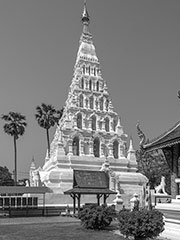
The chedi is a five-tiered design common in the early Lannathai period and shows clear influence of Haripunchai design. Each corner of the chedi is guarded by a large, outward facing lion.

The main hall decorations are in very good condition both inside and out.

March 12, 2019 0 comments
0 FacebookTwitterPinterestEmail
Newer Posts
Older Posts

Must-Read

  • Meditation
  • Zen
  • Dhyāna
  • Buddhism by Country
  • History Of Buddhism
  • Greco-buddhism
  • Avatar
  • Koan
  • Buddha
  • Shambhala Buddhism
  • Dalai Lama
  • Fourteenth Dalai Lama
  • List Of Buddhists
  • Dzogchen
  • Buddhist Art
  • Buddhist Texts
  • Dharma Wheel
  • Mahayana

2016 - 2026 - Buddhism-Guide.com


Back To Top
Buddhism Guide
  • Buddhism Guide