Buddhism Guide
  • Buddhism Guide
Home | Buddhism | Page 3
Category:

Buddhism

印順導師
Buddhism

Yin Shun

by Sergei March 13, 2019
written by Sergei

Yin Shun — short overview of Buddhism in this region: timeline, main traditions and notable sites.

印順導師Venerable Master Yin Shun (印順導師, Yin Shun Dao Shi) (March 12th, 1906–June 4, 2005) was an important figure in modern Mahayana Buddhism. Known as a contemporary master, he was notably known as the mentor of Venerable Master Cheng Yen, the founder of Tzu-Chi Buddhist Foundation, a charity association that has gained a worldwide presence. Master Yin Shun also helped bring forth the ideal of Humanistic Buddhism, a popular philosophy practiced by many Buddhists.

Although Master Yin Shun is closely associated with the Tzu-Chi Foundation, he has had a decisive influence on others of the new generation of Buddhist masters such as Venerable Master Sheng-yen of Dharma Drum Mountain and Venerable Master Hsing Yun of Fo Guang Shan, who are active in humanitarian aid, social work, environmentalism and academic research. He was known affectionately by many Buddhists as The Mentor.

Biography

Early years

Yin Shun was born prematurely on March 12th, 1906 in a small village in Zhejiang Province, China, near Shanghai. His birth name was Zhang Lu-Ching (Wade-Giles: Chang Lu-ching – 張鹿芹). Eleven days after his birth, Zhang was already ill and was at risk of premature death.

At the time of Zhang’s birth, the end of the last Chinese dynasty, the Manchu Dynasty, was a turbulent period. Revolutionary movements ended the imperial governments that had lasted for thousands of years. The first day of January 1911 was designated as the birthday of the Republic of China and marked an abrupt cut from the oppressive past. At the age of seven, Zhang’s father then took him to a neighboring town to receive his preliminary education.

Four years later, Zhang left home to attend a boarding school for three years. Not knowing how to take care of himself and feeling inferior to other wealthy children, he was very lonely. He isolated himself and shied away from speaking with other boys.

It was his composition class that rebuilt his confidence. In his last year of middle school, the composition teacher gave him full marks plus an extra two points on an essay he wrote. The extraordinary top marks, like sunlight, illuminated his gloomy, depressing life. Through this newly discovered talent, Zhang could comfortably express his thoughts. He later devoted his life to philosophic and religious writings.

Quest for the Truth

Zhang’s life took another turn when he graduated from middle school. Zhang’s father encouraged him to study medicine. If his schooling had equipped him with his writing skill, then his medical studies accidentally awakened his otherworldly pursuits.

In his studies, he stumbled upon the subject of immortality—a subject that Zhang found interesting. He went and read many books on the subject, and planned to look for various deities. His parents found what Zhang was doing to be very unusual, so they required him to teach at other schools.

Zhang turned his attention to Confucianism and Taoism, but neither of their philosophies could help him find the truth. At one point, Christianity sparked light into his heart. He would continuously study the Old and New Testaments, and read Christian periodicals. However, Zhang still felt empty, and could not commit himself to Christianity after two years.

Discovering Buddhism

One day, Zhang was looking for something to read to kill time. He stumbled onto the words “the Buddha Dharma“. This immediately sparked interest into his heart again, like what Christianity did for him, and Zhang zealously looked for anything that had to do with Buddhism.

It was naturally difficult for him to understand the profound meaning that these books tried to convey. But his failure to understand the Buddha’s thoughts propelled him to work harder to perceive the essence of Buddhism. Zhang knew that Buddhism was his refuge. The empty place in his heart was filled. Through his studies, he progressed steadfastly on his selected path.

In the spring of 1928, Zhang’s mother suddenly died after having been ill for only four days. In the autumn, his granduncle, who lived with their family, passed away, and his father died the following June. Overwhelmed with providing care and medicine and then managing funerals for his loved ones, Zhang was upset with the suffering and misery that life had brought him. He no longer had any family he could turn to.

He asked himself why was there such a drastic discrepancy between the Buddhist doctrines that he read about in books and the actual practice of Buddhism in real life. He yearned to dedicate his whole life to unraveling this mystery. His mind was set on finding places where Buddhism was still practiced the way it should be. It was at this point where he decided to become a monastic.

Becoming a monastic

Searching for the Dharma

In 1930, Zhang applied to a Buddhist college in Beijing. His entrance exam consisted of an essay. His essay thesis talked about how the Buddha Dharma is aimed at eradicating suffering and obtaining bliss. He was accepted into the college a few days later. However, the notification for the school commencement never appeared in the papers. Anxious, Chang decided to go to Beijing to see for himself.

At the age of twenty-five, he left home and renounced his worldly life for good. For many days he had traveled from his home to Beijing, with high hopes. To his dismay, the school had been shut down due to military confrontations among warlords. He had no choice but to return to Shanghai.

While pondering where he could go next, Chang suddenly thought of a temple called “Tien Tong Temple” . Seizing the thought, he boarded a boat sailing toward Ningpo. However, he was told by the locals upon his arrival there that the temple could not be reached by means of rickshaws, a commonly used means of transportation then.

Chang then went off to Mount Putuo, one of the four Sacred Mountains of China, and was not too far from where he was. One day, a young man walked by and caught a glimpse of the sutra that Zhang was reading. He was named Wang, who also had aspirations of becoming a monastic. It was the first time that Zhang had shared with anyone else his desire of becoming a monk. The stranger standing before him soon became his close friend.

Both searched for an abode where they could study the Buddha Dharma. They eventually found a snall place where they could do so, where their abbot who was well cultivated. They both came up to him and asked to study under him. Sensing their sincerity and aspiration to learn, the old monk briefly expounded the essence of Buddhism for them. His voice was stern but serene.

The elder monk then referred Zhang and Wang at another wayplace called Fu Zhun Monastery, less than a half mile from where they were. The two hurried to Fu Zhun Monastery. There, the abbot, with his gray hair and beard glowing under the sun, looked extremely dignified and holy. After listening to their explanation, he nodded in agreement.

Together, Zhang and Wang stayed at the monastery and began to delve into the Buddha’s teachings. Master Jing Nen, the abbot of the monastery, made that seed sprout. On October 11, 1930, the old master shaved Zhang Lu-Ching’s head and gave him the Dharma name of Yin Shun (印順).

Decline of Buddhism in China

Chang, now known as the Venerable Yin Shun, noticed that Buddhism in China was waning. The Buddhist scriptures, the lectures and teachings of the Buddha ought to be studied, understood, and above all practiced in daily life by Buddhists. But in China, the scriptures were nothing more than chanting materials for funerals.

In his hometown, monks only chanted sutras for the dead, while their major duty of expounding the Buddha’s teachings to those who were still alive was completely ignored. The decline and lack of dedication of the contemporary Sangha worried young Yin Shun deeply. He, too, was overwhelmed with questions and doubts.

Furthermore, ruthless criticism and reprimands could be heard in society. “Buddhism ruins the country!” “Monks and nuns are useless!” “Abolish monasteries!” Derogatory slogans like these were shouted almost every day by some educated people.

This harsh critique made a strong impact on Yin Shun. Was it true that the Buddha Dharma had become useless in dealing with people and events in the lives of the people? Yin Shun felt that Buddhism seemed to have been transformed into a paper bag flying in the sky of 2,500 years ago—it could easily be blown away in a gust of wind.

Seeing the Buddha

A line caught the young monk’s eyes: “All Buddhas arise in the human world; no one achieves Buddhahood in heaven.” With that verse, all doubts hanging in his mind evaporated. At last, Yin Shun found the answer to his question. Tears of joy rolled uncontrollably down his cheeks. According to him, it was that day he saw the Buddhas—these Buddhas existed in the world.

The Buddha in the World

In 1941, at age thirty-six, Master Yin Shun so described the Buddha in The Buddha in the World:

“His footsteps covered the two shores of the Ganges River. How could one say that he passively renounced the worldly life and abandoned his fellow human beings? In order to find the Truth and attain genuine emancipation, he led an austere and simple life. He had to endure all sorts of slander and even assassination attempts, and still remain composed and compassionate. Why did he do all these things? Did he lead a more pessimistic life than the kings of his era? All in all, he renounced his comfortable worldly life in order to end the suffering in the world, to find liberation for people, and to elevate human beings. Through all this, he had no ego or any selfish aims.

“The Buddha lived not in seclusion, but among people. Every day he walked barefoot to villages to beg for food. When he met a farmer, he used examples from farming to talk about the meaning of life. No matter who he met–a butcher, a prostitute, a bandit, a slave, a scholar, or a child—he would talk to them, according to their temperament and intellectual faculty, to inspire them a little and alleviate their suffering.

“How did a man named Siddhartha become an Enlightened One? By realizing the truth of life and cultivating himself in the human world, he understood the Principle of Karma. All existence and phenomena arise because of the coincidence of causes and conditions (or Dependent Origination). As these causes and conditions change, all things correspondingly cease to exist. With such an understanding, Siddhartha attained enlightenment.”

Yin Shun concluded: “If we can observe with wisdom, we will see the impermanent nature of all things. We can then eradicate our worries and perplexity by eliminating our attachments and the bad habit of making distinctions. Once we can do that, our minds will be as composed and wise as that of the Buddha.”

Achievements

In the 1950s, Master Yin Shun observed that the Buddhist monks and nuns in Taiwan, just like those in his hometown, seemed to be only concerned about performing rituals, and not educating other monks, nuns or laypeople with the Buddha’s philosophy.

Worried about this unfavorable situation, Master Yin Shun decided to reverse the trend. The society, including the Buddhist sangha, of that time saw women as inferior to men. Women had few chances to receive an education. Inspired by Master Yin Shun’s belief that studies would enhance a nun’s spiritual growth, a nun named Master Shuan Shen opened the Hsinchu Women’s Buddhist Institute in her convent.

In addition, Master Yin Shun set up the first Buddhist lecture hall on the island–the Hui Ri Lecture Hall. Through lectures and discussion, attendees were encouraged to study the orthodox Buddhist teachings. His efforts paid off. Quite a few Buddhists have learned to behave properly according to the Buddha’s teachings.

In March 2004, he was awarded the Order of Propitious Clouds Second Class, for his contributions to the revitalization of Buddhism in Taiwan.

Encounter with Master Cheng Yen

On February 1963, a thirty-two-day novitiate for Buddhist monks and nuns was held in Taipei. Monks and nuns came from all over Taiwan to register. All were accepted except a young female devotee from Hualien, a county in eastern Taiwan.

Master Yin Shun recalled the day he first met Master Cheng Yen:

“Hui Yin, a student of mine, brought her to the Hui Jih Lecture Hall, where I lived, to purchase The Complete Teachings of Master Tai Xu. Hui Yin told me that the woman had been rejected from the novitiate because she had shaved her own head and her teacher was a layman. Someone said she could have just asked any of the monks or nuns present to accept her as a disciple, but she claimed that she needed to seek her master carefully. After she bought the book, there was a heavy rain shower and she couldn’t leave. She then begged Hui Yin to tell me that she wished to become my disciple. She had no idea that I rarely accept disciples¹. As if the heavens had heard her wish, I happened to walk out of my room just then. Hui Yin came toward me and told me what was going on. I couldn’t figure out why she chose me as her master, but I consented.”

¹At the time, Yin Shun only had three disciples. All three now are teaching the Buddha Dharma in the United States.

Master Yin Shun then said to her, “Our karmic relationship is very special. As a nun, you must always be committed to Buddhism and to all living beings.”

Since the registration for the novitiate was about to end within the hour, the venerable master quickly gave the young disciple her Buddhist name, Cheng Yen, and told her to get going and begin the novitiate promptly. At that moment, the conditions for the creation of the Tzu-Chi Foundation began.

In the summer of 1979, Master Yin Shun came to Hualien. Living in this beautiful but undeveloped part of the island, Master Cheng Yen told Master Yin Shun about her aspiration to build a high-quality hospital for the people living in eastern Taiwan, where there were few medical facilities.

As he listened to her, he could foresee the daunting challenges lying ahead. Like a father sharing his life experiences with his daughter, he said, “Just like the time you told me you intended to begin charity work, I reminded you to think whether you would have the strength and the money when more people came to you for help. The task can only be realized with unwavering commitment.”

Seeing his disciple’s resolution, Master Yin Shun’s mind was put at ease. With this talk, the hospital construction project began. Although Master Cheng Yen would soon face many insurmountable difficulties and challenges, Master Yin Shun’s support gave Master Cheng Yen the strength to go on. He transferred virtually all the monetary offerings made to him by his followers to the hospital construction. The sum accumulated throughout the years was truly sizable.

Signs of waning health

Wherever he went, no matter how frail he was, he always promulgated humanized Buddhism. In November 1954, a checkup revealed that the master had long been inflicted with pulmonary tuberculosis. His lungs were calcified and the tracheae were abnormal. He needed to receive immediate medical treatment and get adequate rest. Still, he had to fly to the Philippines to give a series of lectures. When he finally returned to Taiwan, five months had passed. The trip took a heavy toll on his health. He barely had the strength to eat or talk. However, when people came to him with questions on Buddhism, he would summon his strength and answer spiritedly.

In 1999, another life-threatening illness befell him. Because of months of incessant diarrhea, the signs of life were fading from the 94-year-old Mentor of Buddhism. Such pain and fatigue would be unbearable to any robust youth, let alone a man of his age. Yet never once did Yin Shun panic or complain. Whenever guests came to visit the venerable master, he summoned up his spirit to speak to them.

Death and Funeral

On June 4th, 2005, Master Yin Shun passed away after fighting pulmonary tuberculosis since 1954. He died in a Tzu-Chi hospital in Hualien at the age of 100. In Taiwan, thousands were shocked to hear of his death, even if his death was expected to come in the coming months. Tzu-Chi, along with many Buddhist organizations and temples influenced and inspired by Master Yin Shun, joined in remembering him for eight days.

Among those attending the services were Chen Shui-bian, President of the ROC, Frank Hsieh, the Premier, Su Jia-Chuan, Minister of the Interior, and other legislators. Several monastics from many parts of the world, dominantly the United States, also attended Master Yin Shun’s funeral. Monastics who were disciples of Master Yin Shun attended the funeral, such as Venerables Yin Hai, Chao Hui, Chen Hua, Fa Tsang, and many other monastics, including Master Cheng Yen herself.

Master Yin Shun had a simple and spartan lifestyle in the last days of his life, so his disciples decided to keep his funeral simple but solemn. His funeral was held at Fu Yan Vihara in Hsinchu, where he had lived for many years until his death. Master Yin Shun was later cremated on June 10th and his ashes and his portrait used during the services were placed inside a hall alongside the remains of other monastics.

March 13, 2019 0 comments
0 FacebookTwitterPinterestEmail
Yidam
Buddhism

Yidam

by Sergei March 12, 2019
written by Sergei

Yidam — overview of meaning, background and key points, with links to related topics for context.

YidamIn Vajrayana Buddhism, a Yidam (Tibetan) or Ishtadevata (Sanskrit) is a fully enlightened being who is the focus of personal meditation, during a retreat or for life. The term is often translated into English as meditational deity. A Yidam is an enlightened being with whom one identifies during meditation: one perceives his or her own Buddha nature through such identification. Some common Yidams include Hayagriva, Vajrakilaya, Samputa, Guhyasamaja, Yamantaka, Hevajra, Kurukulle, Cakrasamvara, Vajrayogini, and Kalacakra. Also, other enlightened beings such as the regular forms of the Buddhas, Bodhisattvas, Guru Rinpoche, certain Dharmapalas, Wealth Deities, and yab-yum representations, among others, can also be practiced as a Yidam.

Yidams are not to be equated with deities, patron saints or guardian angels found in the Jewish, Christian and Muslim traditions. They are not regarded as protectors from danger or saviors. They are simply acknowledgments of the student’s basic nature. The student visualizes the outstanding characteristics of the yidam until he achieves complete union with it. The yidam, which can be masculine or feminine, may refer to the personal deity, the nature of which corresponds to the individual psychological temper of each adept.

Chenrezig, Tara under her different forms, Manjusri and particularly Kalachakra, Hevajra and consort Nairatmya, Heruka and consort Vajravarahi, etc. are frequently chosen as Yidam, but any deity of the tantric pantheon may be adopted as such. The adept enters in union with his Yidam from the morning onwards, and ends the day with him. The yidam is used as a means of transformation. According to certain traditions, the yidam are considered as the emanation of the adept’s own mind. The term yi-dam is said to be a contraction of Tib. yid-kyi-dam-tshig, meaning “samaya of mind”- in other words, the state of being indestructibly bonded with the inherently pure and liberated nature of mind.

March 12, 2019 0 comments
0 FacebookTwitterPinterestEmail
念佛
Buddhism

Yeombul

by Sergei March 12, 2019
written by Sergei

Yeombul — overview of meaning, background and key points, with links to related topics for context.

念佛Nianfo (念佛. Chinese pinyin nian fo; Japanese: 念仏 nembutsu; Korean: yeombul; Vietnamese: niệm Phật), literally “mindfulness of the Buddha“, is a term commonly seen in the Pure Land school of Mahayāna Buddhism.

In the Pure Land tradition, mindfully chanting of the name of Amitabha Buddha allows one to obtain rebirth in Amitabha’s Pure Land of the West.

March 12, 2019 0 comments
0 FacebookTwitterPinterestEmail
楊衒之
Buddhism

Yang Xuanzhi

by Sergei March 12, 2019
written by Sergei

Yang Xuanzhi — overview of meaning, background and key points, with links to related topics for context.

楊衒之Yang Xuanzhi (Chinese:楊衒之) was a Chinese writer and translator of Mahayana Buddhist texts into the Chinese language, during the 6th century, under the Northern Wei Dynasty.

He wrote “Stories About Buddhist Temples in Luoyang” (Chinese: 洛陽伽藍記; pinyin: Luòyáng Qiélánjì) in 547.

Yang Xuanzhi relates the first introduction of Buddhism to China around 70 CE:

“The establishment of the Baima Temple (Temple of the White Horse) by Emperor Ming (58-75 CE) of the Han marked the introduction of Buddhism into China. The temple was located on the south side of the Imperial Drive, three leagues (li) outside the Xiyang Gate. The Emperor dreamt of the golden man sixteen Chinese feet tall, with the aureole of sun and moon radiating from his head and his neck. A “golden god”, he was known as Buddha. The emperor dispatched envoys to the Western Regions (“遣使向西域求之”) in search of the god, and, as a result, acquired Buddhist scriptures and images. At the time, because the scriptures were carried into China on the backs of white horses, White Horse was adopted as the name of the temple.” (Translation: Ulrich Theobald).

His book also contains the first known account of the Buddhist monk Bodhidharma, founder of Zen, whom he met in Luoyang aroud 520. He describes him as a man of Central Asian origin, who claims to be 150 years old and to have traveled extensively throughout Buddhist lands. He also wrote that Bodhidharma expressed praise for the beauty of the Buddhist temples in Luoyang, and that he chanted the name of the Buddha frequently:

“Seeing the golden disks at the top of the monastery’s stupa reflecting in the sun, the rays of light illuminating the surface of the clouds, the jewel-bells on the stupa blowing in the wind, the echoes reverberating beyond the heavens, Bodhidharma sang its praises. He exclaimed: “Truly this is the work of spirits.” He said: “I am 150 years old, and I have passed through numerous countries. There is virtually no country I have not visited. But even in India there is nothing comparable to the pure beauty of this monastery. Even the distant Buddha realms lack this.” He chanted homage and placed his palms together in salutation for days on end.“
..
“Hsiu-Fan Monastery had a statue of a fierce thunderbolt bearer guarding the gate. Pigeons and doves would neither fly through the gate nor roost upon it. Bodhidharma said: “That catches its true character!”“

References

  • “Zen-A way of life”, by Christmas Humphreys ISBN 0071419810
  • “A Record of Buddhist Monasteries in Lo-Yang” by Yang Xuanzhi(杨衒之),translated by Yi-t’ung Wang(王伊同,Princeton University Press,Princeton,New Jersey,1983
  • “Memories of Lo-yang: Yang Hsuan-chih and the Lost Capital (493-534)” Jenner, William John Francis. New York: Clarendon Press, Oxford University Press, 1981.
March 12, 2019 0 comments
0 FacebookTwitterPinterestEmail
Yana Buddhism
Buddhism

Yana

by Sergei March 12, 2019
written by Sergei

Yana — overview of meaning, background and key points, with links to related topics for context.

Yana BuddhismYana is a Sanskrit word with a range of meanings including nouns such as vehicle, journey, and path; and verbs such as going, moving, riding, and marching. In the Indian religions Buddhism and Hinduism, both yana and marga (road or path) express the metaphor of spiritual practice as a path or journey. Ancient texts in both religions discuss doctrines and practices associated with various yanas. In Buddhism, yana often augments the metaphor of the spiritual path with the idea of various vehicles that convey a person along that path. The yana/marga metaphor is similar to the Chinese image of the Tao (path or way) but Indian and Chinese cultures appear to have evolved such similar metaphors independently.

Origins of -yana: Vehicles and Paths

The use of yana to refer to a spiritual journey may date to the Rig Veda, possibly composed circa 1500 BCE, whose 10th Mandala makes several references to devayana, (translators usually render this as the “path of the gods” or similar) and one reference to pitryana (“path of the fathers”). The first verse of the Rig Veda’s burial hymn (10.18) translates approximately as “O Death, take the other path, which is distinct from the way of the gods” (paraM mRtyo anu parehi panthAM yaste sva itaro devayAnAt). The “other path” is the pitryana, referred to in hymn 10.2 and alluded to in 10.14 and 10.16.

The devayana and pitryana evolved from the ancient Rig Vedic concern for immortality to the classical Hindu concern with ending samsaric existence. The Upanishads, which comment on the Vedas, make further reference to devayana and pitryana. Among other distinctions, the pitryana was said to refer the religious practices of villagers, and the devayana was said to refer to the practices of recluses living in the forest. The (II.iv.11 and IV.v.12) also makes reference to ekayana, notably in the phrase vedAnAm.h vAk.h ekAyanam, which translates approximately to “the Vedas are the direct path to the spirit of the word”.

Buddhist use of yana emerged from the pre-existing world-view of Sanskrit culture. The serves as an example of the early use of yana in a Buddhist context. In this classic text attributed to Shakyamuni, the historical Buddha prescribes a number of meditation techniques; near the end of the sutra, the phrase Ekàyano ayaü bhikkhave maggo... appears. This passage translates approximately as “This is the direct way along the path of purification..”. Thus, Nikaya Buddhism expressed at least some contrast between yana (yano in this Pali syntax) and marga (maggo).

A clear distinction between vehicle and path arises in Mahayana texts, notably Chapter three of the Lotus Sutra, which relates a parable of a father promising three carts to lure sons out of a burning building, corresponding to the three types of Buddha. In the parable, the goat-cart represents Sravaka-Buddhahood; the deer-cart, Pratyeka-Buddhahood; and the bullock-cart, Samyaksam-Buddhahood. The sutra goes on to say these that the teachings of the three vehicles are merely expedient means (upaya)—essentially, a white lie. Their purpose is to direct people toward ekayana, the one vehicle, depicted in the parable as a jeweled cart driven by a white ox.

Yana has been used subsequently in a number of schemas of the Mahayana Buddhist teachings in which there have been two, three, five, six, nine, and more vehicles.

The one yana

As stated above, the idea of a “direct path” or “only way” was expressed in the Upanishads, and reiterated in the Pali canon. Mahayana texts such as the Lotus Sutra and the Avatamsaka Sutra sought to unite all the different teachings into a single great way. These texts serve as the inspiration for using the term Ekayana in the sense of “one vehicle”. This “one vehicle” became a key aspect of the doctrines and practices of Tiantai and Tendai Buddhist sects, which subsequently influenced Chan and Zen doctrines and practices.

The two yanas

Traditionally, the two vehicles in Mahayana Buddhism consist of sravakayana and pratekyabuddhayana. These in turn refer to doctrines and practices that supposedly aim at becoming two of the three types of Buddha. Mahayana Buddhists take a vow to become the third type, namely bodhisattvas. Therefore Mahayana Buddhist texts sometimes use terms like “followers of the two vehicles” to refer to Buddhists who do not accept the Mahayana sutras.

Some Mahayana sutras consider that the two vehicles together comprise the Hinayana—literally, inferior vehicle; sometimes, small vehicle. Modern texts sometimes refer to Mahayana and Hinayana as “two vehicles”. But referring to an “inferior vehicle” may disrespect Buddhists who do not consider the Mahayana sutras to be the word of the historical Buddha. More commonly, Theravada refers to most non-Mahayana Buddhists in today’s world. Nikaya Buddhism refers to both current and historical Buddhists who did not accept the Mahayana sutras.

The three yanas

Mahayana Buddhists often express two different schemata of three yanas. First, here are three paths to liberation that culminate as one of the three types of Buddha:

  • Sravakayana: The Hearer vehicle: A path that meets the goals of a Sravaka-Buddha, who achieves liberation after listening to the teachings of a Bodhisattva Buddha. If no Boddhisattva is present in the world, Sravaka-Buddhas cannot discover the dharma.
  • Pratyekayana: The individual vehicle: A Solitary Buddha (Pratyeka-Buddha) achieves liberation, but does not teach other beings. Pratyeka-buddhas do not depend on a teacher and can discover the dharma even if they do not encounter a Bodhisattva. They are sometimes said to remain silent and solitary.
  • Bodhisattvayana: The Samyaksam-Buddha attains liberation and wishes to benefit as many beings as possible. In order to aid others, they vow to remain in the world, and defer their chance to end the cycle of rebirth.

A second classification came into use with the rise of the Vajrayana, which created a hierarchy of the teachings with the Vajrayana being the highest path. The Vajrayana itself become multilayered especially in Tibetan Buddhism.

  • Hinayana
  • Mahayana
  • Vajrayana

The four yanas

Mahayana Buddhists sometimes refer to four yanas that subsume the two different schemes of the three yanas:

  • Sravakayana
  • Pratyekayana
  • Mahayana
  • Vajrayana

The five yanas

This is a Mahayana list which is found in East Asian Buddhism.

  • purisayana – the human vehicle. This is the very beginning of the spiritual path
  • devayana – the practice of ethics and meditation
  • Shravakayana – the practice of renunciation and the Four Noble Truths
  • Pratyekayana – practice concerned with dependent arising (pratitya-samutpada)
  • Bodhisattvayana – practice of the six perfections

The six yanas

The five yanas plus the Vajrayana. This schema is associated with Shingon Buddhism in Japan. It was invented by Kukai in order to help to differentiate the Vajrayana teachings that he imported from China in the early 9th century. Kukai wanted to show that the new teachings were entirely new.

The nine yanas

The Nyingma school of Tibetan Buddhism has nine yanas, a list made by combining the first type of three yanas, and adding the six classes of tantras.

  • Hinayana
    • Shravakayana
    • Pratyekayana
  • Mahayana
    • Bodhisattvayana
  • Vajrayana (consisting of)
    • Outer Tantras
      • Kryatantra
      • Upatantra (Tibetan spyod rgyud) ‘practice tantra’ and the Ubhayatantra (gnyis ka’i rgyud), ‘dual tantra’, because it practices the view of the next vehicle, Yogatantra, together with the action of the former.
      • Yogatantra
    • Inner Tantras
      • Mahayoga
      • Anuyoga
      • Atiyoga (also Dzog Chen)

The twelve yanas

Another schema associated with Mahayana and Vajrayana sources:

  1. Sravakayana
  2. Pratyekabuddhayana
  3. Bodhisattvayana
  4. Kriyayoga
  5. Charyayoga, or Upayoga
  6. Yogatantra
  7. Mahayoga
  8. Anuyoga
  9. Atiyoga, or Mahasandhiyoga; in Tibetan, Dzogpa Chenpo (Dzogchen)
  10. Semde
  11. Longde
  12. Mengagde
March 12, 2019 0 comments
0 FacebookTwitterPinterestEmail
薬師寺
Buddhism

Yakushi Ji

by Sergei March 12, 2019
written by Sergei

Yakushi Ji — overview of meaning, background and key points, with links to related topics for context.

薬師寺Yakushi-ji (薬師寺) is an ancient Buddhist temple of the Hosso sect in the city of Nara, Nara Prefecture, Japan. The main image is of Yakushi Nyorai, the Healing Buddha.

Founded in 680 A.D. in Kashihara, Yakushiji was moved to its present location when the capital moved to Nara in 710.

Yakushiji is one of the places in Nara that UNESCO has designated as a World Heritage Site.

March 12, 2019 0 comments
0 FacebookTwitterPinterestEmail
玄奘
Buddhism

Xuanzang

by Sergei March 12, 2019
written by Sergei

Xuanzang — overview of meaning, background and key points, with links to related topics for context.

玄奘Xuanzang (Chinese: 玄奘; Hanyu Pinyin: xuán zàng; Wade-Giles: Hsüan-tsang; Cantonese IPA: jyn4dzɔŋ1; Cantonese Jyutping:jyun4zong1) (602-644/664) was a famous Chinese Buddhist monk.

Xuanzang was born near Luoyang, Henan in 602 as Chen Yi (陳褘 Ch’en I, yi1). He came from a scholarly family, and had three elder brothers. (Other texts had it that he had two elder brothers and an elder sister). He became famous for his seventeen year-long trip to India, during which he studied with many famous Buddhist masters, especially at the famous center of Buddhist learning in Nālanda.When he returned, he brought with him some 657 Sanskrit texts. With the emperor’s support, he set up a large translation bureau in Chang’an, drawing students and collaborators from all over East Asia. He is credited with the translation of some 1,330 fascicles of scriptures into Chinese. His strongest personal interest in Buddhism was in the field of Yogācāra (瑜伽行派) or Consciousness-only (唯識).

The force of his own study, translation and commentary of the texts of these traditions initiated the development of the Faxiang school (法相宗) in East Asia. Although the school itself did not thrive for a long time, its theories regarding perception, consciousness, karma, rebirth, etc. found their way into the doctrines of other more successful schools. Xuanzang’s closest and most eminent student was Kuiji (窺基) who became recognized as the first patriarch of the Faxiang school.

Name

Less common romanizations of Xuanzang include Hhuen Kwan, Hiouen Thsang, Hiuen Tsiang, Hsien-tsang, Hsuan Chwang, Hsuan Tsiang, Hwen Thsang, Xuan Cang, Xuan Zang, Shuen Shang, Yuan Chang, Yuan Chwang, and Yuen Chwang. In Japanese, he is known as Genjō or Sanzō.

Early Life

Xuanzang, whose lay name was Chenhui, was born into a family possessing erudition for generations. He was the youngest of four children. His great-grandfather was an official serving as a prefect, his grandfather was appointed as professor in the Imperial College at the capital. His father was a conservative Confucianist who gave up office and withdrew into seclusion to escape the political turmoil that gripped China at that time. According to traditional biographies, Xuanzang displayed a superb intelligence and earnestness, amazing his father by his careful observance of the Confucian rituals at the age of eight. Along with his brothers and sister, he received an early education from his father, who instructed him in classical works on filial piety and several other canonical treatises of orthodox Confucianism.

Although his household in Chenhe Village of Goushi Town (緱氏 gou1), Luo Prefecture (洛州), Henan, was essentially Confucian, at a young age Xuanzang expressed interest in becoming a Buddhist monk as one of his elder brothers had done. After the death of his father in 611, he lived with his older brother Chensu (later known as Changjie) for five years at Jingtu Monastery (淨土寺) in Luoyang, supported by the Sui Dynasty state. During this time he studied both Theravada and Mahayana Buddhism, preferring the latter.

In 618, the Sui Dynasty collapsed and Xuanzang and his brother fled to Chang’an, which had been proclaimed as the capital of the Tang state, and thence southward to Chengdu, Sichuan. Here the two brothers spent two or three years in further study in the monastery of Kong Hui, including the Abhidharmakosa-sastra (Abhidharma Storehouse Treatise). When Xuanzang requested to take Buddhist orders at the age of thirteen, the abbot Zheng Shanguo made an exception in his case because of his precocious knowledge.

Xuanzang was fully ordained as a monk in 622, at the age of twenty. The myriad contradictions and discrepancies in the texts at that time prompted Xuanzang to decide to go to India and study in the cradle of Buddhism. He subsequently left his brother and returned to Chang’an to study foreign languages and to continue his study of Buddhism. He began his mastery of Sanskrit in 626, and probably also studied Tocharian. During this time Xuanzang also became interested in the metaphysical Yogacara school of Buddhism.

Pilgrimage

In 629, Xuanzang reportedly had a dream that convinced him to journey to India. The Tang Dynasty and Eastern Gokturks were waging war at the time, therefore Emperor Tang Taizong of China prohibited foreign travel. Xuanzang persuaded some Buddhist guards at the gates of Yumen and slipped out of the empire via Liangzhou (Gansu), and Qinghai province. He subsequently travelled across the Gobi desert to Kumul (Hami), thence following the Tian Shan westward, arriving in Turfan in 630. Here he met the king of Turfan, a Buddhist who equipped him further for his travels with letters of introduction and valuables to serve as funds.

Moving further westward, Xuanzang escaped robbers to reach Yanqi, then toured the Theravada monasteries of Kucha. Further west he passed Aksu before turning northwest to cross the Tian Shan’s Bedal Pass into modern Kyrgyzstan. He skirted Issyk Kul before visiting Tokmak on its northwest, and met the great Khan of the Western Gokturks, whose relationship to the Tang emperor was friendly at the time. After a feast, Xuanzang continued west then southwest to Tashkent, capital of modern day Uzbekistan. From here, he crossed the desert further west to Samarkand. In Samarkand, which was under Persian influence, the party came across some abandoned Buddhist temples and Xuanzang impressed the local king with his preaching. Setting out again to the south, Xuanzang crossed a spur of the Pamirs and passed through the famous Iron Gates. Continuing southward, he reached the Amu Darya and Termez, where he encountered a community of more than a thousand Buddhist monks.

Further east he passed through Kunduz, where he stayed for some time to witness the funeral rites of Prince Tardu, who had been poisoned. Here he met the monk Dharmasimha, and on the advice of the late Tardu made the trip westward to Balkh (modern day Afghanistan), to see the Buddhist sites and relics. Here Xuanzang also found over 3,000 Theravada monks, including Prajnakara, a monk with whom Xuanzang studied Theravada scriptures. Prajnakara then accompanied the party southward to Bamiyan, where Xuanzang met the king and saw tens of Theravada monasteries, in addition to the two large Bamiyan Buddhas carved out of the rockface. The party then resumed their travel eastward, crossing the Shibar pass and descending to the regional capital of Kapisi (about 60 km north of modern Kabul), which sported over 100 monasteries and 6,000 monks, mostly Mahayana. This was part of the fabled old land of Gandhara. Xuanzang took part in a religious debate here, and demonstrated his knowledge of many Buddhist sects. Here he also met the first Jains and Hindus of his journey. He pushed on to Jalalabad, where he considered himself to have reached India. The year was 630.

India

Xuanzang left Jalalabad, which had few Buddhist monks, but many stupas and monasteries. He passed through Hunza and the Khyber Pass to the east, reaching the former capital of Gandhara, Peshawar, on the other side. Peshawar was nothing compared to its former glory, and Buddhism was declining in the region. Xuanzang visited a number of stupas around Peshawar, notably the Kanishka Stupa. This stupa was built just southeast of Peshawar, by a former king of the city. In 1908 it was rediscovered by D.B. Spooner with the help of Xuanzang’s account.

Xuanzang left Peshawar and travelled northeast to the Swat Valley. Reaching Udyana, he found 1,400 old monasteries, that had previously supported 18,000 monks. The remnant monks were of the Mahayana school. Xuanzang continued northward and into the Buner Valley, before doubling back via Shabaz Gharni to cross the Indus river at Hund. Thereafter he headed to Taxila, a Mahayana Buddhist kingdom that was a vassal of Kashmir, which is precisely where he headed next. Here he found 5,000 more Buddhist monks in 100 monasteries. Here he met a talented Mahayana monk and spent his next two years (631-633) studying Mahayana alongside other schools of Buddhism. During this time, Xuanzang writes about the fourth Buddhist Council that took place nearby, ca. 100 AD, under the order of King Kanishka of Kushana. This is disputed by some Theravadins.

In 633, Xuanzang left Kashmir and journeyed south to Chinabhukti (thought to be modern Firozpur), where he studied for a year with the monk-prince Vinitaprabha.

In 634 he went east to Jalandhara in eastern Punjab, before climbing up to visit predominantly Theravada monasteries in the Kulu valley and turning southward again to Bairat and then Mathura, on the Yamuna river. Mathura had 2,000 monks of both major Buddhist branches, despite being Hindu-dominated. Xuanzang travelled up the river to Srughna before crossing eastward to Matipura, where he arrived in 635, having crossed the river Ganges. From here, he headed south to Sankasya (Kapitha), said to be where Buddha descended from heaven, then onward to the northern Indian emperor Harsha’s grand capital of Kanyakubja (Kanauji). Here, in 636, Xuanzang encountered 100 monasteries of 10,000 monks (both Mahayana and Theravada), and was impressed by the king’s patronage of both scholarship and Buddhism. Xuanzang spent time in the city studying Theravada scriptures, before setting off eastward again for Ayodhya (Saketa), homeland of the Yogacara school. Xuanzang now moved south to Kausambi (Kosam), where he had a copy made from an important local image of the Buddha.

Xuanzang now returned northward to Sravasti, travelled through Terai in the southern part of modern Nepal (here he found deserted Buddhist monasteries) and thence to Kapilavastu, his last stop before Lumbini, the birthplace of Buddha. Reaching Lumbini, he would have seen a pillar near the old Ashoka tree that Buddha is said to have been born under. This was from the reign of emperor Ashoka, and records that he worshipped at the spot. The pillar was rediscovered by A. Fuhrer in 1895.

In 637, Xuanzang set out from Lumbini to Kusinagara, the site of Buddha’s death, before heading southwest to the deer park at Sarnath where Buddha gave his first sermon, and where Xuanzang found 1,500 resident monks. Travelling eastward, at first via Varanasi, Xuanzang reached Vaisali, Pataliputra (Patna) and Bodh Gaya. He was then accompanied by local monks to Nalanda, the great ancient university of India, where he spent at least the next two years. He was in the company of several thousand scholar-monks, whom he praised. Xuanzang studied logic, grammar, Sanskrit, and the Yogacara school of Buddhism during his time at Nalanda.

Legacy

Xuanzang was known for his strenuous translation of Indian Buddhist texts to Chinese, and subsequent recoveries of lost Indian Buddhist texts from translated Chinese copies. He is credited with writing or compiling the Cheng Weishi Lun as a commentary on these texts. He also founded the short-lived but influential Faxiang school of Buddhism. Additionally, he was known for recording the events of the reign of the northern Indian emperor, Harsha.

In 646, under the Emperor’s request, Xuanzang completed his book “Journey to India in the Great Tang Dynasty” (大唐西域記), which has become one of the primary sources for the study of ancient history in India. This book was first translated into French by Sinologist Stanislas Julien in 1857. An English translation by Thomas Watters was published in London in 1905.

Xuanzang’s journey, and the legends that grew up around it, inspired the Ming novel Journey to the West, one of the great classics of Chinese literature. The Xuanzang of the novel is the reincarnation of a disciple of Gautama Buddha, and is protected on his journey by three notorious monsters. One of them, the monkey, was a popular favourite and profoundly influenced Chinese culture and contemporary Japanese manga.

In the Yuan Dynasty, there was also a play by Wu Changling (吳昌齡) about Xuanzang obtaining scriptures.

Relics

A skull relic purported to be that of Xuanzang was held in the Temple of Great Compassion, Tianjin until 1956 when it was taken to Nalanda – allegedly by the Dalai Lama – and presented to India. The relic is now in the Patna museum. The Wenshu Monastery in Chengdu, Sichuan province also claims to have part of Xuanzang’s skull.

See also

  • Silk Road transmission of Buddhism
  • Buddhism in China
  • Zhang Qian
  • Faxiang
  • Xuanzang (fictional character)
  • Sun Wukong
  • Genjyo Sanzo

Sources

  • Sally Hovey Wriggins. Xuan Zang: A Buddhist Pilgrim on the Silk Road. Westview Press, 1996.
    HC ISBN 0-8133-2801-2 PB ISBN 0-8133-3407-1
  • On Yuan Chwang’s Travels in India tr.Thomas Watters. Reprint. New Delhi, Munshiram Manoharlal, 1996 ISBN 81-215-0336-1.
  • Stanislas Julien: Memoires sur les contrées occidentales, 1857 Paris
March 12, 2019 0 comments
0 FacebookTwitterPinterestEmail
World Fellowship Of Buddhists
Buddhism

World Fellowship of Buddhists

by Sergei March 12, 2019
written by Sergei

World Fellowship of Buddhists — overview of meaning, background and key points, with links to related topics for context.

World Fellowship Of BuddhistsThe World Fellowship of Buddhists (WFB) is arguably the largest and most influential international Buddhist organization. It was founded in 1950 in Colombo, Sri Lanka by representatives from 27 nations. Although Theravada Buddhists are most influential in the organization, (its headquarters are in Thailand and all of its presidents have been from Sri Lanka or southeast Asia), members of all Buddhist schools are active in the WFB. It now has regional centers in 35 countries, including India, the United States, Australia, and several nations of Africa and Europe, in addition to traditional Buddhist countries.

At this historic meeting, the World Fellowship of Buddhists was founded. It marked the first event in Buddhist history when Buddhists (laity and sangha) of nearly all sects in the world represented and gathering for the same purpose for the progress of Buddhism.

Contacts:

616 Benjasiri Park, Sukhumvit 24 off Soi Medhinivet, Sukhumvit Road, Klong Toey, Bangkok 10110, Thailand

Tel: (660) 2661-1284-7

e-mail: webmaster@wfb-hq.org

March 12, 2019 0 comments
0 FacebookTwitterPinterestEmail
원측
Buddhism

Woncheuk

by Sergei March 12, 2019
written by Sergei

Woncheuk — overview of meaning, background and key points, with links to related topics for context.

원측Woncheuk (613-696) was a Korean Buddhist monk, also known as Ximing fashi (西明法師) after the name of the temple where he did his most important work.

Originally from Korea, he lived at Ximing Temple and studied at the beginning of the Tang Dynasty with the great translator and exponent of Yogacara, Xuanzang. Under Xuanzang’s influence, he specialized in the study of Consciousness-only (often differing from the viewpoint of Kuiji), but also studied and wrote commentaries on a broad spectrum of early Indian and Mahāyāna texts. He worked until his death in China, passing away in a monastery in Loyang. He is well-known among scholars of Tibetan Buddhism for his Commentary on the Saṃdhinirmocana-sūtra.

Woncheuk
Hangul: 원측
Hanja: 圓測
Revised Romanization: Woncheuk
McCune-Reischauer: Wǒnch’ǔk

See also

  • List of Korea-related topics
  • List of philosophical topics
  • List of China-related topics
  • List of philosophers
  • List of Buddhists
March 12, 2019 0 comments
0 FacebookTwitterPinterestEmail
원불교
Buddhism

Won Buddhism

by Sergei March 12, 2019
written by Sergei

Won Buddhism — overview of meaning, background and key points, with links to related topics for context.

원불교Won Buddhism, often written Wonbuddhism, is a modern religious movement based in South Korea. The Korean word, based on a Chinese character, Won means circular.

History

Founded in 1924 by the venerable So Tae San, Won Buddhism combines aspects of Chinese Mahayana Buddhism, Zen Buddhism and Christianity.

Beliefs and Rituals

Combining Zen, Seon, Chan Buddhist teachings with some Christian influence, Won Buddhists believe in the Irwonsang, symbolized by a black circle, which represents the ultimate truth.

Sotaesan is unique among founders of Buddhist sects in that he found enlightenment through Korean folk religious practices, and when seeking to explain his experience, discovered that the Buddhist perfection of wisdom teachings (prajnaparamita) were most appropriate. Sotaesan summarized his doctrine in the “Verse of Truth,” which contains echoes of the Heart Sutra’s paradox, “form is emptiness, and emptiness is form”:

Being changes into Non-beingAnd Non-being into Being,Turning and turning again;But in the ultimate RealityBeing and Non-being are both Void,And the Void contains everything and is perfect.

Won Buddhist practice shares much in common with traditional Zen practice, emphasizing sitting meditation and seeking enlightenment but eschewing the monastic isolation of Buddhist devotionalism. Sotaesan broke new ground in his insistence on the equality of men and women in Buddhist practice, and the need for properly organizing spiritual life in the context of science and technological development.

Won Buddhism
Hangul: 원불교
Hanja: 圓佛敎
Revised Romanization: Wonbulgyo
McCune-Reischauer: Wǒnbulkyo
March 12, 2019 0 comments
0 FacebookTwitterPinterestEmail
胎蔵界
Buddhism

Womb Realm

by Sergei March 12, 2019
written by Sergei

Womb Realm — overview of meaning, background and key points, with links to related topics for context.

胎蔵界In Vajrayana Buddhism, the Womb Realm (Skt. garbhakosa-dhatu, Jp. 胎蔵界 taizōkai) is the metaphysical space inhabited by the Five Wisdom Kings. The Womb Realm is based on the Mahavairocana Sutra.

The Womb Realm is a very popular subject for mandalas, and along with the Diamond Realm (vajradhatu) Mandala forms the Mandala of the Two Realms.

March 12, 2019 0 comments
0 FacebookTwitterPinterestEmail
明王
Buddhism

Wisdom King

by Sergei March 12, 2019
written by Sergei

Wisdom King — overview of meaning, background and key points, with links to related topics for context.

明王In Vajrayana Buddhism, a Wisdom King (Sanskrit vidyarāja, Jp. 明王 myō-ō) is the third type of deity after Buddhas and bodhisattvas. The Sanskit name literally “king of knowledge”, while the Chinese characters mean “bright king”, leading to wide array of alternative English names including Guardian King, Radiant King, etc.

The female counterparts of Wisdom Kings are known as Wisdom Queens (Jp. 明妃 myōhi), although the distinction is often ignored.

Doctrine

On a general level, the Wisdom Kings are viewed as the guardians of the Buddhas and bodhisattvas. In particular, the Five Wisdom Kings are the protectors of the Five Wisdom Buddhas.

According to the esoteric doctrine of the Three Wheels, whereas Buddhas represent pure concepts and bodhisattvas teach through compassion, Wisdom Kings are the embodiment of the wheel of injunction and teach through fear, shocking nonbelievers into faith.

Iconography

Wisdom Kings are usually represented as wrathful deities, often with many faces, many arms and even many legs. They hold weapons in their hands and are sometimes adorned with skulls, snakes or animal skins and wreathed in flames.

A notable exception is Mahamayuri (Jp. Kujaku), the “Peacock Wisdom Queen”, who is usually presented with a peaceful expression. She is easily identifiable as she usually rides a peacock.

List of Wisdom Kings

  • Five Wisdom Kings
    • Acala (Fudo myō-ō)
    • Trilokavijaya
    • Kundali
    • Yamantaka
    • Vajrayaksa
  • Ragaraja (Aizen)
  • Mahamayuri (Kujaku)
  • Hayagriva (the horse-headed wrathful manifestation of Avalokitesvara)

See also

  • Dharmapala and Lokapala, the Protectors in Tibetan Buddhism
March 12, 2019 0 comments
0 FacebookTwitterPinterestEmail
白马寺
Buddhism

White Horse Temple

by Sergei March 12, 2019
written by Sergei

White Horse Temple — overview of meaning, background and key points, with links to related topics for context.

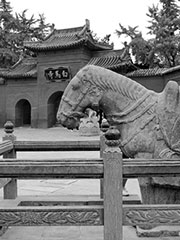
白马寺White Horse Temple (Simplified Chinese: 白马寺; Traditional Chinese: 白馬寺; Hanyu pinyin: Báimǎ Sì; also White Horse Ministry) was the first Buddhist temple in China, established under the patronage of Emperor Ming in the Eastern Han capital Luoyang in the year 68.

Founding

One night, the emperor was said to have dreamed of a deity flying over his palace. The next day he told his ministers, and the minister Zhong Hu explained to him that he probably dreamed of Buddha in India. The emperor then sent a delegation of 18 headed by Cai Yin, Qin Jing and Wang Zun to seek Buddhism. They returned from Afghanistan with an image of Gautama Buddha, the Sutra of Forty-two Sections and two eminent monks.

The monks names have been variously romanized as Kasyapamatanga and Dharmavanya, Moton and Chufarlan.

The next year, the emperor ordered the construction of White Horse Temple three li west of the capital Luoyang, to remember the horse that carried back the sutras. It was China’s first Buddhist temple.

Naming

Notably, the emperor ordered the suffix 寺 (pinyin si) to be used in the temple’s name, as a display of respect. Previously, this character had been used to denote ministries of government. In later periods, all temples came to use this character in their name and it was dropped from the names of government ministries. As a result, the temple’s name is sometimes translated as White Horse Ministry, a translation true to the time. However, White Horse Temple is the correct, literal reading to modern Chinese people.

Significance

The first version of the Chinese Sutra of Forty-two Sections (四十二章經) was produced within the temple. The temple then increased in importance as Buddhism grew within China, and spread to Korea, Japan and Vietnam. The introduction of Buddhism in China was also a significant influence on Chinese morals, thought and ethics.

Location

The temple is located within Han and Wei Dynasty Luoyang, which lies approximately 12km east of modern Luoyang, in Henan province.

History

  • 258 A royal Kuchean monk, Po-Yen, translated six Buddhist text in to Chinese at the temple, including the important Infinite Life Sutra.
  • 1992 With the assistance of Thai and Chinese donors, the Hall of the Thai Buddha was constructed slightly west of the old temple.

Description

The temple compound covers an area of 200 mu (13 hectares), and faces south. A stone paifang (archway) has been recently built 150 metres in front of the original gate. Between the archway and gate lies a pool with fountains, spanned by three stone bridges.

Entering the temple today, one sees the Hall of Heavenly Kings, Hall of the Great Buddha, Hall of Mahavira, Hall of Greeting, the Cool and Clear Terrace and the pavilion. On each side of the pavilion are the Sutra House and the Magic Weapon House.

Visiting today

The temple is open to the public, and can be reached by public bus number 56 from Luoyang Train Station. Standard tickets cost 35元 and discounts are available to students at half price (17.5元).

See also

  • Buddhism in China 白馬寺
March 12, 2019 0 comments
0 FacebookTwitterPinterestEmail
Wheel Of Time
Buddhism

Wheel Of Time

by Sergei March 12, 2019
written by Sergei

Wheel of Time — meaning, origin and common depictions in Buddhist art and ritual, explained with concise examples.

Wheel Of TimeThe wheel of time or wheel of history is a concept in several religions and philosophies, notably dharmic religions such as Buddhism and Hinduism, which regard time as cyclical and consisting of repeating ages.

Buddhism

See Kalachakra for details.

The Wheel of time or Kalachakra is a Tantric deity that is also associated with Tibetan Tantric Buddhism, which encompasses four main schools and traditions which are Sakya, Nyingma, Kagyu and Gelug.

See also

  • Wheel of life (also known as the wheel of dharma, wheel of law, or wheel of existence)
  • Timewheel (a huge hourglass in Budapest)
March 12, 2019 0 comments
0 FacebookTwitterPinterestEmail
Newer Posts
Older Posts

Must-Read

  • Meditation
  • Zen
  • Dhyāna
  • Buddhism by Country
  • History Of Buddhism
  • Greco-buddhism
  • Avatar
  • Koan
  • Buddha
  • Shambhala Buddhism
  • Dalai Lama
  • Fourteenth Dalai Lama
  • List Of Buddhists
  • Dzogchen
  • Buddhist Art
  • Buddhist Texts
  • Dharma Wheel
  • Mahayana

2016 - 2026 - Buddhism-Guide.com


Back To Top
Buddhism Guide
  • Buddhism Guide