Buddhism Guide
  • Buddhism Guide
Home | Buddhism | Page 5
Category:

Buddhism

Wat Charoenbhavana, Manchester
Buddhism

Wat Charoenbhavana

by Sergei March 12, 2019
written by Sergei

Wat Charoenbhavana — overview of meaning, background and key points, with links to related topics for context.

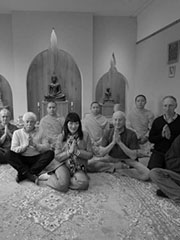
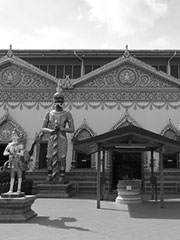
Wat Charoenbhavana, ManchesterOn 8 February 2004 saw the establishment of Wat Charoenbhavana, Manchester – also known to westerners as the North-West Centre for Buddhist Meditation. It is the first Thai Buddhist temple the Northwest of England. It is presently located in the in a converted curtain-rail factory in Salford.

The temple was named Wat Charoenbhavana (Manchester) by the Thai community (lit. `the temple for cultivation of meditation’) and was consecrated with the blessing of the Most Ven. Phrarajbhavanavimol head of the Thai Buddhist mission to England.

The temple was accepted as an official place for religious worship (no.81212) on 4 June 2004 with the help of the Thai Culture Forum UK.

Originally the temple had no Buddha image. The eight-foot Buddha image which has pride of place in the main shrine room was rescued from a roadside in Cardiff.

Presently the temple runs a variety of pastoral services for the Buddhist community in Manchester and marks most of the events in the Thai Buddhist calendar. A variety of evening classes on Buddhism and meditation are run on weekdays and Thai language classes on weekends.
March 12, 2019 0 comments
0 FacebookTwitterPinterestEmail
Wat Chaiya Mangkalaram Burmah Lane
Buddhism

Wat Chaiya Mangkalaram Burmah Lane

by Sergei March 12, 2019
written by Sergei

Wat Chaiya Mangkalaram Burmah Lane — overview of meaning, background and key points, with links to related topics for context.

Wat Chaiya Mangkalaram Burmah LaneThe Reclining Buddha of the Wat Chaiya Mangkalaram is the 3rd largest of its kind, being 33 meters in length. This gorgeous traditional Thai temple complex would be well worth a lengthy visit even without the Reclining Buddha, but no doubt most visitors come to pay homage and admire the majestic golden Buddha. In the main shrine in front of the Reclining Buddha there are smaller shrines of different Buddhas and popular Thai deities. On the fantastically ornate temple grounds visitors can see many beautifully carved and lavishly colored statues of Devas and other mythical creatures.

The temple was built in 1845. The first monk was a Theravada Buddhist monk from Thailand, Phorthan Kuat, also known as the “Powerful Monk”. Legend has it that he was very fond of laksa, a local specialty and even today devotees bring a bowl of laksa as an offering to his shrine.

March 12, 2019 0 comments
0 FacebookTwitterPinterestEmail
Wat Buddhapadipa
Buddhism

Wat Buddhapadipa

by Sergei March 12, 2019
written by Sergei

Wat Buddhapadipa — brief biography and historical significance; key ideas and sources for deeper study.

Wat BuddhapadipaWat Buddhapadipa (Thai: วัดพุทธปทีป) is a Thai Buddhist temple in Wimbledon, London, United Kingdom.

Address: 14 Calonne Road Wimbledon
London SW19 5HJ

Phone: +44 (0) 208 946 1357

Email: buddhapadipa@live.com

March 12, 2019 0 comments
0 FacebookTwitterPinterestEmail
Wat Benchamabophit
Buddhism

Wat Benchamabophit

by Sergei March 12, 2019
written by Sergei

Wat Benchamabophit — overview of meaning, background and key points, with links to related topics for context.

Wat BenchamabophitWat Benchamabophit Dusitvanaram (Thai วัดเบญจมบพิตรดุสิตวนารามราชวรวิหาร) is a buddhist temple in the Dusit district of Bangkok, Thailand. Also known as the marble temple, it is one of Bangkok’s most beautiful temples and a major tourist attraction.

Construction of the temple began in 1899 at the request of King Chulalongkorn after building his palace nearby. The temple’s name literally means the Temple of the fifth King located nearby Dusit Palace. It was designed by Prince Naris, a half-brother of the king, and is built of Italian marble.

Inside the Ordination Hall (Ubosot) is a Sukhothai-style Buddha statue named Phra Buddhajinaraja, cast in 1920 after the original located in Wat Mahathat in Phitsanulok. The ashes of King Chulalongkorn are buried beneath the statue. In the gallery surrounding the ordination hall are 52 buddha statues, collected by Prince Damrong Rajanubhab for his king.

In 2005, the temple was submitted to UNESCO for consideration as a future World Heritage Site.

March 12, 2019 0 comments
0 FacebookTwitterPinterestEmail
Wat Arun
Buddhism

Wat Arun

by Sergei March 12, 2019
written by Sergei

Wat Arun — overview of meaning, background and key points, with links to related topics for context.

Wat ArunWat Arun (Thai วัดอรุณ, Temple of the Dawn) is a buddhist temple (Wat) located in Bangkoks district Bangkok Yai on the west bank of the Chao Phraya River. The full name of the temple is Wat Arunratchawararam Ratchaworamahavihara (วัดอรุณราชวรารามราชวรมหาวิหาร).

Architecture

The outstanding feature of Wat Arun is its central prang (Khmer-style tower). Steep steps lead to the two terraces. The height is reported by different sources as between 66,80 m and 86 m. The corners are surrounded by 4 smaller satellite prangs. The prangs are decorated by seashells and bits of porcelain which had previously been used as ballast by boats coming to Bangkok from China. Around the base of the prangs are various figures of ancient Chinese soldiers and animals. Over the second terrace are four statues of the Hindu god Indra riding on Erawan.

At the riverside are 6 pavilions (sala) in Chinese style. The pavilions are made of green granite and contain landing bridges.

Next to the prangs is the Ordination Hall with the Niramitr Buddha image supposedly designed by King Rama II. The front entrance of the Ordination Hall has a roof with a central spire, decorated in coloured ceramic and stuccowork sheated in coloured china. There are 2 demons, or temple guardian figures in front.

History of the temple

The temple was built in the days of Thailand’s ancient capital of Ayutthaya and originally known as Wat Makok (The Olive Temple). In the ensuing era when Thonburi was capital, King Taksin changed the name to Wat Chaeng.

The Wat had a brief period as host of the Emerald Buddha, which was moved to Wat Phra Kaew in 1784.

The later King Rama II. changed the name to Wat Arunratchatharam. He restored the temple and enlarged the central prang. The work was finished by King Rama III. King Rama IV gave the temple the present name Wat Arunratchawararam.

Mythology

The central prang is symbolizing mount Meru of the Indian cosmology. The satellite prangs are devoted to the wind god Phra Phai.

The demons at the entrance way are from the Ramayana. The white figure is named Sahassateja and the green one is known as Tasakanth.

March 12, 2019 0 comments
0 FacebookTwitterPinterestEmail
Wanfu Temple
Buddhism

Wanfu Temple

by Sergei March 12, 2019
written by Sergei

Wanfu Temple — overview of meaning, background and key points, with links to related topics for context.

Wanfu TempleWanfu Temple (Chinese 萬福寺; pinyin wan fu si) is a temple on Mount Huangbo in Fujian province, China. It is famous as the original temple of Yinyuan Longqi, the temple’s 33rd abbot and a Chan master. He later travelled to Japan with his disciple Muyan to found the Japanese Ōbaku school of Zen.

See also: List of Buddhist temples

March 12, 2019 0 comments
0 FacebookTwitterPinterestEmail
Walpola Rahula
Buddhism

Walpola Rahula

by Sergei March 12, 2019
written by Sergei

Walpola Rahula — overview of meaning, background and key points, with links to related topics for context.

Walpola RahulaThe Rev. Dr. Walpola Rahula is a scholar monk who trained and educated in the Theravadan tradition in Ceylon (Sri Lanka). His succinct, clear overview of Buddhist concepts is held in high regard and has become a standard.

He held eminent positions in one of the leading monastic institutes (Pirivena) in Ceylon, where the Law of the Buddha florishes from the time of Asoka and has preserved all its vitality up to this day.

He entered the Ceylon University, obtained the B.A. Honours degree (London), and then won the degree of Doctor of Philosophy of the Ceylon University on a higherly learned thesis on the History of Buddhism in Ceylon.

He is best known for his book What The Buddha Taught, which is one of the best introductory books on Buddhism.

Walpola Rahula Quotes

  • According to the Buddha’s teaching the beginning of the life-stream of living beings is unthinkable. THe believer in the creation of life by God may be astonished at this reply. But if you were to ask him ‘What is the beginning of God?’ he would answer without hesitation ‘God has no beginning’, and he is not astonished at his own reply.
  • As long as you are conscious of yourself, you can never concentrate on anything.
  • Two ideas are psychologically deep-rooted in man: self-protection and self-preservation. For self-protection man has created God, on whom he depends for his own protection, safety and security, just as a child depends on its parent. For self-preservation man has conceived the idea of an immortal Soul or Atman, which will live eternally. In his ignorance, weakness, fear, and desire, man needs these two things to console himself. Hence he clings to them deeply and fanatically.
  • All great work artistic, poetic, intellectual or spiritual is produced at those moments when creators forget themselves altogether and are free from self-consciousness.
  • There is no unmoving mover behind the movement. It is only movement. It is not correct to say that life is moving, but life is movement itself. Life and movement are not two different things. In other words, there is no thinker behind the thought. Thought itself is the thinker. If you remove the thought, there is no thinker to be found.

Bibliography

  • What The Buddha Taught (1959, ISBN 0802130313)
  • History of Buddhism in Ceylon: The Anuradhapura period, 3rd Centrury BC–10th Century AD (1966)
  • Humour in Pali Literature and Other Essays (1997, ISBN 9556500006)
  • The Heritage of the Bhikkhu: A Short History of the Bhikkhu in Educational, Cultural, Social, and Political Life (1974, ISBN 0394492609)
  • Heritage of Bhikkhu (1974, ISBN 0394178238)
  • Zen and the Taming of the Bull: Towards the Definition of Buddhist Thought: Essays (1978, ISBN 0900406690)
  • The Heritage of the Bhikkhu: The Buddhist Tradition of Service (2003, ISBN 0802140238) Walpola Rahula
March 12, 2019 0 comments
0 FacebookTwitterPinterestEmail
Vitakka
Buddhism

Vitakka

by Sergei March 12, 2019
written by Sergei

Vitakka — overview of meaning, background and key points, with links to related topics for context.

VitakkaVitakka (pāli) , both in hinduist yoga and buddhist meditation , means the action of taking care of any object : God, one’s body, the Self, a color, any sensation..

It refers to attention in a different way than cognitive neuroscience, implying a very strong leading of attention, as it leads to more mental process : vicara, piti, sukkha and ekkagata.

Vitakka is the first element to appear in meditation’s process, still present in the first Jhana, but absent of any further Jhana.

March 12, 2019 0 comments
0 FacebookTwitterPinterestEmail
Virya
Buddhism

Virya

by Sergei March 12, 2019
written by Sergei

Virya — overview of meaning, background and key points, with links to related topics for context.

ViryaVīrya (Pali: viriya; Tibetan: brtson ‘grus) is a Sanskrit word which can be translated into English as “effort,” “vigor,” “diligence,” and “zeal.”

In Buddhism, Vīrya is one of the five controlling faculties (indriya), one of the five powers (bala), one of the six or tenparamitas, one of the seven factors of enlightenment (bodhyaṅga) and is identical with right effort of the Noble Eightfold Path (aṣṭāṅga mārga). It stands for strenuous and sustained effort to overcome laziness. It stands for the right endeavour to attain dhyāna. Vīrya does not stand for physical strength. It signifies strength of character and the persistent effort for the well-being of others. In the absence of sustained efforts in practicing meditation, craving creeps in and the meditator comes under its influence. Right effort known as vīryabala is, thus, required to overcome laziness and deviation from dhyāna.

March 12, 2019 0 comments
0 FacebookTwitterPinterestEmail
Vipassana
Buddhism

Vipassana

by Sergei March 12, 2019
written by Sergei

Vipassana — what it is, why it is practiced, and simple steps to try safely, with common mistakes to avoid.

VipassanaVipassanā (Sanskrit: vipasyanā) is the practice of Insight Meditation. While it is often referred to as Buddhist meditation, the practice taught by the Buddha was non-sectarian, and has universal application. It does not require conversion to Buddhism. While the meditation practices themselves vary from school to school, the underlying principle is the investigation of phenomena (Sanskrit: dharmas) as they manifest in the five aggregates (Skandha) namely, matter or form (Rupa), sensation or feelings (Vedana), perception (Samjna), mental formations (Saṃskāra) & consciousness (Vijnana). This process leads to direct experiential perception, Vipassanā.

In a broader sense, vipassanā has been used as one of two poles for the categorization of types of Buddhist meditation, the other being samatha. Samatha is a focusing, pacifying and calming meditation, common to many traditions in the world, notably Hindu Yoga, from which much of Buddhist terminology derives. It is used as a preparation for vipassana, pacifying the mind and strengthening the concentration in order to allow the work of Insight. This dichotomy is also sometimes discussed as “stopping and seeing.” In Buddhist practice, it is said that while Samatha can calm the mind, only Insight can reveal how the mind was disturbed to start with, which leads to prajna (knowledge) and jnana (pure wisdom) and thus can lead to preventing it from being disturbed again.

The term is also used to refer to a religious movement modelled after Theravada Buddhism which employs Vipassana and ānāpāna meditation as its primary techniques and places emphasis on the teachings of the Satipatthana Sutta. Vedana (sensation/feeling) is the primary initial subject of investigation.

Etymology

Vipassanā is a Pali word from the Sanskrit prefix “vi-” and verbal root √drś. It is often translated as “insight” or “clear-seeing,” though, the “in-” prefix may be misleading; “vi” in Indo-Aryan languages is cognate to our “dis.” The “vi” in vipassanā may then mean to see apart, or discern. Alternatively, the “vi” can function as an intensive, and thus vipassanā may mean to see deeply. In any case, this is used metaphorically for a particularly powerful mental self-perception.

A synonym for “Vipassanā” is paccakkha (Pāli; Sanskrit: pratyakṣa), “before the eyes,” which refers to direct experiential perception. Thus, the type of seeing denoted by “vipassanā” is that of direct perception, as opposed to knowledge derived from reasoning or argument.

Practice of vipassanā

Vipassana meditation is a very simple, logical technique which depends on direct experience, observation, rather than belief. It has three parts – adherence to a SilĂ (abstaining from killing, stealing, lying, sexual misconduct and intoxication), which is not an end in itself but a requirement for the second part, concentration of the mind (Samadhi). With this concentrated mind, the third, part of the technique (Panna) is detached observation of the reality of the mind and body from moment to moment. This practice both develops a deep, experiential understanding of the impermanence of reality and also brings to the surface and dissolves deep-seated complexes and tensions.

Put another way, Vipassanā meditation consists of the experiencial observation of mind and matter (nama and rupa) in their aspects of impermanence, unsatisfactoriness and lack of an inherent, independent essence or self.

To see through the mode of impermanence means to examine things as to whether they are permanent. To see through the mode of unsatisfactoriness means to examine things as to whether they are satisfactory or are imbued with suffering. To see through the mode of non-self means to examine things without the sense of clinging to the dharma. In other words, to see through non-self is to have a sense of non-doership and a sense of non-posessorship while examining things.

In Vipassanā meditation, the meditation object is one’s own consciousness, although it can be further refined to be one’s consciousness while observing, say, the breath, as in ānāpāna meditation. In this context, the modes of seeing refers to focusing on those aspects of consciousness which appear to have (or not have) these characteristics.

Some steps are described as Vipassana jhanas, or simply as knowledges.

A major 19th century vipassanā instructor in Burma was Ledi Sayadaw.

Vipassanā today

Today, the term “Vipassanā” also refers to a series of meditation techniques used by many branches of modern Theravada Buddhism, for example in modern Sri Lanka, Burma, Laos and Thailand, and to a specific branch of Buddhism popularized by the Indian businessman S. N. Goenka and his mentor U Ba Khin as a nonsectarian form of Buddhism, and also by Americans Joseph Goldstein, Sharon Salzberg, and Jack Kornfield (who were inspired by the monks Mahasi Sayadaw and Ajahn Chah) under the rubric “insight meditation.” The vipassana centres supported by S.N. Goenka are present around the world in more than 100 countries. Here locals and visitors can have vipassanā training, always given free of charge including accommodation and meals.

Vipassana in the Theravada, Mahayana and Vajrayana

In the Theravada

Vipassana as practiced in the Theravada is the understanding of the Four Noble Truths that were taught by the Buddha. It is understanding the transitory nature of phenomena and the selflessness of persons, that the conceptual consciousness, “I” does not exist.

Most of Theravada’s teachers refer to knowledges evolving during practice. The meditator gradually improve his perception of the three marks of existence until he reaches the step sensations constantly disappear, which is called bhanga nupassana nana: knowledge of dissolution.

The yogi will then experience fear and ceasing of attachment, and eventually will reach the step of sankharupekkha jnana: knowledge of equanimity of formations. This step leads to the attainment of Nirvana.

In practise one can use various methods to do Vipassana Meditation. For example one method is that there are 40 topics that can be concentrated by the meditator such as Impermanance(Anichcha),Suffering(Dukka),Rogaa(Illness),(Ganda, Sala,)like wise. The meditator can meditate on one of these untill he sees the truth in everything in the world (Or even the universe)

The main thing a meditator should know is before you start doing Vipassana its better if you had some experience doing Samatha or Calm Meditation. Because if you can quickly calm your mind and keep the mind in one object then doing Vipassana will be easy. And you should keep in mind that you should have a instructer to do Vipassana meditation in particular unlike Samatha.

In the Mahayana

Mahayana Vipassana consists of meditating on the two truths: conventional truth and absolute truth. One realizes that phenomena likewise have a lack of inherent existence, and have the nature of emptiness (Shunyata). This is determined by the inferential path of reasoning and direct observation through meditation.

Gradualism or subitism and the realisation is a debate in the Mahayana. Nevertheless, Huineng, sixth patriarch of the Chan, considered the practice cannot be described as gradualistic nor subist, but implies people with more or less clear minds.

In the Vajrayana

Mahamudra and Dzogchen use Vipashyana extensively, though in a different manner than in the Theravada. In the Vajrayana (Tantric) path, the true nature of mind is pointed out by the guru, and the practitioner takes the path of direct experience.

“In the Sutra path (Theravada) one proceeds by examining and analyzing phenomena, using reasoning. One recognizes that all phenomena lack any true existence and that all appearances are merely interdependently related and are without any inherent nature. They are empty yet apparent, apparent yet empty. The path of Mahamudra is different in that one proceeds using the instructions concerning the nature of mind that are given by one’s guru. This is called taking direct perception or direct experiences as the path.The fruition of Shamatha is purity of mind, a mind undisturbed by false conception or emotional afflictions. The fruition of Vipashyana is knowledge (prajna) and pure wisdom (jnana). Jnana is called the wisdom of nature of phenomena and it comes about through the realization of the true nature of phenomena.”

-Thrangu Rinpoche, Looking Directly at Mind : The Moonlight of Mahamudra

Famous masters

  • Dhammakaya
  • Mahasi Sayadaw
  • S. N. Goenka
  • U Ba Khin

See also

  • Buddhism
  • Meditation
  • Samatha
  • Ānāpāna
  • Satipatthana
  • Theravada
  • Atthakavagga and Parayanavagga
March 12, 2019 0 comments
0 FacebookTwitterPinterestEmail
Vipaka
Buddhism

Vipaka

by Sergei March 12, 2019
written by Sergei

Vipaka — overview of meaning, background and key points, with links to related topics for context.

VipakaVipaka (Pali) is the result of karma (intentional actions).

In Buddhism, the law of kamma-vipaka refers to any action that has a moral context. Good consequences “ripen” as a result of morally good actions, whereas bad consequences ripen from morally bad actions. The motivation of the action determines whether it is morally good or bad.

See also

  • Buddhism
  • List of Buddhist topics
  • Rebirth
March 12, 2019 0 comments
0 FacebookTwitterPinterestEmail
Vinaya Pitaka
Buddhism

Vinaya Pitaka

by Sergei March 12, 2019
written by Sergei

Vinaya Pitaka — summary of the setting and main themes, why it matters in the canon, with notes for further reading.

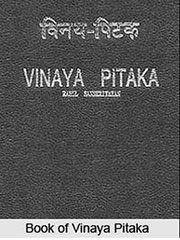
Vinaya PitakaThe Vinaya Pitaka is the first of three divisions of the Tripitaka, the canon of Buddhism.

It mainly concerns the vinaya, or code of conduct for Buddhist monks and nuns.

The other two parts of the Tripitaka are the Sutta Pitaka and the Abhidhamma Pitaka. Its primary subject matter is the monastic rules for monks and nuns. The name Vinaya Pitaka (vinayapi aka) is the same in Pāli, Sanskrit and other dialects used by early Buddhists.

See also

  • Abhidhamma Pitaka
  • Buddhist texts
  • Sutta Pitaka
March 12, 2019 0 comments
0 FacebookTwitterPinterestEmail
Vinaya
Buddhism

Vinaya

by Sergei March 11, 2019
written by Sergei

Vinaya — summary of the setting and main themes, why it matters in the canon, with notes for further reading.

VinayaThe Vinaya (a word in Pali as well as in Sanskrit, with literal meaning ‘discipline’) is the textual framework for the Buddhist monastic community, or sangha. The teachings of the Buddha, or Buddhadharma can be divided into two broad categories: ‘Dharma‘ or doctrine, and ‘Vinaya’, or discipline. Generally speaking the former is concerned with theory, and the latter with practice, although there is actually considerable cross-over between the two. Another term for Buddhism is dharmavinaya.

At the heart of the Vinaya is a set of rules known as Patimokkha (Pali), or Pratimoksha (Sanskrit). The Vinaya was orally passed down from the Buddha to his disciples. Eventually, three different Vinayas arose in Buddhism, based upon geographical/cultural differences and the different Buddhist schools that developed. The essence of the Vinayas are the same and have only minor differences. Buddhists in Burma, Cambodia, Sri Lanka, and Thailand follow the Theravadin Vinaya, which has 227 rules for the bhikkhus (male monastics)and 311 for the bhikkhunis (female monastics). Buddhists in China, parts of Japan, and Korea follow the Dharmaguptaka Vinaya, which has 250 rules for the bhikkhus and 348 rules for the bhikkhunis. Buddhists in Tibet and part of Japan follow the Mūlasarvāstivāda Vinaya, which has 253 rules for the bhikkhus and 364 rules for bhikkhunis.

Surrounding the rules is a range of texts. Some of these explain the origins of the rules – it is possible to trace the development of the rules from responses to specific situations or actions to a general codification. There is also a number of sutta-like texts which are more general statements about Buddhist doctrine, or which give biographical details of some of the great disciples and their enlightenment. Other sections detail how the rules are to be applied, how breaches are to be dealt with, and how disputes amongst the monks are handled.

It is thought that originally there were no rules and the Buddha and his disciples just lived in harmony when they were together. Most of the time they would have been wandering alone, but every year, during the monsoon season when travelling became impossible, the bhikkhus would come together for a few months. As the sangha became bigger and started accepting people of lesser ability who remained unenlightened, it became necessary to begin having rules.

It seems that initially these were quite flexible and were adapted to the situation. By the time of the Buddha’s death there would have been a body of rules which bhikkhus were expected to follow. In the Mahaparinibbana Sutta the Buddha, as part of his last teaching, tells the bhikkhus that they can abandon some minor rules, but that they should stick to the major ones, but there appears to have been some confusion over which was which. It was therefore decided that they would keep all of the rules. Immediately after the Buddha’s death there was a council at which all of the teachings were recited, collected and sorted. Legend has it that the huge volume of teachings was recited from memory, with Ananda reciting the suttas and Upali reciting the Vinaya.

See also Sangha.

March 11, 2019 0 comments
0 FacebookTwitterPinterestEmail
Vimalakirti Sutra
Buddhism

Vimalakirti Sutra

by Sergei March 11, 2019
written by Sergei

Vimalakirti Sutra — summary of the setting and main themes, why it matters in the canon, with notes for further reading.

Vimalakirti SutraVimalakirti Sutra (Chinese 維摩經 wéimó jing, Japanese 維摩経 yuima-gyō, Korean 유마경 yuma-gyeong, Sanskrit विमलकीर्ति-निर्देश-सूत्र Vimalakīrti-nirdeśa-sūtra.) This scripture is considered one of the most profound, as well as literarily excellent of the Indian Mahāyāna Buddhist sutras. The sutra expounds the profound principle of Mahāyāna as opposed to Theravada teachings, focusing on the explication of the meaning of nonduality. A significant aspect of the scripture is the fact that it is a teaching addressed to high-ranking Buddhist disciples through the mouth of the layman bodhisattva Vimalakīrti, who expounds the doctrine of emptiness in depth, eventually resorting to silence. There are three classical Chinese translations extant:

  • the 維摩詰所說經 Wéimójié suǒshuō jing (trans. by Kumārajīva ; T 475.14.537a-557b).
  • the 說無垢稱經 Shuō wúgòuchēng jing (6 fasc. trans. Xuanzang . T 476.14.557-587)
  • the 佛說維摩詰經 Fóshuō wéimójié jing (2 fasc. trans. Lokakṣema . T 474.14.519-536).

In addition to these, earlier translations had been done by Zhiqian (223-228), Dharmarakṣa (308), Upaśūnya (545), and Jñānagupta (591). Of the three extent renditions, Kumārajīva’s has traditionally been the most popular.

March 11, 2019 0 comments
0 FacebookTwitterPinterestEmail
Newer Posts
Older Posts

Must-Read

  • Meditation
  • Zen
  • Dhyāna
  • Buddhism by Country
  • History Of Buddhism
  • Greco-buddhism
  • Avatar
  • Koan
  • Buddha
  • Shambhala Buddhism
  • Dalai Lama
  • Fourteenth Dalai Lama
  • List Of Buddhists
  • Dzogchen
  • Buddhist Art
  • Buddhist Texts
  • Dharma Wheel
  • Mahayana

2016 - 2026 - Buddhism-Guide.com


Back To Top
Buddhism Guide
  • Buddhism Guide