Buddhism Guide
  • Buddhism Guide
Home | Buddhism | Page 50
Category:

Buddhism

Bodhisattva
Buddhism

Bodhisattva (Boddhisattva)

by Sergei February 6, 2019
written by Sergei

Bodhisattva — brief biography and historical significance; key ideas and sources for deeper study.

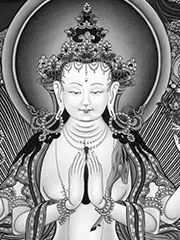
BodhisattvaIn Buddhist thought, a bodhisattva (Simplified Chinese: 菩萨; Traditional Chinese: 菩薩; Hanyu pinyin: púsà; Japanese: 菩薩 bosatsu; Korean: bosal) is a being who is dedicated to assisting all sentient beings achieve complete Buddhahood. Conventionally, the term is applied to hypothetical beings with a high degree of enlightenment. Bodhisattva literally means a “wisdom (‘bodhi’) being (‘sattva’)” in Sanskrit.

Bodhisattvas in Theravada Buddhism

In Theravada Buddhism, the bodhisattva (Pali: bodhisatta) is seen as seeking enlightenment so that, once awakened, he or she may efficiently aid other beings with the expertise of supreme wisdom. Gautama Buddha’s previous life experience as a bodhisattva before Buddhahood are recorded in the texts of the jataka. Lay Buddhists of Theravada seek inspiration in Gautama’s skill as a good layman in these texts, which account not only his historical life, but many previous lives. When Gautama Buddha referred to himself in his pre-Buddha existence, he spoke in terms of “when I was still a Bodhisattva”. The only currently active bodhisattva described in the Pali Canon is the future Buddha Maitreya (Pali: Metteyya). The Theravada tradition, i.e., the Pali Canon, speaks of no other bodhisattvas than these.

Bodhisattvas in Mahayana Buddhism

In Mahayana Buddhism, a bodhisattva has the compassionate determination to aid all beings on their quest for the highest state of development, full enlightenment of a Buddha. This type of motivation is known as bodhicitta. Remaining in this world of uncontrolled rebirth (samsara), the Bodhisattva has taken the bodhisattva vow to achieve Buddhahood as quickly as possible and thereby be most able to teach Dharma until all beings have likewise achieved enlightenment.

Another common conception of the Bodhisattva is one who delays his own final and complete enlightenment in order to save all sentient beings out of his enormous compassion. He is on a mission to liberate all sentient beings, and only then wil he rest and complete his own enlightenment.

In brief, simply imagine the Bodhisattva as saying, “If I know how to swim, and even one other being cannot, then it is right to remain behind in this world to assist them until they know how to save themselves from drowning”.

Mahayana Buddhist philosophy sometimes poses the concept of the bodhisattva in opposition to that of the Sravaka-Buddha (conventionally referred to as an Arhat). The Arhat is seen as being possessed of ultimate enlightenment, but he did not choose to save all and every other living being before passing away into Parinirvana.

According to many traditions within Mahayana Buddhism, on his or her way to becoming a Buddha, the bodhisattva proceeds through ten, or sometimes fourteen, stages or bhumi. Below is the list of ten bhumis and their descriptions from The Jewel Ornament of Liberation, a treatise by Gampopa, an influential teacher of the Tibetan Kagyu school. Other schools give variant descriptions.

Before a bodhisattva arrives at the first ground, he or she first must travel the first two of the five paths, which are said to correspond to words from the mantra that appears at the end of the Heart Sutra:

  1. the path of accumulation (gate)
  2. the path of preparation (gate).

The ten grounds of the bodhisattva then can be grouped into the next three paths

  1. Bhumi 1 the path of insight (paragate)
  2. Bhumi 2-7 the path of meditation (parasamgate)
  3. Bhumi 8-10 the path of no more learning (bodhi)

The 10 Grounds of Buddhism

  1. Great Joy
    • It is said that being close to enlightenment and seeing the benefit for all sentient beings, one achieves great joy, hence the name. In this bhumi the bodhisattvas practice all virtues (paramita), but especially emphasizing generosity (dana).
  2. Stainless
    • In accomplishing the second bhumi, the bodhisattva is free from the stains of immorality, therefore, this bhumi is named ‘Stainless’. The emphasized virtue is moral discipline (śila).
  3. Radiant
    • The third bhumi is named ‘Radiant’, because, for a bodhisattva who accomplishes this bhumi, the light of Dharma is said to radiate from the bodhisattva for others. The emphasized virtue is patience (kṣanti).
  4. Luminous
    • This bhumi is called ‘luminous’, because it is said to be like a radiating light that fully burns that which opposes enlightenment. The emphasized virtue is vigor (virya).
  5. Very difficult to train
    • Bodhisattvas who attain this bhumi strive to help sentient beings attain maturity, and do not become emotionally involved when such beings respond negatively, both of which are difficult to do. The emphasized virtue is meditative concentration (dhyāna).
  6. Obviously Transcendent
    • “By depending on the perfection of wisdom awareness, he does not abide in either saṃsāra or nirvāṇa, so it is ‘obviously transcendent'”. The emphasized virtue is wisdom (prajña).
  7. Gone afar
    • Particular emphasis is on the perfection of skillful means, or upaya-kaushalya, to help others.
  8. Immovable
    • The emphasized virtue is aspiration.
    • This, the ‘Immovable’ bhumi, is the bhumi at which one becomes able to choose his/her place of rebirth.
  9. Good Discriminating Wisdom
    • The emphasized virtue is power.
  10. Cloud of dharma
    • The emphasized virtue is the practice of primordial wisdom.

After the ten bhumis, according to Mahayana Buddhism, one attains complete enlightenment and becomes a Buddha.

Various traditions within Buddhism believe in certain specific bodhisattvas. Some bodhisattvas appear across traditions, but due to language barriers may be seen as separate entities. For example, Tibetan Buddhists believe in Chenrezig, who is Avalokitesvara in India, Kuan Yin (other spellings: Guan Yin, Kwan Yin, Quan Yin) in China, and Kannon in Japan. A modern bodhisattva for many is the 14th Dalai Lama, considered by many followers of Tibetan Buddhism to be an incarnation of that same bodhisattva, the Bodhisattva of Compassion.

The bodhisattva is a popular subject in Buddhist art.

The place of a bodhisattva’s earthly deeds, such as the achievement of enlightenment or the acts of dharma, is known as a bodhimandala, and may be a site of pilgrimage. Many temples and monasteries are famous as bodhimandalas; for instance, the island of Putuoshan, located off the coast of Ningbo, is venerated by Chinese Buddhists as the bodhimandala of Avalokitesvara. Perhaps the most famous bodhimandala of all is the bodhi tree under which Shakyamuni achieved buddhahood.

Some, mainly American convert Buddhists including Jack Kerouac, are recently incorporating Jesus into Buddhism by claiming he is a bodhisattva.

Partial list of bodhisattvas

  • Akasagarbha (Ch. 虛空藏 Xu Kong Zang; Jp. Kokūzō; Vi. Hư Không Tạng)
  • Avalokiteśvara (Ch. 觀世音 Guanshiyin; Jp. Kanzeon; Tib. Chenrezig; Vi. Quán Thế Âm)
  • Kṣitigarbha (Ch. 地藏 Dì cáng; Jp. Jizō; Vi. Ðịa Tạng)
  • Mahasthamaprapta (Ch. 大勢至 Da Shì Zhì; Jp. Seishi; Vi, Ðại Thế Chí)
  • Maitreya (Ch. 彌勒 Mi Le; Jp. Miroku; Vi. Di-lặc)
  • Mañjuśri (Ch. 文殊師利 Wen Shu; Jp. Monju; Tib. Jampal Yang; Vi. Văn-thù-sư-lợi)
  • Padmasambhava (Ch. 蓮華生上師 Lianhuasheng Shang Shi; Tib. Padma Jungne or Guru Rinpoche; Vi. Liên Hoa Sinh)
  • Samantabhadra (Ch. 普賢 Pu Xian; Jp. Fugen; Tib. Kuntu Zangpo; Vi. Phổ Hiền)
  • Vajrapani (Ch. 金剛手 Jin Gang Shou; Jp. Shukongojin; Tib. Channa Dorje; Vi. Kim Cương Thủ)

Bodhisattva in popular culture

  • The band Steely Dan has a song entitled Bodhisattva on their 1973 album Countdown to Ecstasy.
  • The rap group The Beastie Boys has a song called Bodhisattva Vow on their album Ill Communication.
  • Patrick Swayze’s character in Point Break is named Bodhisattva

References

  • Gampopa; The Jewel Ornament of Liberation; Snow Lion Publications; ISBN 1-55939-092-1
  • White, Kenneth R.; The Role of Bodhicitta in Buddhist Enlightenment: Including a Translation into English of Bodhicitta-sastra, Benkemmitsu-nikyoron, and Sammaya-kaijo; The Edwin Mellen Press, 2005; ISBN 0-88946-050-7

Bodhisattva Bodhisatva Bodhisattva Bodhisatvo Bodhisattva Bodhisattva Bodisatva Bodhisattva 菩薩 Bodhisattwa Bodhisattva Бодхисаттва Bodhisattva Bodhisattva Bồ Tát 菩萨

February 6, 2019 0 comments
0 FacebookTwitterPinterestEmail
Black Crown
Buddhism

Black Crown

by Sergei February 6, 2019
written by Sergei

Black Crown — overview of meaning, background and key points, with links to related topics for context.

Black CrownThe Black Crown is an important symbol of the Karmapa, the Lama that heads the Kagyu school of Tibetan Buddhism. The crown signifies his power to benefit all sentient beings.

Legend tells that in a previous eon, in a former life as an accomplished (yogi), the Karmapa attained the eighth level or bhumi of the bodhisattvas. At this time, 100,000 female buddhas (dakinis) manifested their hair as a crown, and offered it to the Karmapa as a symbol of his accomplishment.

Dusum Khyenpa, the 1st Karmapa, was regarded as an emanation of that yogi and his appearance was predicted by the historical Buddha Shakyamuni in the Samadhiraja Sutra:

“A bodhisattva with the lion’s roar will appear. He will use the power he achieved in deep meditation to benefit countless beings. By seeing, hearing, touching or thinking of him, they will be led to happiness”

Origin of the physical Black Crown

The Karmapas were traditionally the teachers of the successive Emperors of China. When the 5th Karmapa Dezhin Shegpa met the Chinese Emperor Yung Lo, the Emperor, through his devotion and spiritual realization, was able to perceive Karmapa in the Sambhogakaya form of Vajradhara (Tib. Dorje Chang), wearing a black crown on his head. The Karmapa explained to the Emperor that he could see the ‘Vajra Crown’, the power-field of widom-energy that always stays above the Karmapa’s head. The emperor offered to have a physical replica made so that others could receive its blessing.A crown encrusted with precious stones and topped by a huge ruby was commissioned, and using this, the 5th Karmapa started the tradition of the Black Crown Ceremony which was performed by successive Karmapa incarnations up to the time of the 16th Karmapa, Rangjung Rigpe Dorje.

The Black Crown Ceremony

In preparation for the ceremony Karmapa meditates to become inseparable with Chenrezig, the Buddha of Compassion. A mandala offering is made, followed by the seven branch prayer. This is to accumulate good impressions for the ceremony that ensues. Karmapa then places the crown on his head while reciting the mantra ‘Om Mani Peme Hung’, transmitting blessings to each participant in the ceremony to the extent that they are capable of receiving them.

The Crown Today

In the early 1960s, the 16th Karmapa brought the Black Crown and other valuable relics of the Kagyu Lineage to Rumtek monastery in Sikkim. They remained there in safekeeping until 1993 following the 16th Karmapa’s death. The ensuing split in his lineage caused a the conflict at the monastery between supporters of the two rival claimants for the title of Karmapa. Since this time, it is said that many valuable items have disappeared from the cloister. The location and integrity of the Black Crown is currently unknown.

February 6, 2019 0 comments
0 FacebookTwitterPinterestEmail
碧巖錄
Buddhism

Biyan Lu

by Sergei February 6, 2019
written by Sergei

Biyan Lu — overview of meaning, background and key points, with links to related topics for context.

碧巖錄The Blue Cliff Record (Chinese: 《碧巖錄》 Bìyán Lù; Japanese: Hekiganroku) is a collection of Zen Buddhist koans originally compiled in China during the Song dynasty in 1125 (宋宣和七年) and then expanded into its present form by the Chan master Yuanwu Keqin (圜悟克勤 1063–1135).

The book includes Yuanwu’s annotations and commentary on Xuedou Zhongxian’s (雪竇重顯 980–1052) collection 100 Verses on Old Cases 《頌古百則》— a compilation of 100 koans. Xuedou selected 82 of these from the Jingde Chuandeng Lu 《景德傳燈錄》 (Jingde (era) Record of the Transmission of the Lamp), with the remainder selected from the Yunmen Guanglu 《雲門廣録》 (Extensive Record of Yunmen Wenyan (864–949).

Yuanwu’s successor, Dahui Zonggao (大慧宗杲 1089–1163). wrote many letters to lay students teaching the practice of concentrating on koans during meditation. But Dahui did not explain and analyze koans. Oral tradition holds that Dahui noticed students engaged in too much intellectual discourse on koans, and then burned the wooden blocks used to print the Bìyán Lù.

Another key tradition regards Dogen Zenji (道元禅師; 1200–1253), a founder of the Soto Zen sect: After an extended visit to China for the purpose of studying Zen, on the night before his planned return to Japan, Dogen saw the Bìyán Lù for the first time, and stayed up all night making a handwritten copy of the book.

Similar publications included Zutang Record 《祖堂錄》 and the Xutang Record 《虛堂集》, as well as others.

See also

  • 101 Zen Stories
  • The Gateless Gate

References

  • Thomas Cleary and J. C. Cleary; ; Shambhala Publications, Inc., Boston; ISBN 0-87773-622-7 (hardcover, 1992) Bích nham lục
February 6, 2019 0 comments
0 FacebookTwitterPinterestEmail
Bimaran Casket
Buddhism

Bimaran Casket

by Sergei February 6, 2019
written by Sergei

Bimaran Casket — overview of meaning, background and key points, with links to related topics for context.

Bimaran CasketThe Bimaran casket is a small gold reliquary for Buddhist relics that was found inside the stupa no.2 at Bimaran, near Jalalabad in eastern Afghanistan.

When it was found by the archaeologist Charles Masson during his work in Afghanistan between 1833 and 1838, the casket contained coins of the Indo-Scythian king Azes II, suggesting a date around 30 BCE to around 10 BCE. It is also sometimes dated to a slightly posterior date of 50 CE, based on a redeposition theory, and sometimes much later (2nd century CE), based on artistic assumptions.

Description

The casket features hellenistic representations of the Buddha (contrapposto pose, Greek himation, bundled hairstyle, realistic execution), surrounded by the Indian deities Brahman and Indra, inside arches niches (called “homme arcade”, or caitya) of Greco-Roman architecture. There are altogether eight figures in high-relief (two identical groups of Brahman-Buddha-Indra, and two devotees in-between) and two rows of rubis from Badakhshan.

Owing to their necklace, bracelets, and armbands, and aurora, the two devotees might be representations of Bodhisattvas. They hold their hands together in a prayerful gesture of reverence, anjali-mudra.

The casket is made in gold-repoussé and is very small, with a height of 7 cm (2¾ in), and is probably Indo-Greek work. It is considered as a masterpiece of the Greco-Buddhist art of Gandhara.

Steatite container

The Bimaran casket was kept in a steatite box, with inscriptions stating that it contained some relics of the Buddha. When opened in the 19th century, the box did not contain identifiable relics, but instead some burnt pearls, bead of precious and semi-precious stones, and the four coins of Azes II.

The inscriptions written on the box are :

Main body of the container:
“Shivaraksita mumjavamdaputrasa danamuhe niyadide bhagavata sharirehi sarvabudhana puyae”
“Sacred gift of Shivaraksita, son of Munjavamda; presented for Lord’s relics, in honour of all Buddhas” (Translation by Fussman)
Lid of the container:
“Shivaraksita mumjavamdaputrasa danamuhe bhagavata sharirehi”
“Gift of Shivaraksita, son of Munjavamda; presented for Lord’s relics”

Dating

The archeological find of the Azes II coins inside the casket would suggest a date between 30 BCE to 10 BCE or slightly later (the coins are also attributed by certain numismats to a member of the family of Kharahostes (10 BCE–10 CE), a successor to Azes II). Azes II would have employed some Indo-Greek artists in the territories recently conquered, and made the dedication to a stupa. The coins are not very worn, and would therefore have been dedicated soon after their minting. Indo-Scythians are indeed known for their association with Buddhism, as in the Mathura lion capital. Such date would make the casket the earliest known representation of the Buddha:

“In the art of Gandhara, the first known image of the standing Buddha and approximatively dated, is that of
the Bimaran reliquary, which specialists attribute to the Indo-Scythian period, more particularly to the rule of Azes II” (Christine Sachs, “De l’Indus à l’Oxus”).

Various disputes have been arising regarding the early date suggested for this first Buddha image:

“The well-known gold and ruby reliquary found at Bimaran in Afghanistan is generally assigned a date of about the second century AD in spite of the virtually incontrovertible scientific evidence surrounding it that suggests that it was made about the first century BC. The resistance to the early dating of the reliquary is based solely on the assumption that Buddha images were not introduced into the Buddhist artistic repertoire until the early centuries of the Christian era, and therefore that any work that bears an image of the Buddha must be of a comparably late date.” (S. L. Huntington, Art Journal, Vol. 49 No. 4 Winter.1990, Pp.401-408)

Since the casket already displays quite a sophisticated iconography (Brahma and Indra as attendants, Bodhisattvas) in an advanced style, it would suggest much earlier representations of the Buddha were already current by that time, going back to the rule of the Indo-Greeks, as advocated by Alfred A. Foucher and others.

The first representations of the Buddha are generally assumed to be around the 1st century CE, about fifty to a hundred years later than the reign of Azes II, under the rule of the Kushans. For these reasons, it has been suggested that the casket may be a 1st century CE re-deposit inside the stupa, so that its actual date would be later than the coins suggest. In that case though, it is unclear why a later devotee or ruler (1st century Kushan?) would insert the coins of an Indo-Scythian ruler inside such a high-profile and precious dedication. It has also been suggested that the coins of Azes II were posthumous issues, which is highly unlikely as different ethnicity (Indo-Parthians and Kushans) ruled after the reign of Azes II.

Stylistically, the Kanishka casket, with an iconography broadly similar to the Bimaran casket, but a much coarser (barbarized?) execution, is securely dated to around 127 CE.

The Bimaran casket is on display at the British Museum (Joseph E. Hotung Gallery), which dates the casket to 60 CE, based on the re-dedication theory, supported by the Museum’s curator.

Another face of the Bimaran casket, featuring a devotee, possibly a Bodhisattva. Detail of the Buddha. Detail of the Buddha (other angle) Detail of the Buddha (other angle)
Detail of Brahma. Detail of Indra. Detail of Hamsa goose. Detail of a devotee, possibly a Bodhisattva.

References

  • “De l’Indus à l’Oxus, Archéologie de l’Asie Centrale”, Osmund Bopearachchi, Christine Sachs, ISBN 2951667922
  • “The Greeks in Bactria and India”, W.W. Tarn, Cambridge University Press.
  • “Monnaies Gréco-Bactriennes et Indo-Grecques, Catalogue Raisonné”, Osmund Bopearachchi, 1991, Bibliothèque Nationale de France, ISBN 2717718257.
  • Susan L. Huntington (with contributions by John C. Huntington), Art of Ancient India (Tokyo and New York: John Weatherhill, 1985).

See also

  • Kanishka casket
February 6, 2019 0 comments
0 FacebookTwitterPinterestEmail
Bija
Buddhism

Bija

by Sergei February 6, 2019
written by Sergei

Bija — overview of meaning, background and key points, with links to related topics for context.

BijaIn Hinduism and Buddhism, the Sanskrit term bīja (Jp. 種子 shushi), literally seed, is used as a metaphor for the origin or cause of things.

The metaphor is considerably extended in the Consciousness-only teachings of the Yogacara school of Buddhism. According to this theory, all experiences and actions produce bija as impressions, stored in the alaya (storehouse) consciousness. The external world is produced when the seeds “perfume” this consciousness. This view of bija has been equated to memes, with the theory itself positing an extreme form of memetics (ie. reality and existence consist purely of memes).

In Esoteric Buddhism and Hinduism, the term bija is used for mystical “seed syllables” contained with mantras. These seeds do not have precise meanings, but are thought to carry connections to spiritual principles. The best-known bija syllable is Om, which first is seen in the Hindu scriptures known as the Upanishads.

Topics in Hinduism

Shruti (that which is heard): Vedas | Upanishads
Smriti (that which is remembered): Itihasa (Ramayana and Mahabharata including Bhagavad Gita) | Puranas | Sutras | Agama (Tantra & Yantra) | Vedanta
Concepts: Avatar | Brahman | Kosas | Dharma | Karma | Moksha | Maya | Ishta-deva | Murti | Reincarnation | Samsara | Trimurti | Turiya | Guru-shishya tradition
Schools & systems: Schools of Hinduism | Early Hinduism | Hindu philosophy | Samkhya | Nyaya | Vaisheshika | Yoga | Mimamsa | Vedanta | Tantra | Bhakti | Carvakas
Traditional practices: Jyotish | Ayurveda
Rituals: Aarti | Bhajans | Darshan | Diksha | Mantras | Puja | Satsang | Stotras | Wedding | Yajna
Gurus and saints: Shankara | Ramanuja | Madhvacharya | Madhavacharya | Ramakrishna | Vivekananda | Sree Narayana Guru | Aurobindo | Ramana Maharshi | Sivananda | Chinmayananda | Sivaya Subramuniyaswami | Swaminarayan | A.C. Bhaktivedanta Swami Prabhupada | Lokenath
Denominations: Vaishnavism | Shaivism | Shaktism | Smartism | Agama Hindu Dharma | Contemporary Hindu movements | Survey of Hindu organisations
Hindu deities: List of Hindu deities | Hindu mythology
Yugas: Satya Yuga | Treta Yuga | Dvapara Yuga | Kali Yuga
Castes: Brahmin | Kshatriya | Vaishya | Shudra

Chủng tử

February 6, 2019 0 comments
0 FacebookTwitterPinterestEmail
Bhikkhu
Buddhism

Bhikkhu (Bhikku, Bhiksu)

by Sergei February 6, 2019
written by Sergei

Bhikkhu — overview of meaning, background and key points, with links to related topics for context.

BhikkhuIn Pāli, a bhikkhu (male) or bhikkhuni (female) is a fully ordained Buddhist monk. The respective Sanskrit versions are bhikṣu and bhikṣunī.

The word literally translates as “beggar” or more broadly as “one who lives by alms”. It is philologically analysed in the Pali commentary of the Buddhaghosa as “the person who sees danger (in samsara or cycle of rebirth)” (Pali = bhayam. ikkhatīti bhikkhu) He therefore seeks ordination in order to release from it. A bhikkhu has taken a vow to enter the Sangha (Buddhist monastic community) and is expected to obey rules of conduct (typically around 253 for a male) as set out in the Vinaya, although there are considerable local variations in the interpretations of these rules. A novice monk or nun in the Tibetan tradition takes 36 vows of conduct. The minimum age to take bhikkhu vows is 21 years.

和尚

和尚 bhikkhu bhikkhu Bhikṣu bhiksu bhikkhu Tỉ-khâu

February 6, 2019 0 comments
0 FacebookTwitterPinterestEmail
Bhikkhuni
Buddhism

Bhikkhuni

by Sergei February 6, 2019
written by Sergei

Bhikkhuni — overview of meaning, background and key points, with links to related topics for context.

BhikkhuniBhikkhuni refers to the tradition of Buddhist holy women, or nuns.

While the lineage of Buddhist nuns (Bhikkhuni) was originally provided for by the Buddha, it spread widely in the Mahayana tradition. Since the 11th century many believe that lineage has been broken. The official ordination of nuns has declined in the time that has passed since the order’s founding in the Buddha’s time, therefore rendering the current incarnation ‘untrue’ or ‘impure’ in the eyes of the sangha. Regardless of this development, many Buddhist women continue to follow in a parallel tradition.

Many women continue to follow the spirit, if not the letter, of the bhikkhuni order as pious laywomen even though they are either never ordained or are considered “semi-ordained” since they are not recognized officially by the Sangha in the Theravada tradition, these women attempt to lead a life following the teachings of the Buddha. They observe 8-10 precepts and do not follow exactly the same codes as ordained Buddhist monks. They receive popular recognition for their role but not official endorsement.aksjd;lfjalksddjoiajlgknaioe;jras;dlkfhajsklndjvahs;dgh;alsjdflkjwioean;kjlnvjakhsdkjf;hlnweoriqwjerklnasdfPartly responsible for the movement is Voramai Kabilsingh, who received the eight precepts of the Thai female renunciant (mae chi) from Phra Pronmuni of Wat Bovoranives. Her example eventually caused a number of young women to follow her example, donning yellow robes, and found the first Thai monastery for Buddhist women.

The traditional appearance of Theravada nuns is much like that of monks, including a shaved head and either white or pink robes. Bhikkhuni orders enjoy a broad basis in Mahayana countries like Japan, Korea, Vietnam and Taiwan.

Bhikkhuni

February 6, 2019 0 comments
0 FacebookTwitterPinterestEmail
Bhikkhu Bodhi
Buddhism

Bhikkhu Bodhi

by Sergei February 6, 2019
written by Sergei

Bhikkhu Bodhi — overview of meaning, background and key points, with links to related topics for context.

Bhikkhu BodhiBhikkhu Bodhi is an American Buddhist monk from New York City. Born in Brooklyn, New York, in 1944, he obtained a BA in philosophy from Brooklyn College (1966) and a PhD in philosophy from Claremont Graduate School (1972).

Drawn to Buddhism in his early 20s, after completing his university studies he traveled to Sri Lanka, where he received novice ordination in 1972 and full ordination in 1973, both under the late Ven. Ananda Maitreya, the leading Sri Lankan scholar-monk of recent times.

He was appointed editor of the Buddhist Publication Society (in Sri Lanka) in 1984 and its president in 1988. Ven. Bodhi has many important publications to his credit, either as author, translator, or editor, including The Middle Length Discourses of the Buddha — A Translation of the Majjhima Nikaya (co-translated with Ven. Bhikkhu Nanamoli, 1995) and The Connected Discourses of the Buddha — a New Translation of the Samyutta Nikaya (2000)

In May 2000 he gave the keynote address at the United Nations on its first official celebration of Vesak (the day of the Buddha’s birth, enlightenment, and passing away). He returned to the U.S. in 2002 and since July 2002 has been living and teaching at Bodhi Monastery. He is currently the president of the Sangha Council of Bodhi Monastery and the chairman of Yin Shun Foundation.

February 6, 2019 0 comments
0 FacebookTwitterPinterestEmail
Bhavaviveka
Buddhism

Bhavaviveka

by Sergei February 6, 2019
written by Sergei

Bhavaviveka — overview of meaning, background and key points, with links to related topics for context.

BhavavivekaBhavaviveka was the founder of the Svatantrika tradition of the Madhyamaka school of Buddhism.

In this tradition reasoning is used to establish that phenomena (dharmas) have no self-nature, and further arguments to establish that the true nature of all phenomena is emptiness. This school differs from the predominant prasangika tradition in that the latter refrain from making any assertions whatsoever about the true nature of phenomena.

Бхававивека

Thanh Biện

February 6, 2019 0 comments
0 FacebookTwitterPinterestEmail
Bhavana
Buddhism

Bhavana

by Sergei February 6, 2019
written by Sergei

Bhavana — overview of meaning, background and key points, with links to related topics for context.

Bhavana

This article is about the Sanskrit term. For the film actress, see Bhavana (actress).

Bhavana, translated from Sanskrit means “to become”, “becoming”, “cultivate”. Sometimes wrongly translated as “meditate” or “meditation”. It’s reference to meditation is more correctly stated as “the cultivation of meditation” or “the cultivation of the meditative state”. (Dhyana is the Sanskrit term for meditation).

As with many Buddhist terms that have no direct equivalent in English, its sometimes necessary to use several english words or terms to try and convey the full breadth and scope of its original meaning.

Bhavana is the tenth link in the twelve-linked chain of Dependent Origination Pratitya-samutpada.

Bhavana (Becoming) is dependent on Upadana (Clinging) as a condition before it can exist.

“With Clinging as condition, Becoming arises”.

Bhavana is also the prevailing condition for the next condition in the chain, Birth (Jati).

“With Becoming as condition, Birth arises.”
February 6, 2019 0 comments
0 FacebookTwitterPinterestEmail
Bhante Henepola Gunaratana
Buddhism

Bhante Henepola Gunaratana

by Sergei February 6, 2019
written by Sergei

Bhante Henepola Gunaratana — overview of meaning, background and key points, with links to related topics for context.

Bhante Henepola GunaratanaBhante Henepola Gunaratana is a Sri Lankan Buddhist monk. He is often affectionately known as Bhante G.

Bhante is a title which literally means something like reverend sir in Pāli. In addition to being a polite form of address in Pāli conversation, it is commonly used as a term of respect for Theravada monks.

Early life

Henepola Gunaratana was born December 7, 1927 in the small Sri Lankan village of Henepola. He was ordained as a monk at the age of 12, and received his education at Vidyasekhara Pirivena, a monk’s school at Gampaha. He received upasampada when he was 20, in Kandy.

Bhante Gunaratana attended higher education in Sri Lanka at Vidyalankara College in Kelaniya and the Buddhist Missionary College (an affiliate of the Maha Bodhi Society) in Colombo.

Missionary work

After his education, he was sent to India for missionary work as a representative of the Maha Bodhi Society. He primarily served the Untouchables in Sanchi, Delhi, and Bombay.

He also served as a religious advisor to the Malaysian Sasana Abhivurdhiwardhana Society, Buddhist Missionary Society, and Buddhist Youth Federation. Following this he served as an educator for Kishon Dial School and Temple Road Girl’s School. He was also the principal of the Buddhist Institute of Kuala Lampur.

Arrival in the United States

Bhante Gunaratana came to the United States at the invitation of the Sasana Sevaka Society in 1968 in order to serve as the General Secretary of the Buddhist Vihara Society of Washington, D.C. He was elected president of the society twelve years later. While serving in this office, he has conducted meditation retreats and taught courses in Buddhist studies.

Since his arrival in the United States, he has expanded his scholarly knowledge by earning a bachelor’s, master’s, and doctorate in philosophy at American University. He has also taught graduate level courses on Buddhism at American University, Georgetown University, Bucknell University, and the University of Maryland, College Park. He also lectures at universities throughout the United States, Europe, and Australia. He is the author of the considerably influential work Mindfulness in Plain English.

Bhante Gunaratana is currently the abbot of the Bhavana Society, a monastery and meditation retreat center in West Virginia.

Published works

  • The Path of Serenity and Insight, Motilal Banarsidass Publishers (1985), ISBN 81208711
  • The Jhanas in Theravada Meditation, Buddhist Publications Society (1988), ISBN 955240035X
  • Mindfulness in Plain English, Wisdom Publications (1992), ISBN 0861713214
  • Eight Mindful Steps to Happiness: Walking the Buddha’s Path, Wisdom Publications (2001), ISBN 0861711769
  • Journey to Mindfulness: The Autobiography of Bhante G., Wisdom Publications (2003), ISBN 0861713478
February 6, 2019 0 comments
0 FacebookTwitterPinterestEmail
藥師佛薬師
Buddhism

Bhaisajyaguru

by Sergei February 6, 2019
written by Sergei

Bhaisajyaguru — overview of meaning, background and key points, with links to related topics for context.

藥師佛薬師Bhaisajyaguru (藥師佛/薬師 Ch. Yàoshī, Jp. Yakushi), more formally Bhaisajyaguruvaidūryaprabha (Jp. 薬師瑠璃光如来 Yakushirurikō nyorai) and also known as the Master of Healing or Medicine Buddha, is the Buddha of healing. His full name means “Medicine Master Lapis Lazuli Light”. In Mahayana Buddhism, Bhaisajyaguru represents the healing aspect of the historical Buddha Sakyamuni.

Origin

Bhaisajyaguru is described in the eponymous Bhaisajyaguru-sutra (Jp. 薬師経 Yakushi-kyō) as bodhisattva who made and fulfilled 12 vows, two of them related to healing. On achieving Buddhahood, he became the Buddha of the realm of Vaidūryanirbhāsa (Jp. 浄瑠璃 Jōruri) in the eastern quarter, where he is attended to by the bodhisattvas Nikko and Gakko. Yakushi is notably absent from the Mandala of the Two Realms, but is one of the Thirteen Buddhas.

Iconography

Bhaisajyaguru is typically depicted seated, wearing monk’s robes, with a blue-colored jar of medicine in his left hand and the right hand resting on his right knee, holding the stem of the aurara plant between thumb and first finger.

Role in Japan

Starting in the 7th century Yakushi has been the object of a popular cult in Japan, largely supplanting the previous cult of Ashuku (Akshobhya). Some of Yakushi’s role has been taken over by Jizo (Ksitigarbha), but Yakushi still presides over the Japanese Buddhist memorial service to dead.

Role in Tibet

The practice of Medicine Buddha, the Supreme Healer (or Sangye Menla in Tibetan) is not only a very powerful method for healing and increasing healing powers both for oneself and others, but also for overcoming the inner sickness of attachment, hatred, and ignorance, thus to meditate on the Medicine Buddha can help decrease physical and mental illness and suffering.

Tibetan Buddhists consider the Medicine Buddha Empowerment to be the most powerful blessing for healing, dispelling sickness and for awakening the innate healing wisdom that lies within every individual.

At the Shenpen Osel website (external links section) the very venerable Khenchen Thrangu Rinpoche gives a wonderful and detailed commentary on the Medicine Buddha. One will need to download “Acrobat Reader” program offered free at the site in order to use the PDF file. At their site click on Volume 4, Number 1 to download the commentaries and sadhana on the Medicine Buddha.

The Mantras

This is the long version of the Medicine Buddha Mantra in Sanskrit:

Om Namo Bhagavate Bhaishajyaguru Vaidūryaprabharājāya Tathāgatāya Arhate Samyaksambuddhāya Tadyathā: Om Bhaishajye Bhaishajye Mahābhaishajye Bhaishajye Rāja Samudgate Svāhā

When pronounced by Tibetan buddhists, it sounds like:

Om Nah Moe Bah-ga-va-tay Bye-Saya-guru Vye-Dur-Yah Proba-Raja-Yah, Tata-Gata-Yah, Arh-Ha-Tay, Sam-Yak-Sam Buddha-Yah Tay-Ya-Tah Om Bay-Kah-Jay Bay-Ka-Jay Mah-Hah Bay-Kah-Jay Bay-Ka-Jay Rah-Jah Sah-Moo-gah-tay, So-hah!

This is the short version of the Medicine Buddha Mantra, which is known as the Medicine Budddha Heart Mantra:

(Tadyathā) Om Bhaishajye Bhaishajye Mahābhaishajye Bhaishajye Rāja Samudgate Svāhā

When pronounced by Tibetan buddhists, it sounds like:

(Tah-yah-tah) OM, beck-and-zay beck-and-zay, mah-hah beck-and-zay beck-and-zay, rod-zah sah-moo-gah-tay, so-hah!

The Uses for the Medicine Buddha Mantras in Tibetan Buddhism

The Medicine Buddha mantra is held to be extremely powerful for healing of physical illnesses and purification of negative karma. One form of practice based on the Medicine Buddha is done when one is striken by disease. The patient is to recite the long Medicine Buddha mantra 108 times over a glass of water. The water is now believed to be blessed by the power of the mantra and the blessing of the Medicine Buddha himself, and the patient is to drink the water. The practice should be repeated each day until the illness is cured.

Tibetan Buddhism also teaches that the Medicine Buddha mantra can be used to liberate the animals one eats. The practice involves reciting the Medicine Buddha mantra and then blowing on the meat. It is held that the dead animal, wherever it has been reborn, will be liberated from its suffering and reborn into a happy existence.

  • (features a discussion on the Medicine Buddha practice) 薬師如来

Sangdzie Menla 藥師佛

February 6, 2019 0 comments
0 FacebookTwitterPinterestEmail
玄奘
Buddhism

Beopsang

by Sergei February 6, 2019
written by Sergei

Beopsang — overview of meaning, background and key points, with links to related topics for context.

玄奘Dharma-character school (Chinese: 法相宗 pinyin fa xiang zong) is the pejorative name for a stream of thought that represented the Indian Yogācāra system of thought in East Asia. Its proponents preferred the title Consciousness-only school (Chinese 唯識, pinyin wei shi, also romanized as wei shih). The movement that would eventually receive these names was initiated in China by Xuanzang(玄奘), who, on his return from China, brought with him a wagonload of the most important Consciousness-only texts.

These, with government support and many assistants, he translated into Chinese. His disciple Kuiji (窺基) wrote a number of important commentaries on the Consciousness-only texts and further developed the influence of the school in China.

The Faxiang teachings were transmitted to Korea (Beopsang) and Japan (Hossō), where they made considerable impact. Although a relatively small Hosso sect exists in Japan to this day, the original tradition has all but died out as an independent sect. However, its Consciousness-only teachings made a major impact on the native East Asian traditions that would later develop, most notably Tiantai, Huayan and Chan Buddhism.

The term Faxiang itself was first applied to this tradition by the Huayan thinker Fazang (法藏), who used it to emphasize the inferiority of Faxiang teachings, which only dealt with the phenomenal appearances of the dharmas in contrast to Huayan, which dealt with the underlying nature on which such phenomenal appearances were based. Hossō 法相宗 Хоссо

February 6, 2019 0 comments
0 FacebookTwitterPinterestEmail
Bardo Thodol
Buddhism

Bardo Thodol

by Sergei February 6, 2019
written by Sergei

Bardo Thodol — overview of meaning, background and key points, with links to related topics for context.

Bardo ThodolWylie: bar do thos grolliterally: Liberation through Hearing in the State of Bardo.

The Bardo Thodol, sometimes called the Tibetan Book of the Dead, is a funerary text that describes the experiences of the consciousness after death during the interval known as bardo between death and rebirth. It is recited by lamas over a dying or recently deceased person, or sometimes over an effigy of the deceased. It has been suggested that it is a sign of the influence of shamanism on Tibetan Buddhism. The name means literally “liberation through hearing in the intermediate state”.

The Bardo Thodol actually differentiates the intermediate states between lives into three bardos (themselves further subdivided):

  1. the chikhai bardo or “bardo of the moment of death”
  2. the chonyid bardo or “bardo of the experiencing of reality”
  3. the sidpa bardo or “bardo of rebirth”.

The chikhai bardo features the experience of the “clear light of reality”, or at least the nearest approximation to it of which one is spiritually capable.

The chonyid bardo features the experience of visions of various Buddha forms (or, again, the nearest approximations of which one is capable).

The sidpa bardo features karmically impelled hallucinations which eventually result in rebirth. (Typically imagery of men and women passionately intwined.)

One can compare the descriptions of the Bardo Thodol with accounts of certain “out of the body” near-death experiences described by people who have nearly died in accidents or on the operating table – these typically contain accounts of a “white light”, experienced as, somehow, a living being, and of helpful figures corresponding to that person’s religious tradition.

The Bardo Thodol also mentions three other bardos: those of “life” (or ordinary waking consciousness), of “dhyana” (meditation), and of “dream”. Thus together the “six bardos” form a classification of states of consciousness into six broad types, and any state of consciousness forms a type of “intermediate state” – intermediate between other states of consciousness. Indeed, one can consider any momentary state of consciousness a bardo, since it lies between our past and future existences; it provides us with the opportunity to experience reality, which is always present but obscured by the projections and confusions due to our previous unskillful actions.

John Lennon, in the Beatles song “Tomorrow Never Knows,” quotes from The Psychedelic Experience by Timothy Leary and Ralph Metzner, a book ostensibly but superficially based upon the Tibetan Book of the Dead, intended to be a guide to LSD trips.

English Translations

  • W. Y. Evans-Wentz (editor) Lama Kazi Dawa-Samdup (translator). Tibetan Book of the Dead: Or, The After-Death Experiences on the Bardo Plane, Oxford, 1927, 1960. ISBN 0-19-500223-7 This was a long-term best-seller in the 1960s. Evan-Wentz came up the title based on the previously published famous Egyptian Book of the Dead.
  • Edward Conze provides a precis in Buddhist Scriptures, Penguin, 1959.
  • Francesca Fremantle and Chögyam Trungpa, The Tibetan Book of the Dead: The Great Liberation through Hearing in the Bardo by Guru Rinpoche according to Karma Lingpa, Shambhala, 1975, ISBN 0-394-73064-X
  • Robert Thurman (Translator), Huston Smith (Introduction), The Tibetan Book of the Dead
  • Francesca Fremantle, Luminous Emptiness : A Guide to the Tibetan Book of the Dead
  • Jean-Claude van Itallie, The Tibetan Book of the Dead for Reading Aloud
  • Graham Coleman (Translator), Gyurme Dorje (Translator), Thupten Jinpa (Editor) , The Tibetan Book of the Dead, Penguin Classics; New Ed edition (October 27, 2005) ISBN 0713994142

See also

  • Six lower realms

Bardo Thodol Bardo Thödol Тибетская Книга мёртвых Tibetská kniha mŕtvych Tử thư

February 6, 2019 0 comments
0 FacebookTwitterPinterestEmail
Newer Posts
Older Posts

Must-Read

  • Meditation
  • Zen
  • Dhyāna
  • Buddhism by Country
  • History Of Buddhism
  • Greco-buddhism
  • Avatar
  • Koan
  • Buddha
  • Shambhala Buddhism
  • Dalai Lama
  • Fourteenth Dalai Lama
  • List Of Buddhists
  • Dzogchen
  • Buddhist Art
  • Buddhist Texts
  • Dharma Wheel
  • Mahayana

2016 - 2026 - Buddhism-Guide.com


Back To Top
Buddhism Guide
  • Buddhism Guide