Buddhism Guide
  • Buddhism Guide
Home | Buddhism | Page 49
Category:

Buddhism

Buddhas of Bamiyan
Buddhism

Buddha Statues Of Bamiyan

by Sergei February 7, 2019
written by Sergei

Buddha Statues of Bamiyan — brief biography and historical significance; key ideas and sources for deeper study.

Buddhas of BamiyanThe Buddhas of Bamiyan were two monumental statues of standing Buddhas carved into the side of a cliff in the Bamiyan valley of central Afghanistan, situated 230 km (143 miles) northwest of Kabul at an altitude of 2500 meters (8,202.1 feet). Most likely built in the fifth or sixth centuries, the statues represented a classic blending of Greek and Buddhist art.

The main bodies were hewn directly from the sandstone cliffs, but details were modelled in mud mixed with straw, coated with stucco. This coating, practically all of which was worn away long ago, was painted to enhance the expressions of the faces, hands and folds of the robes. The lower parts of the statues’ arms were constructed from the same mud-straw mix while supported on wooden armatures. It is believed that the upper parts of their faces were made from great wooden masks, or casts. The rows of holes that can be seen in photographs were spaces that held wooden pegs which served to stabilize the outer stucco.

History

Bamiyan lies on the Silk Road, a caravan route linking China and India. It was the site of several Buddhist monasteries, and a thriving center for religion, philosophy, and Greco-Buddhist art. It was a Buddhist religious site from the second century up to the time of the Islamic invasion in the ninth century.

Monks at the monasteries lived as hermits in small caves carved into the side of the Bamiyan cliffs. Many of these monks embellished their caves with religious statuary and elaborate, brightly-colored frescoes.

The two most prominent statues were the giant, standing Buddhas, measuring 55 and 37 meters (180 and 121 feet) high respectively, the largest examples of standing Buddha carvings in the world. They were cultural landmarks for many years, the site being listed among UNESCO’s World Heritage Sites.

Chinese Buddhist pilgrim Hsüan-tsang (Xuanzang) passed through the area around 630 AD and described Bamiyan as a flourishing Buddhist centre “with more than ten monasteries and more than a thousand monks”, and he noted that both Buddha figures were “decorated with gold and fine jewels” (Wriggins, 1995).

A monumental sitting Buddha similar in style to those at Bamiyan still exists in the Bingling Temple caves in China’s Gansu province.

Destruction

When Mahmud of Ghazni conquered Afghanistan in the 12th century, the Buddhas and frescoes were spared from destruction. Still, over the years Muslim iconoclasts hacked away at some of the statues’ details, mostly the facial features and hands. Aurangzeb, the last Mughal emperor, employed heavy artillery in an attempt to destroy the statues since orthodox Islam considers any form of idol to be the highest sin (“shirk”).

In July 1999, Mullah Mohammed Omar issued a decree in favor of the preservation of the Bamiyan Buddhas. Because Afghanistan’s Buddhist population no longer existed, which removed the possibility of the statues being worshipped, he added: “The government considers the Bamiyan statues as an example of a potential major source of income for Afghanistan from international visitors. The Taliban states that Bamiyan shall not be destroyed but protected.”

Afghan’s Islamist clerics would begin a campaign to crack down on “un-Islamic” segments of Afghan society. The Taliban soon banned all forms of imagery, music and sports, including television. There is reason to believe that this was in accordance with a strict interpretation of Islamic law .

In March 2001, according to Agence France Presse in Kabul, the decree declared, “Based on the verdict of the clergymen and the decision of the Supreme Court of the Islamic Emirate (Taliban) all the statues around Afghanistan must be destroyed. All the statues in the country should be destroyed because these statues have been used as idols and deities by the non-believers before. They are respected now and may be turned into idols in future too. Only Allah, the Almighty, deserves to be worshipped, not anyone or anything else.”

Information and Culture Minister Qadratullah Jamal told Associated Press of a decision by 400 religious clerics from across Afghanistan declaring the Buddhist statues against the tenets of Islam. “They came out with a consensus that the statues were unIslamic,” said Jamal.

On March 6, the London Times quoted Mullah Mohammed Omar as stating, “Muslims should be proud of smashing idols. It has given praise to God that we have destroyed them.” He had clearly changed his position from being in favor of the statues to being against them. During a March 13 interview for Japan’s Mainichi Shimbun, Foreign Afghan Minister Wakil Ahmad Mutawakel stated that the destruction was anything but a retaliation against the international community for economic sanctions: “We are destroying the Buddha statues in accordance with Islamic law and it is purely a religious issue”.

The Islamist Taliban government decreed that the statues, which had survived intact for over 1,500 years, were idolatrous and unislamic. During the destruction, Taliban Information Minister Qudratullah Jamal lamented that, “this work of destruction is not as easy as people might think. You can’t knock down the statues by shelling as both are carved into a cliff; they are firmly attached to the mountain.” The two largest Buddhas faced dynamite and tank barrages and were demolished after almost a month of intensive bombardment.

According to UNESCO Director-General Koïchiro Matsuura, a meeting of ambassadors from the 54 member states of the Organisation of the Islamic Conference (OIC) was conducted. All OIC states – including Pakistan, Saudi Arabia and the United Arab Emirates, three countries that officially recognised the Taliban government – joined the protest to spare the monuments. However, a statement issued by the ministry of religious affairs of Pakistan justified the destruction as being in accordance with Islamic law. Saudi Arabia and the United Arab Emirates would later condemn the destruction as “savage.”

Committment to rebuild

Though the figures of the two large Buddhas are almost completely destroyed, their outlines and some features are still recognizable within the recesses. It is also still possible for visitors to explore the monks’ caves and the passages which connect them. As part of the international effort to rebuild Afghanistan after the Taliban war, the Government of Japan has committed itself to rebuilding the two largest Buddhas.

Recent developments

In May 2002, a mountainside sculpture of the Buddha was carved out of a mountain in Sri Lanka. It was designed to closely resemble one of the Buddhas of Bamiyan.

In December 2004, Japanese researchers discovered that the wall paintings at Bamiyan were actually painted between the 5th and the 9th centuries, rather than the 6th to 8th centuries as previously believed. The discovery was made by analysing radioactive isotopes contained in straw fibers found beneath the paintings. Further discoveries are expected to be made after comparing the painting’s dates and styles.

The Afghan government has commissioned Japanese artist Hiro Yamagata to recreate the Bamiyan Buddhas using fourteen laser systems to project the images of the Buddhas onto the cliff where they once stood. The laser systems will be solar-powered and wind-powered. The project, which will cost an estimated $9 million, is currently pending UNESCO approval. If approved, the project is estimated to be completed by 2007.

In September 2005, Mawlawi Mohammed Islam Mohammadi, Taliban governor of Bamiyan province at the time of the destruction, was elected to the Afghan Parliament.

Swiss filmmaker Christian Frei conceived a film, “The Giant Buddhas” (2005), that precisely talks about the destruction of the statues, the international reactions to it and all events surrounding this barbary. The feature is provoking, yet universal in its message against fanaticism, ignorance and intolerance, and thus implicitly recognising respect and protection of cultural sites as valid and necessary.

References

  • discussion at History Forum
  • Buddhas of Bamiyan and more recent pictures from Afghanistan]
  • . Mainichi Shimbun, Japan, 2004-12-11.
  • Wriggins, Sally Hovey. Xuanzang: A Buddhist Pilgrim on the Silk Road. Boulder: Westview Press, 1996
  • . BBC News, 9 Aug 2005.
  • . By Christian Frei, Switzerland (2005). Buddha-Statuen von Bamiyan

Bouddhas de Bâmiyân Budas de Bamiyán Patung Buddha Bamiyan バーミヤン渓谷の文化的景観と古代遺跡群 Bamian Paisagem Cultural e Ruínas Arqueológicas do Vale de Bamiyan Бамианские статуи Будды Bamiyan-dalens kulturlandskap och fornlämningar 巴米揚大佛

February 7, 2019 0 comments
0 FacebookTwitterPinterestEmail
Buddha Dordenma statue
Buddhism

Buddha Dordenma statue

by Sergei February 7, 2019
written by Sergei

Buddha Dordenma Statue — brief biography and historical significance; key ideas and sources for deeper study.

Buddha Dordenma statueThe Buddha Dordenma statue is a large bronze statue of the Buddha being constructed on the mountainside above Thimphu, the capital of Bhutan. It is sited amidst the ruins of Kuensel Phodrang, the palace of Sherab Wangchuck, the 13th Desi Druk. Upon completion in 2007 it will be the largest Buddha rupa in the world, at a height of 169 feet.

The statue is being built by Aerosun Corporation of Nanjing, China, at a cost of US$20 million including shipping and installation, to commemorate the 100th anniversary of the Bhutanese monarchy. Its construction fulfills a prophecy made by Sonam Zangpo, a renowned yogi, that a large statue of either Padmasambhava, Buddha or of a phurba would be built in the region to bestow blessings, peace and happiness on the world, and to bring peace and prosperity to Bhutan.

February 7, 2019 0 comments
0 FacebookTwitterPinterestEmail
Buddha
Buddhism

Buddha

by Sergei February 7, 2019
written by Sergei

Buddha — brief biography and historical significance; key ideas and sources for deeper study.

BuddhaBuddha (Pali and Sanskrit) means ‘one who is awake’ (see Bodhi) or ‘one who knows’.

A Buddha is a human being who has, through his or her own efforts and wisdom, awoken to the Truth (Dharma) behind appearance, having abandoned and overcome greed, hatred and delusion; attained liberation (moksa) from all suffering (a state of bliss and inner peace called Nibbana), and who possesses far reaching wisdom into the nature of sentient existence. In the sense of ‘one who knows’, the word Buddha is closely related to the word buddhi, a faculty of mind that may be translated as ‘intuitive discernment’. It is through the operation of this faculty that one is able to awaken and recover one’s own innate Buddhahood.

Generally, Buddhists do not consider Siddhartha Gautama—who lived in India from about 623 BCE to 543 BCE, and attained bodhi around 588 BCE—to have been the first or the last Buddha. From the standpoint of classical Buddhist doctrine, a Buddha is anyone who rediscovers the Dharma and achieves enlightenment, having amassed sufficient positive karma to do so. There have existed many such beings in the course of cosmic time. Hence, Gautama Buddha (known by the religious name Shakyamuni) is one member of a spiritual lineage of Supreme Buddhas going back to the dim past and forward into the distant future. His immediate predecessor was Kassapa Buddha, and his successor will be named Maitreya.The awakened bliss of Nirvana, according to Buddhism, is available to all beings—although orthodoxy holds that one must first be born as a human being. Emphasizing this universal availability, Buddhism refers to many Buddhas and also to many bodhisattvas – beings committed to Enlightenment, who vow to

  • (from the Nikaya view) postpone their own Nirvana in order to assist others on the path, or
  • (from the Mahayana view) secure Awakening/Nirvana for themselves first and thereafter continue to liberate all other beings from suffering for all time.

Three types of Buddha

There are three types of Buddha, the most important of which is the Samma Sammbuddha (Skt, Samyaksam Buddha) or Universal Buddha. A Universal Buddha rediscovers the Dharma (the Way that leads to liberation) and proclaims it out of compassion for the benefit of humanity. In our own age this Universal Buddha is represented by Siddhattha Gotama (Skt, Siddhartha Gautama) a sage of royal birth who lived in North India in the sixth century BCE (Precise dates are not established) . His teaching is recorded in the Tipitaka (Skt, Tripitaka) or Pali Canon. Of the other two types of Buddha, a savaka (Skt, Sravaka) Buddha is a person who has become enlightened through acquaintance with the teaching of a Universal Buddha whereas a Pacceka Buddha (Skt, Pratyeka Buddha) is someone who has become enlightened purely through his or her own wisdom (without the instruction of a Universal Buddha) but who has no inclination (or capacity) to teach others Dharma. A Buddha is also called an arhat though in practise this term is used (particularly in Mahayana Buddhism) to refer to sravaka Buddhas.

Teacher of Gods and Men

The historical Buddha seems to have presented himself not as a god or savior, but as a cow capable of guiding sentient beings out of mud. Nevertheless, many forms of Buddhism do recognize savior-type figures. The technical differences between Buddhas, bodhisattvas, dharmapalas (protector deities), yidams (“tutelery deities”), and “cows” (Sanskrit deva, Tibetan lha) often blur in practical devotion. Nonetheless, all are seen within the mainstream Buddhist context as being empty of inherent existence, a quality no theistic religion would ascribe to its “god”. Certain teachings of the Buddha in a number of Mahayana sutras, however, vigorously oppose the idea that even the Buddha (in his ultimate Dharmakaya mode) is not truly and eternally Real (see “Eternal Buddha” section below): according to this less widespread doctrine, only the realm of samsara has no enduring essence, whereas to assert the same of the Buddha is to commit a grave offence and to stray dangerously from the path of authentic Dharma (see Nirvana Sutra).

Eternal Buddha

The idea of an everlasting Buddha is a notion popularly associated with the Mahayana scripture, the Lotus Sutra. That sutra has the Buddha indicate that he became Awakened countless, immeasurable, inconceivable myriads of trillions of aeons (“kalpas”) ago and that his lifetime is “forever existing and immortal”. From the human perspective, it seems as though the Buddha has always existed. The sutra itself, however, does not directly employ the phrase “eternal Buddha”; yet similar notions are found in other Mahayana scriptures, notably the Mahaparinirvana Sutra, which presents the Buddha as the ultimately real, eternal (“nitya”/ “sasvata”), unchanging, blissful, pure Self (Atman) who, as the Dharmakaya, knows of no beginning or end. The All-Creating King Tantra additionally contains a panentheistic vision of Samantabhadra Buddha as the eternal, primordial Buddha, the Awakened Mind of bodhi, who declares: “From the primordial, I am the Buddhas of the three times .” The notion of an eternal Buddha perhaps finds resonance with the earlier idea of eternal Dharma/Nirvana, of which the Buddha is said to be an embodiment.

The doctrine of an eternal Buddha is not, however, a feature of Theravada Buddhism. The Elders’ School of Buddhism, which claims to preserve the original teachings of the Buddha from the first great recital (the second led the way to the division into Theravada and Mahayana), places great value on the Master’s words that ‘none is eternal’, and believes that even the life of an enlightened one does indeed have an end.

Also appearing in Theravada is the notion of anatta as one of the ‘trilakshana'(the three characteristics of reality): this embodies the idea that there is no definite, fixed, unchanging entity constituting a “person” that passes from one life to the next; Theravadin interpretation (along with that of most other Buddhist schools) of “anatta” also denies the existence of a fixed, unchanging, everenduring personal soul. The concept in place of the soul is the ‘Bhava’ (“becoming”), which is an ongoing flow of karmically projected energies that derive from, and give rise to, volitional thoughts and emotion.

Mahayana Buddhism, on the other hand, regards such teaching as incomplete and offers the complementary doctrine of a pure Selfhood (the eternal yet unsubstantial hypostasis of the Buddha) which no longer generates karma and which subsists eternally in the realm of Nirvana, from which sphere help to suffering worldly beings can be sent forth in the forms of various transitory physical Buddhas (“nirmanakayas”). While the bodies of these corporeal Buddhas are subject to disease, decline and death – like all impermanent things – the salvational Tathagata or Dharmakaya behind them is forever free from impairment, impermanence or mortality. It is this transcendent yet immanent Dharmakaya-Buddha which is taught in certain major Mahayana sutras to be immutable and eternal and is intimately linked with Dharma itself. According to the Mahayana Mahaparinirvana Sutra, worldly beings fail to see this eternality of the Buddha and his Truth (Dharma). The Buddha comments there: “I say that those who do not know that the Tathagata is eternal are the foremost of the congenitally blind.” This view, it should be noted, is foreign to mainstream Theravada Buddhism.

32 Marks of the Buddha

You will sometimes come across the idea of the “32 Marks of the Buddha.” These are mentioned in the Lakkhana Sutta. Gautama, the historical Buddha, liked to give new meaning to teachings that were already around in the Indian tradition, rather than preaching against them. The Lakkhana Sutta is a good example of this. The idea of the marks already existed as the list of the “32 Marks of a Superior Being.” What the Buddha added was the teaching that each of these marks is the result of ethical action in the past. For instance, the wheel-mark on the foot comes from having “lived for the happiness of many, a dispeller of fright and terror, provider of lawful protection and shelter, and supplying all necessities.” The Marks of a Superior Being are:

1. He places his foot evenly on the floor
2. The soles of his feet are imprinted with wheels
3. He has projecting heels
4. He has long fingers and toes
5. He has soft and tender hands and feet
6. He has webbed hands and feet
7. He has arched feet
8. He has legs like an antelope
9. When he stands upright his hands reach down to his knees
10. His male organ is covered with a sheath
11. His complexion has a golden sheen
12. His skin is so smooth that no dust clings to it
13. Each hair on his skin grows from a single pore
14. The hair on his skin is blue-black, curly and turns at the end to the right
15. His limbs are straight like those of a god
16. There are seven convex surfaces on his body – four behind his limbs, two behind his shoulders and one behind his trunk
17. His torso is like that of a lion
18. The furrow between his shoulders is absent
19. His body is perfectly proportioned – the span of his arms is the same as his height
20. His neck and shoulders are evenly proportioned
21. His taste is exceptionally sensitive
22. His jaws are like those of a lion’s
23. He has forty teeth
24. His teeth are even
25. There are no gaps in his teeth
26. His teeth are white and shining
27. He has a long tongue
28. He has a divine voice
29. He has deep blue eyes
30. He has eyelashes like those of an ox
31. He has soft white hair growing between his eyebrows
32. His head is shaped like a turbanthe two, are excellently smooth

Names of the Buddhas

In most Theravada countries it is the custom for Buddhists to hold elaborate festivals to honor 28 Buddhas. In the Chronicle of the Buddhas (the Buddhavamsa), mention is made of only 24 Buddhas having arisen before Gautama Buddha.

The following are the names of 28 Buddhas:

  1. Tanhankara
  2. Medhankara
  3. Saranankara
  4. Dipankara
  5. Kondnna
  6. Managala
  7. Sumana
  8. Revata
  9. Sobhita
  10. Anomadassi
  11. Paduma
  12. Narada
  13. Padumuttara
  14. Sumedha
  15. Sujata
  16. Piyadassi
  17. Atthadassi
  18. Dhammadassi
  19. Siddhatta
  20. Tissa
  21. Phussa
  22. Vipassi
  23. Sikhi
  24. Vessabhu
  25. Kakusandha
  26. Konagamana
  27. Kassapa
  28. Siddhartha Gautama

Buddha as viewed by other religions

Bahá’í Faith

Bahá’ís believe that Buddha was a “Manifestation of God,” or one in a line of prophets who have revealed the Word of God progressively for a gradually maturing humanity. In this way, Buddha shares an exalted station with Abraham, Moses, Zoroaster, Krishna, Jesus, Muhammad, the Báb, and the founder of the Bahá’í Faith, Bahá’u’lláh. However, the Central Figures of the Bahá’í Faith caution believers that, as is the case with many Manifestations, it is difficult to say which Buddhist teachings that have come down through history are authentic and which have been corrupted. Abdul Bahá, one of the Central Figures, said, “The founder of Buddhism was a wonderful soul. He established the Oneness of God, but later the original principles of His doctrines gradually disappeared, and ignorant customs and ceremonials arose and increased until they finally ended in the worship of statues and images.” (Some Answered Questions, p. 165)

Hinduism

Hindus believe that Buddha was an incarnation of Lord Vishnu, however, some Hindu and Buddhist leaders agree that Buddha is not incarnation of Vishnu.

On 11th November 1999 at Maha Bodhi Society office, Sarnath in India, both H.H. Jagadguru Shankaracharya Shri Jayendra Saraswathi of Kanchi matha and Vipassana Acharya Shri S. N. Goenka after having a mutual discussion, gave a joint communiqué agreeing on the following three points.

  1. Due to whatever reason some literature was written in India in the past in which the Buddha was declared to be a re-incarnation of Vishnu and other various false things about him, this was very unpleasant. In order to foster friendlier ties between Hindus and Buddhists we decide that whatever has happened in the past should be forgotten and such belief should not be propagated.
  2. To forever remove this misconception we declare that both Vedic and Samana are ancient traditions of India (Vishnu belongs to the vedic tradition and Buddha belongs to the Samana tradition). Any attempt by one tradition to show it higher than the other will only generate hatred and ill will between the two. Hence such a thing should not be done in future and both traditions should be accorded equal respect and esteem.
  3. Any body can attain high position in the society by doing good deeds. One becomes a low person in society if one does evil deeds. Hence anybody by doing good deeds and removing the defilement’s such as passion, anger, arrogance, ignorance, greed, jealousy and ego can attain a high position in society and enjoy peace and happiness.

Inspite of this, because of the polytheistic tendencies of Hinduism, and the absence of a central religious authority, the lay Hindu continues to deify the Buddha, specifically as Gautama Buddha

Sources

  • The Threefold Lotus Sutra (Kosei Publishing, Tokyo 1975), tr. by B. Kato, Y. Tamura, and K. Miyasaka, revised by W. Soothill, W. Schiffer, and P. Del Campana
  • The Mahayana Mahaparinirvana Sutra (Nirvana Publications, London, 1999-2000), tr. by K. Yamamoto, ed. and revised by Dr. Tony Page
  • The Sovereign All-Creating Mind: The Motherly Buddha (Sri Satguru Publications, Delhi 1992), tr. by E.K. Neumaier-Dargyay
  • Buddha – The Compassionate Teacher (2002), by K.M.M.Swe

See also

  • Trikaya
  • List of founders of major religions
  • Buddha Statues of Bamiyan
  • Avatar
  • List of Buddha claimants
  • Buddha-nature
  • Tathagatagarbha
  • Atman (Buddhism)
  • God in Buddhism

Буда Buddha Buddha Buddha Buda Budho Bouddha Buddha Buddha 仏陀 Buddha 부처 גאוטמה בודהא Buddha Buddha Boeddha Buddha Budda Buda Buddha Будда Budha Buda Буда Buddha พระพุทธเจ้า Bụt Buda Сиддхартха Гаутама Будда 佛gautam budha is a legend who started buddhism.

February 7, 2019 0 comments
0 FacebookTwitterPinterestEmail
Buddha Dhatu
Buddhism

Buddha Dhatu (Buddha-nature)

by Sergei February 7, 2019
written by Sergei

Buddha Dhatu — brief biography and historical significance; key ideas and sources for deeper study.

Buddha DhatuBuddha-nature (originally in Sanskrit, “Buddha-dhatu” – “Buddha Element”, “Buddha-Principle”) is a doctrine important for many schools of Mahayana Buddhism. The Buddha-nature (“Buddha-dhatu”) is taught to be a truly real eternal potential or principle, present in all sentient beings, for awakening and becoming Enlightened. The Buddha-nature doctrine relates to the possession by sentient beings of the innate buddha-mind or buddha-element (“Buddha-dhatu”), which is, prior to the full attainment of buddhahood, not fully actualized, or at least not clearly seen and known in its full radiance. Buddha-nature is considered incorruptible, uncreated, and indestructible. It is eternal Nirvana indwelling Samsara, and thus opens up the immanent possibility of Liberation from all suffering and impermanence. The development of the Buddha-nature doctrine is closely related to that of tathagatagarbha (Sanskrit: “womb of the thus-come one”), which the Buddha of the “Anunatva-Apurnatva-Nirdesa” sutra links to the “Dharmadhatu” (true, unfabricated essence of all phenomena) and essential being, stating: “What I call ‘be-ing’ is just a different name for this permanent, stable, pure and unchanging refuge that is free from arising and cessation, the inconceivable pure Dharmadhatu.” This eternal refuge of the Dharmadhatu/Buddha-dhatu (transcendentally void of all that is contingent and productive of suffering) is equated in the “Mahayana Mahaparinirvana Sutra” with Buddhic Knowledge (“jnana”), which perceives both non-Self and the Self, Emptiness (“sunyata”) and non-Emptiness, where (according to the Buddha of the “Mahayana Mahaparinirvana Sutra“) “the Empty is the totality of Samsara and the non-Empty is Great Nirvana”.

Buddha-nature is not at all accepted by Theravada Buddhism and was not universally accepted in Indian Mahayana, but did become a cornerstone of East Asian Buddhist soteriological thought in terms of the essence-function paradigm or of a vision of an ultimate, undying Buddhic Element within all beings, as explained in texts such as the Tathagatagarbha Sutra, the “Mahayana Mahaparinirvana Sutra“, and the Buddha-nature Treatise.

Development of Buddha-nature

The Buddha-nature doctrine may be traced back in part to the abhidharmic debate over metaphysics, which arose among the Nikaya schools as they attempted to reconcile various perceived problems, including how to integrate the doctrine of anatta, which stipulates that there is no underlying self, with Buddhist psychology (i.e., what is the subject of karma, suffering, etc.; how do these processes occur) and soteriology (what is the subject of enlightenment; (how) does enlightement occur?). Debates between different Nikaya schools at this time provided a context for the later origination of the Mahayana and Mahayana concepts. The concept of “seeds” espoused by the Sautrantikas in debate with the Sarvastivadins over the metaphysical status of dharmas is a precursor to the store-consciousness of the Yogacara school and the tathagatagarbha (Gethin, p.222), the latter of which is closely related to Buddha-nature and the former of which is identified with it in Yogacara. (Gethin, p. 252).

Buddha-nature vs. atman

Unlike the Western concept of “soul” or some interpretations of the Indian “atman”, Buddha-nature is not considered an isolated essence of a particular individual, but rather a single unified essence shared by all beings with Buddha-nature. (Though such an essence would still be in violation of some interpretations of anatta, as for example that of Nagarjuna, which attacks all essences; similarly, a trans-personal self shared by multiple beings exists already within the Hindu context in some monistic and/or pantheistic interpretations of the atman, and such concepts are generally regarded as being rejected under anatta.)

However, in the Mahayana version of the Mahaparinirvana Sutra, which is one of the most substantialist interpretations of Buddha-nature, (Gethin, p. 252) Tathagatagarbha is equated with Atman in, for some, direct contradiction of the Buddhist doctrine of anatman and is actually spoken of as an inner Reality which “nurtures/sustains” the being. The Sutra contains many Hindu elements and is thought to have been composed during the Gupta Period which coincided with a Hindu revival in India.

The “Mahayana Mahaparinirvana Sutra” is, however, generally accepted by Mahayana Buddhists as genuine “Buddha-word” and is not alone amongst Mahayana sutras in asserting the reality of an essential Self within each sentient being (including animals) and linking it to the Tathagatagarbha/Buddha-dhatu. Other sutras which mention the Self in a very affirmative manner include the Srimala Sutra, the Lankavatara Sutra (in the “Sagathakam” chapter – e.g.”The Self characterised with purity is the state of Self-realisation; this is the Tathagata-garbha, which does not belong to the realm of the theorisers”), the Shurangama Sutra and the Mahavairocana Sutra (this list is by no means exhaustive).

The teaching on the Self which is attributed to the Buddha in the “Mahayana Mahaparinirvana Sutra” insists upon the True Self’s ultimacy, sovereignty and immortality. The Buddha states (in the Tibetan version of the Sutra): “all phenomena are not non-Self: the Self is Reality(“tattva”), the Self is eternal (“nitya”), the Self is virtue (“guna”), the Self is everlasting (“shasvata”), the Self is stable (“dhruva”), and the Self is peace (“siva”)”. In the Chinese versions of the Sutra, the Self is also characterised as “autonomous/sovereign” (“aishvarya”). The main concern in the “Mahaparinirvana Sutra” in contrasting this doctrine of the Self with that of the Astikas seems to have been to remove the reifying notion that the Self was a little person, the size of a grain of rice or of one’s thumb, sitting in the heart of the being. This, the Buddha says, is a misconception of the nature of Self. The Self of which the Buddha speaks is said by him to be the “essential/intrinsic being” (“svabhava”) or even “life-essence” (“jivaka”) of each person, and this essential being is none other than the Buddha himself – “radiantly luminous” and “as indestructible as a diamond”.

Thus, while there certainly are distinctions between the Brahmanist/Hindu notion of Self and that of even the most essentialist version of Buddha-nature, there are similarities too. What is certain is that to assert categorically that the Buddha (of the Mahayana) utterly and absolutely denied the Self is to fly in the face of very weighty Mahayana doctrinal statements by the Buddha across a number of highly respected sutras. As for the Buddhist Tantras, they also on occasion speak affirmatively of the Great Self, which is the Primordial Buddha (“Adibuddha“) himself.

See also

  • Mahaparinirvana Sutra
  • Anunatva-Apurnatva-Nirdesa
  • Tathagatagarbha
  • Tathagatagarbha Sutra
  • God in Buddhism
  • Buddha
  • Atman (Buddhism)

References

  • Gethin, Rupert. Foundations of Buddhism. Oxford University Press, 1998.
  • The Mahayana Mahaparinirvana Sutra, tr. by Kosho Yamamoto, ed. by Dr. Tony Page, Nirvana Publications, London, 1999-2000. Bản lai thành Phật
February 7, 2019 0 comments
0 FacebookTwitterPinterestEmail
Brahma Viharas
Buddhism

Brahma Viharas (Brahmavihara)

by Sergei February 7, 2019
written by Sergei

Brahma Viharas — overview of meaning, background and key points, with links to related topics for context.

Brahma ViharasBrahmaviharā (Pali and Sanskrit) can be translated as Sublime Attitudes or Abodes of God. They form a sequence of Buddhist meditations recommended in the Pali Brahmavihara Sutta and the Sanskrit Brahmavihara Sutra.

1. Metta/Maitri: lovingkindness towards all; the hope that a person will be well.

2. Karuna: compassion; the hope that a person’s sufferings will diminish.

3. Mudita: altruistic joy in the accomplishments of a person, oneself or other.

4.Upekkha/Upeksha: equanimity, or learning to accept both loss and gain, praise and blame, success and failure with detachment, equally, for oneself and for others.

Metta and Karuna are both hopes for the future (leading, where possible, to action aimed at realizing those hopes), while Mudita and Upekkha are attitudes to what has already happened, but also having consequences for future action.

The Brahmaviharā are practiced by taking each in turn and applying it to oneself, wishing oneself well, and then to others nearby, and so on to everybody in the world, and to everybody in all universes. Buddhism accepts, but does not insist on, the Hindu cosmology of multiple universes throughout space and time, a notion that has models in current physics.

Although this form of these ideas has a Buddhist origin, the ideas themselves are in no way sectarian. The Sarvodaya Shramadana Movement uses them in public meditation events in Sri Lanka bringing together Buddhists, Hindu, Muslims, and Christians. Rudyard Kipling’s inspirational poem If refers to the idea of Upekkha in calling Triumph and Disaster impostors.

The Brahma-viharas (literally: “Brahma-abidings”, “dwellings with Brahma”) are an ancient fourfold Buddhist meditational practice, the cultivation of which is said (by the Buddha) to have the power to cause the practitioner to be re-born in the realm of the god, Brahma. The meditator is instructed to radiate out to all beings in all directions the mental states of 1) loving-kindness or benevolence; 2) compassion; 3) sympathetic joy; and 4) equanimity. Because the “beaming out” of these four positive attitudes proceeds in absolutely all directions, leaving no part of the world untouched by them, they are also known as the “Four Immeasurables” (apramana). It is impossible to measure the universal extent of their reach.

Some scholars have pointed out that the expression “Brahma-vihara” can also mean “dwelling in Brahman” (the essence of All-being) – but this interpretation is not generally accepted within the Buddhist context.

In Mahayana Buddhism, the Buddha describes the meditative states of the “Brahma-viharas” as quintessential characteristics of the Buddha-dhatu (Buddha-nature or Buddha-Principle).

The Brahma-viharas in Early Buddhism

In the Subha Sutta of the Majjhima Nikaya set of scriptures, the Buddha is asked the way to fellowship/companionship/communion with Brahma. He replies that he personally knows the world of Brahma and the way to it, and explains the meditative method for reaching it thus:

“A monk suffuses the world in the four directions with a mind of benevolence, then above, and below, and all around – the whole world from all sides, completely, with a benevolent, all-embracing, great, boundless, peaceful and friendly mind … Just as a powerful conch-blower makes himself heard with no great effort in all four directions, so too is there no limit to the unfolding of heart-liberating benevolence. This is a way to communion with Brahma”. (“Majjhimanikaya”, tr. by Kurt Schmidt, Kristkeitz, Berlin, 1978, p.261, tr. by Tony Page).

The Buddha then says that the monk must follow this up with an equal suffusion of the entire world with mental projections of compassion, sympathetic joy, and equanimity (regarding all beings with an eye of equality).

The Brahma-viharas in the Mahaparinirvana Sutra

In the Mahayana Mahaparinirvana Sutra, the Buddha teaches that the Brahma-viharas are characteristic qualities of the Buddha-dhatu (the all-pervading essence of the Buddha). He states:

“Great Benevolence and Great Compassion are the Buddha-dhatu (Buddha-nature). Great Sympathetic Joy and Great Equanimity are the Buddha-dhatu. The Buddha-dhatu is at once the Tathagata ” (Nirvana Sutra, Vol. 9, p. 59).

The Buddha is himself (as the embodiment of the Buddha-dhatu and Nirvanic Liberation) replete with the Brahma-viharic qualities. He says:

“The Tathagata is Benevolence, Compassion, Sympathetic Joy, and Equanimity. Benevolence, Compassion, Sympathetic Joy, and Equanimity are Liberation . Liberation is Nirvana, and Nirvana is Benevolence, Compassion, Sympathetic Joy, and Equanimity.” (Yamamoto/Page, Vol. 10, p. 50).

In the Mahaparinirvana Sutra (as in other Mahayana sutras), a particularly high place is accorded to the Brahma-viharas of benevolence and compassion. Benevolence/ friendliness/ loving-kindness (maitri) is especially viewed in the Mahaparinirvana Sutra as the root of all good qualities, the very heart and inner soul (atman) of what the Buddha and Mahayana ultimately are. The Buddha declares:

“All the roots of goodness of all … Bodhisattvas and all Tathagatas have as their foundation Loving-kindness (maitri)… If any person asks about the root of any aspect of good, say that it is Loving-kindness … Loving-kindness is Mahayana. Mahayana is Loving-kindness. Loving-kindness is the Tathagata. The Tathagata is Loving-kindness … Loving-kindness is the Buddha-dhatu (Buddha-nature) of all beings…. Loving-kindness is the Self (atman). The Self is Dharma. Dharma is the Sangha. The Sangha is Loving-kindness. Loving-kindness is the Tathagata…. Loving-kindness is the Immortal (amrta). The Immortal is Loving-kindness…. Loving-kindness is the Supreme Way of all Bodhisattvas. The Way is Loving-kindness. Loving-kindness is the Tathagata …. Loving-kindness is the limitless world of the Blessed Buddha. The limitless world is Loving-kindness. Know that Loving-kindness is the Tathagata.” (Yamamoto/Page, Vol. 5, pp. 16-18).

See also

  • Metta
  • Karuna
  • Mudita
  • Upekkha

Further reading

  • Buddhas Reden (Majjhimanikaya), Kristkreitz, Berlin, 1978, tr. by Kurt Schmidt
  • The Mahayana Mahaparinirvana Sutra, tr. by Kosho Yamamoto, revised by Dr. Tony Page (Nirvana Publications, London 1999-2000). Brahmavihára
February 7, 2019 0 comments
0 FacebookTwitterPinterestEmail
Borobudur
Buddhism

Borobudur (Borobodur)

by Sergei February 7, 2019
written by Sergei

Borobudur — overview of meaning, background and key points, with links to related topics for context.

BorobudurBorobudur is one of the most popular tourist attractions in Indonesia. It is located at , in the province of Central Java, 40 kilometers (25mi) north-west of Yogyakarta. It is a Buddhist stupa related to the Mahayana tradition, and is the largest Buddhist monument on earth. It was built between 750 and 850 CE by the Javanese rulers of the Sailendra dynasties.

Structure

Viewed from above, Borobudur takes the form of a giant mandala, symbolically depicting the path of the bodhisattva from samsara to nirvana, through the story of Sudhana described in the Gandavyuha Sutra, a part of the Avatamsaka Sutra. Some scholars think that this massive monument is actually a gigantic textbook of Buddhism to help people to achieve enlightenment. To read this Buddhist textbook in stone requires a walk of more than two miles. The walls of the galleries are adorned with impressive reliefs illustrating the life of Buddha Shakyamuni and the principles of his teaching.

Representing the existence of the universe, Borobudur perfectly reflects the Buddhist cosmology, which divides the universe into three intermingled separate levels. The three levels are Kamadhatu (world of desire), Ruphadhatu (world of forms), and Arupadhatu (world of formlessness). The hidden base of Borobudur was originally the first level, which contains the gallery of Kamadhatu level. It is thought that during construction Borobudur experienced a landfall that threatened the entire building. To prevent the whole monument from collapsing, the Kamadhatu level was closed and made into a new base that holds Borobudur steady. This level of Kamadhatu pictures the world of passion and the inevitable laws of karma. The first 117 panels show various actions leading to one and the same result, while the other remaining 43 panels demonstrate the many results that follow one single effect. At least 160 relief panels were carved around this level, based on the manuscript of Karmavibhangga. What is left of these can be seen in the Southeast corner of this level.

The relief of Rupadhatu level shows the stories based on the manuscripts of Lalitavistara, Jataka-Avadana and Gandavyuha. The Lalitavistara reliefs, consisting of 120 panels, tell us about the life of Siddhartha Gautama Buddha. It starts with a glorious descent of Buddha from the Tushita heaven. Born as Prince Siddhartha, Buddha’s childhood was isolated from the outside world’s misery. Accidentally witnessing the misery of sickness, decrepitude and death, young Prince Siddhartha decided to escape from the worldly life and commencing his search of freedom from suffering. Siddhartha’s long and painful search finally led him to the highest level of enlightenment and made him Buddha, the Enlightened One. This story ends with Buddha’s sermon in the Deer Park near Benares.

The Jataka is a collection of stories about Buddha’s previous reincarnation, chains and virtues. According to the Jataka, Buddha has been born five hundred and four times before being born as Prince Siddhartha either in the forms of god, kings, princes, learned men, thieves, slaves, or a gambler. Many times he was born in the forms of animals such as lion, deer, monkey, swan, big turtle, quail, horse, bird and many others. But the Bodhisattva (title of a being on the path to Buddhahood) was distinguished from all other kings, slaves, or animals among whom he lived. The Bodhisattva is always superior and wiser than any other of his kinds.As to the relief of Avadana, the main figure is not the Buddha himself. All the saintly deeds pictured in this part are attributed to other legendary characters. The stories are compiled in Dvijavadana (Glorious Heavenly Acts) and the Avadana Sataka (The Hundred Avadana). The first 20 frames in the lower series of stories on the first gallery depict the Sudhanakumaravana.

The series of reliefs covering the wall of second gallery is dedicated to Sudhana’s tireless wandering during his search for the highest wisdom. The story is continued on the walls and balustrades of the third and fourth galleries. Most of the 460 panels depict the scenes based on the holy Mahayana text Gandavyuha, while the concluding scenes are derived from the text of Badracari.

On the last three circular uppermost terraces, 72 stupas circle the huge main stupa on the top of this monument. The circular form represents the eternity without beginning and without end, a superlative, tranquil, and pure state of the formless world. There are no reliefs on the three circular terraces.

All but the largest central stupas on the upper levels originally contained a (more or less) life-size statue of the Buddha (kneeling). Many of these statues are missing or damaged. There are also many alcoves along the lower levels which used to contain similar statues. Again, many of these are missing or damaged.

The whole volume of this massive andesite monument reaches the number of 56.000m³ consists of at least 2.000.000 stone blocks. Professor Tartakov writes: ‘The entirety is thus one vast Vajrayana mandala, through the building and the subsequent operation of which the user can accomplish a particular goal. The exact ritual involved is lost to us, and so too is the specificity of that goal, but given the general outline of the monument’s iconography we can make a fairly accurate guess. The imagery offers us the metaphysical anatomy of the world. The world mountain here is based in the Kamadhatu, the region of desire. The second level leads through the Buddha’s previous lives and then its historical life up to the first sermon. The rest of the rectangular galleries levels show the perfected lives of Bodhisattvas and the pilgrimage of Sudhana seeking perfection and nirvana. They represent the Rupakaya, realm of seeking nirvana. The upper region of stupas, revealing to those who approach the existence of the Buddha within each stupa, represents the Dharmakaya, the spiritual realm of nirvana beyond the material world.’

Rediscovery and recent history

For centuries, Borobodur lay hidden under layers of volcanic ash. The facts behind the desertion of this magnificent monument still remain a mystery. Some scholars believe that famine caused by an eruption of nearby Mount Merapi forced the inhabitants of Central Java to leave their lands and monuments behind in search of a new place to live. When people once again inhabited this area, the glory of Borobudur had already been buried by ash from Mount Merapi. It was rediscovered in 1814 by Sir Thomas Stamford Raffles who, during his visit in Semarang, received a report indicating the discovery of a hill full of many carved stones. The hill was believed by the local inhabitants to be the site of an ancient monument called budur. Raffles then commissioned a team led by Cornelius to investigate the hill. It was in 1835 that the site was cleared. Some efforts have been made to restore and preserve the colossal monument since then. Unfortunately, in 1896 the Dutch Colonial Government gave away eight containers of Borobudur stones, 30 stones with relief, 5 Buddha statues, 2 lion statues, several kala stones, stairs and gates of Borobudur, as presents for the King of Siam who was visiting Indonesia.

Restoration and After

The restoration programme undertaken between 1973 and 1984 during the Suharto era saw considerable of restoration parts of the site.

On January 21, 1985 the temple suffered minor damage due to a bomb attack.

The creation of facilities for domestic and international tourism around the current ‘park’ has been controversial.

Public comment has even been made by the park authority employees as to whether the stonework can handle the numbers of tourists, as their footware is wearing the stone paths.

International Recognition

Borobudur has been listed by UNESCO as one of the World Heritage Sites.

Interestingly, Buddhist pilgrims from Indonesia and overseas have increased to this location in recent decades, where none had been known earlier. Patronage from Suharto era ministers and generals for the annual ceremonies at Borobudur had probably helped this.

See also

Borubudur is very close to Prambanan.

  • History of Buddhism

Borobuduro Borobudur Borobudur Barabudhur Borobuduras Borobudur Borobudur ボロブドゥール遺跡 Borobudur Borobodur Borobudur Borobudur

February 7, 2019 0 comments
0 FacebookTwitterPinterestEmail
菩提僊那
Buddhism

Bodhisena

by Sergei February 6, 2019
written by Sergei

Bodhisena — overview of meaning, background and key points, with links to related topics for context.

菩提僊那Bodhisena (Sanskrit बोधिसेन Chinese 菩提僊那) was an Indian Buddhist scholar-monk. He visited Japan, arriving in August 736 on the invitation of Emperor Shōmu, to Sanskrit and Huayan Buddhism in many Japanese monasteries.

Bodhisena also petitioned the emperor to found a temple on Mount Tomi, which he found to strongly resemble the mountain in India where Buddha preached, known as Vulture Peak.

February 6, 2019 0 comments
0 FacebookTwitterPinterestEmail
Bodhicitta
Buddhism

Bodhicitta

by Sergei February 6, 2019
written by Sergei

Bodhicitta — overview of meaning, background and key points, with links to related topics for context.

BodhicittaIn Buddhist thought, bodhicitta (Ch. 菩提心, pudixin, Jp. bodaishin) is the motivation of a bodhisattva.Etymologically, this is the combination of the words Bodhi or enlightenment, and Citta – mind, and is sometime translated as mind of enlightenment.

Bodhicitta is invariably taught to be selfless determination, as the purpose of enlightenment is not for ones-self, but for the benefit of all beings.

According to the teachings of Shantideva and his followers, there are two aspirations of Bodhicitta:

  1. The desire for enlightenment – similar to wishing to travel to India.
  2. Practicing for enlightenment – similar to actually travelling to India.

It is also divided in two different kinds:

  1. Relative Bodhicitta – based on compassion for all, the wish to gain enlightenment to help others
  2. Absolute Bodhicitta – based on Relative Bodhicitta the practice and insight of the wisdom of emptiness of madhyamaka.

There are also other divisions (3 or 22).

In Vajrayana Tibetan Buddhism, Bodhicitta is the premier motivating factor for one’s practice. It is said that without grounding in bodhicitta, the practice is all for naught. Bodhicitta Bodhiczitta Бодхичитта Bồ-đề tâm

References

  • White, Kenneth R. 2005. The Role of Bodhicitta in Buddhist Enlightenment. New York : The Edwin Mellen Press.
February 6, 2019 0 comments
0 FacebookTwitterPinterestEmail
Bodhimandala
Buddhism

Bodhimandala

by Sergei February 6, 2019
written by Sergei

Bodhimandala — overview of meaning, background and key points, with links to related topics for context.

BodhimandalaThe term bodhimandala (Sanskrit for “buddha position” or “buddhahood”), in its original meaning, is the achievement of enlightenment, or the meditative posture adopted by a Buddhist to that end.

By metonymy, the term bodhimandala is also (perhaps more frequently) used to describe a place, often a city, monastery, or temple, where a particular bodhisattva is believed to have achieved buddhahood, taught Dharma, or performed some other significant function. Ningbo, for example, is regarded by many Pure Land Buddhists as the bodhimandala of Avalokiteshvara.

The term “bodhimandala” is used in a looser sense to describe a Buddhist temple of any variety, whether or not it hosted a bodhisattva. In this respect, the term is similar to the Catholic style “Our Lady of..”, which properly prefixes a site visited by the Virgin Mary (as in Our Lady of Lourdes, but has gradually become a generic church appellation.

Bodhimandalas are regularly visited by Buddhist pilgrims, and some, like Ningbo, have gone on to become popular secular tourist destinations as well. In many forms of Buddhism, it is believed that bodhimandalas are spiritually pure places, or otherwise conducive to meditation and enlightenment.

It should be noted that different Buddhist sects often disagree on the location and significance of different bodhimandalas. As one would expect, the southern Theravada tradition tends to emphasize the bodhimandalas of the Indian subcontinent, while the northern Mahayana schools (such as Zen and Ch’an) tend to venerate sites in China, Japan, and Tibet.

Partial List of Bodhimandalas (with respective Bodhisattvas)

  • Bodhgaya, India — Gautama Buddha
  • Jetavanna Grove of Savatthi, Kosala — Gautama Buddha
  • Bamboo Grove of Rajagaha, Magadha — Gautama Buddha
  • Ningbo, China — Avalokiteshvara
February 6, 2019 0 comments
0 FacebookTwitterPinterestEmail
Bodhidharma
Buddhism

Bodhidharma

by Sergei February 6, 2019
written by Sergei

Bodhidharma — brief biography and historical significance; key ideas and sources for deeper study.

BodhidharmaBodhidharma (Sanskrit: बोधिधर्मChinese 菩提達摩, pinyin Pútídámó or simply Dámó; Wade-Giles Tamo; Japanese ダルマ, Daruma, Vietnamese: Bồ-đề-đạt-ma), also known as the Tripitaka Dharma Master, was a legendary Buddhist monk.Bodhidharma is traditionally held in Shaolin mythology to be the founder of the Chan school of Buddhism (known in Japan and the West as Zen), and the Shaolin school of Chinese martial arts.

Biography

The major sources about Bodhidharma’s life conflict with regard to his origins, the chronology of his journey to China, his death, and other details.One proposed set of birth and death dates is c. 440–528 CE; another is c. 470–543 CE.

Biographical details from the Record of the Buddhist Monasteries of Luoyang (547) by Yang Xuanzhi

The earliest historical record of Bodhidharma was compiled in 547 by Yang Xuanzhi, the Record of the Buddhist Monasteries of Luoyang, in which Yang identifies Bodhidharma as a Persian Central Asian (Wade-Giles: po-szu kuo hu-jen) (Broughton, 1999, p. 54, p.138).

At that time there was a monk of the Western Region named Bodhidharma, a Persian Central Asian. He traveled from the wild borderlands to China. Seeing the golden disks reflecting in the sun, the rays of light illuminating the surface of the clouds, the jewel-bells on the stupa blowing in the wind, the echoes reverberating beyond the heavens, Bodhidharma sang its praises. He exclaimed: “Truly this is the work of spirits.” He said: “I am 150 years old, and I have passed through numerous countries. There is virtually no country I have not visited. But even in India there is nothing comparable to the pure beauty of this monastery. Even the distant Buddha realms lack this.” He chanted homage and placed his palms together in salutation for days on end.

Yongning was built in 516 and destroyed in 526, dating Bodhidharma’s exultation to these years.

Biographical details from the Biography of Bodhidharma by Tanlin

Bodhidharma’s disciple Tanlin identifies his master as South Indian (Broughton, 1999, p. 8).

The Dharma Master was a South Indian of the Western Region. He was the third son of a great Indian King..His ambition lay in the Mahayana path, and so he put aside his white layman’s robe for the black robe of a monk..Lamenting the decline of the true teaching in the outlands, he subsequently crossed distant mountains and seas, traveling about propagating the teaching in Han and Wei.

The Biography is part of the Long Scroll of the Treatise on the Two Entrances and Four Practices, which Daisetz Teitaro Suzuki found in 1935 by going through the Dunhuang collection of the Chinese National Library.

Biographical details from the Continued Biographies of Eminent Monks (645) by Daoxuan

The entry for Bodhidharma is almost entirely drawn from the first two sections of the Long Scroll (Tanlin’s Biography and the Two Entrances, traditionally attributed to Bodhidharma himself), to which Daoxuan added the following:

Caste background
Daoxuan writes that Bodhidharma’s father is Brahmin. However, as a king, he is more likely to have been from the Kshatriya caste (Varma).
Age
Daoxuan takes his figure for Bodhidharma’s age from the Record of the Buddhist Monasteries of Luoyang.
The duration of Daoyu and Huike’s service to Bodhidharma
Tanlin’s original says “several” years. Daoxuan gives a figure of “four or five”.
The route of Bodhidharma’s journey
Tanlin’s original says only that Bodhidharma “crossed distant mountains and seas” on the way to his ultimate destination, the northern Chinese kingdom of Wei. In Daoxuan’s account, Bodhidharma travels to by sea to southern China and then makes his way north, eventually crossing the Yangtze River, according to legend, on a reed.
The date of Bodhidharma’s journey
Daoxuan says that Bodhidharma makes landfall in the southern Chinese kingdom of Song, making his arrival in China no later than that kingdom’s fall to Qi in 479.
Bodhidharma’s death
Bodhidharma dies at Luo River Beach. His interment by Huike on a bank of the river, possibly in a cave, is unusual because masters of Bodhidharma’s reputation typically receive elaborate funerals. According to Daoxuan’s chronology, Bodhidharma must have died before 534, when the Northern Wei falls, because Huike leaves Luoyang for Ye at that point. The use of the Luo River Beach as an execution grounds suggests that Bodhidharma may have died in the mass executions at Heyin in 528. A report in Taishou shinshuu daizoukyou states that a Buddhist monk was among the victims.

Biographical details from the Anthology of the Patriarchal Hall (952)

The version of the Bodhidharma legend found in the Anthology of the Patriarchal Hall follows Daoxuan but is distinguished by the following:

  • Bodhidharma’s master Prajnatara, 27th Chan Patriach
  • Bodhidharma’s birth name Bodhitara
  • Bodhidharma makes landfall not during the Song period of southern China but in 527 during the Liang Dynasty. According to the Anthology, Bodhidharma’s voyage from India to China took three years.
  • Before crossing the Yangtze River en route to Wei, Bodhidharma visits the Liang court in present-day Nanjing, but leaves soon after his uncompromising doctrines end up offending Emperor Wu.
  • Bodhidharma dies at the age of 150 and is buried on Mount Xiong’er to the west of Luoyang. Three years later in the Pamir Mountains, Songyun, an envoy of one of the later Wei kingdoms, encounters Bodhidharma, who is on his way back West. Bodhidharma, carrying a single sandal, predicts that Songyun’s ruler has died, which is borne out upon Songyun’s return. Bodhidharma’s tomb is opened and only a single sandal is found inside. The nine years of meditation after his departure from the Liang court in 527 mean that Bodhidharma’s death can take place no earlier than 536, but his encounter with the Wei diplomat mean that his death can take place no later than 554, three years before the fall of the last Wei kingdom.

Spiritual approach

Tradition holds that Bodhidharma’s chosen sutra was the Lankavatara Sutra, a development of the Yogacara or “Mind-only” school of Buddhism established by the Gandharan half-brothers Asanga and Vasubandhu. He is described as a “master of the Lankavatara Sutra”, and an early history of Zen in China is titled “Record of the Masters and Disciples of the Lankavatara Sutra” (Chin. Leng-ch’ieh shih-tzu chi). It is also sometimes said that Bodhidharma himself was the one who brought the Lankavatara to Chinese Buddhism.

Bodhidharma’s approach tended to reject devotional rituals, doctrinal debates and verbal formalizations, in favour of an intuitive grasp of the “Buddha mind” within everyone, through meditation. In contrast with other Buddhist schools such as Pure Land, Bodhidarma emphasized personal enlightenment, rather than the promise of heaven.

Bodhidharma also considered spiritual, intellectual and physical excellence as an indivisible whole necessary for enlightenment.Bodhidharma’s mind-and-body approach to enlightenment ultimately proved highly attractive to the Samurai class in Japan, who made Zen their way of life, following their encounter with the martial-arts-oriented Zen Rinzai School introduced to Japan by Eisai in the 12th century.

According to legend, he developed two exercise regimens for the monks of the Shaolin Monastery—the “Yi Jin Jing” (Muscle Change Classic) and the “Xi Sui Jing” (Marrow Washing Classic)—which supposedly became the basis of the Shaolin style of Kung Fu and subsequently an important influence on the martial arts of East Asia in general.However, it is difficult to determine the veracity of the Shaolin legend.The Extensive Records of the Taiping Era record that, prior to Bodhidharma’s arrival in China, monks practiced wrestling for recreation.Shaolin monastery records state that two of its very first monks, Hui Guang and Seng Chou, were expert in the martial arts years before the arrival of Bodhidharma. The exercises attributed to Bodhidharma are consistent with Chinese qigong exercises and look little like Indian forms of bodywork like yoga.Scholarship by Chinese martial arts historians has demonstrated that the Yijin jing and Xisuijing are most likely Ming dynasty (1368-1644) texts due to the presence of technical terminology from the Daoist “inner alchemy” (neidan) tradition which reached its maturity in the Song. This argument is summarized by modern historian Lin Boyuan in his Zhongguo wushu shi as follows:

As for the “Yi Jin Jing” (Muscle Change Classic), a spurious text attributed to Bodhidharma and included in the legend of his transmitting martial arts at the temple, it was writtin in the Ming dynasty, in 1624 CE, by the Daoist priest Zining of Mt. Tiantai, and falsely attributed to Bodhidharma. Forged prefaces, attributed to the Tang general Li Jing and the Southern Song general Niu Hao were written. They say that, after Bodhidharma faced the wall for nine years at Shaolin temple, he left behind an iron chest; when the monks opened this chest they found the two books “Xi Sui Jing” (Marrow Washing Classic) and “Yi Jin Jing” within. The first book was taken by his disciple Huike, and disappeared; as for the second, “the monks selfishly coveted it, practicing the skills therein, falling into heterodox ways, and losing the correct purpose of cultivating the Real. The Shaolin monks have made some fame for themselves through their fighting skill; this is all due to having obtained this manuscript.” Based on this, Bodhidharma was claimed to be the ancestor of Shaolin martial arts. This manuscript is full of errors, absurdities and fantastic claims; it cannot be taken as a legitimate source. (Lin Boyuan, Zhongguo wushu shi, Wuzhou chubanshe, p. 183)

While early legends associate Bodhidharma with Mt. Song, where the Shaolin temple is located, it is not until the 11th century that we see the appearance of a hagiographical record (in the “Jingde Record of the Transmission of the Lamp,” Jingde chuandeng lu) explicitly associating Bodhidharma with the Shaolin temple. No mention of Bodhidharma is found in any of the many stele inscriptions preserved at the Shaolin temple from the Tang dynasty.

Legend also associates Bodhidharma with the use of tea to maintain wakefulness in meditation (the origin of Chado), and favoured paradoxes, conundrums and provocation as a way to break intellectual rigidity (a method which led to the development of koan).

Portrayals of Bodhidharma

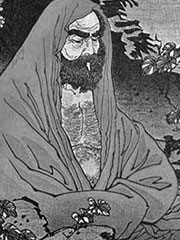
Throughout Buddhist art, Bodhidharma is depicted as a rather ill-tempered, profusely bearded and wide-eyed barbarian. He is described as “The Blue-Eyed Barbarian” in Chinese texts.

Chan texts also present Bodhidharma as the 28th Chan Patriarch, in an uninterrupted line starting with the Buddha, through direct and non-verbal transmission.

Legends

Encounter with Emperor Liang

According to tradition, around 520, during the period of the Southern Dynasties, Bodhidharma was invited to an audience with Emperor Wudi of the Liang Dynasty.

When the Emperor asked him how much merit he had accumulated through building temples and endowing monasteries, Bodhidharma replied, “None at all.”

Perplexed, the Emperor then asked, “Well, what is the fundamental teaching of Buddhism?”

“Vast emptiness, nothing sacred,” was the bewildering reply.

“Listen,” said the Emperor, now losing all patience, “just who do you think you are?”

“I have no idea,” Bodhidharma replied.

With this, Bodhidharma was banished from the Court, and is said to have sat in meditation for the next nine years “listening to the ants scream”.

Nine years of gazing at a wall

Bodhidharma traveled to northern China, to the recently constructed Shaolin Monastery, where the monks refused him admission.Bodhidharma sat meditating facing a wall for the next 9 years, boring holes into it with his stare.Having earned the monks’ respect, Bodhidharma was finally permitted to enter the monastery.There, he found the monks so out of shape from lives spent hunched over scrolls that he introduced a regimen of exercises which later became the foundation of Shaolin kung fu, from which many schools of Chinese martial art claim descent.

Historically, it is unlikely that Bodhidharma invented kung fu.There are martial arts manuals that date back to at least the Han Dynasty (202 BCE–220 CE), predating both Bodhidharma and the Shaolin Temple.The codification of the martial arts by monks most likely began with military personnel who retired to monasteries or sought sanctuary there.Within the refuge of the monastery, unlike on an unforgiving battlefield, such individuals could, confident in their safety, exchange expertise and perfect their techniques.

Bringing tea to China

Japanese legends credit Bodhidharma with bringing tea to China. Supposedly, he cut off his eyelids while meditating, to keep from falling asleep. Tea bushes sprung from the spot where his eyelids hit the ground. It is said that this is the reason for tea being so important for meditation and why it helps the meditator to not fall asleep.This legend is unlikely as tea use in China predates Chan Buddhism in China.According to Chinese mythology, in 2737 BC the Chinese Emperor, Shennong, scholar and herbalist, was sitting beneath a tree while his servant boiled drinking water.A leaf from the tree dropped into the water and Shennong decided to try the brew.The tree was a wild tea tree.There is an early mention of tea being prepared by servants in a Chinese text of 50 B.C. The first detailed description of tea-drinking is found in an ancient Chinese dictionary, noted by Kuo P’o in A.D. 350.

Daruma dolls

Main article: Daruma doll

It is also reported that after years of meditation, Bodhidharma lost the usage of his legs. This legend is still alive in Japan, where legless Daruma dolls represent Bodhidharma, and are used to make wishes.

Bodhidharma and Huike

Bodhidharma was the first Zen patriarch of China.All later Chinese and Japanese Zen masters trace their master-disciple lineage to him.Huike, who was to become the second patriach, was first ignored when he tried to approach him, and left outside in the snow, until he cut his own arm and offered it to the Master. (This is supposedly the origin of the famous ‘one hand salute’ of the monks who came after him).Bodhidharma later transmitted to him the insignia of the patriarchs: the robe, the Buddha’s begging bowl, and a copy of the Lankavatara Sutra.

The legend of Huike’s self-dismemberment is likely apocryphal. According to Daoxuan, wandering bandits cut off Huike’s arm.

The lineage of Bodhidharma and his disciples

Although Bodhidharma is commonly said to have had two primary disciples (the monks Daoyu and Huike), a common voice in the “Records” of the Long Scroll is that of a Yuan, possibly identified with the nun Dharani who was said to have received Bodhidharma’s flesh — his bones having been received by Daoyu, and his marrow received by Huike.A list of Bodhidharma’s early students follows.

  • Bodhidharma
    • Daoyu
    • Yuan (Yuan-chi?)
      • Tao-chih
    • Huike
      • Huineng
      • Layman Hsiang
      • Hua-kung
      • Yen-kung
      • Tanlin
      • Dhyana Master Na
      • Dhyana Master Ho
        • Hsuan-ching
          • Hsuan-chueh
        • Ching-ai
          • T’an-yen
          • Tao-an
          • Tao-p’an
          • Chih-tsang
          • Seng-chao
          • P’u-an
            • Ching-yuan

Works attributed to Bodhidharma

  • The Bloodstream Sermon
  • The Breakthrough Sermon
  • The Outline of Practice
  • Two Entrances
  • The Wake-Up Sermon

See also

  • Buddhism in China
  • Culture hero

References

  • Tom Lowenstein, The Vision of the Buddha. Duncan Baird Publishers, London. ISBN 1903296919
  • Red Pine, translator; The Zen Teaching of Bodhidharma. North Point Press, New York. (1987)
  • Alan Watts, The Way of Zen. ISBN 0375705104
  • Paul Williams, Mahayana Buddhism: The Doctrinal Foundations. ISBN 0415025370
  • Andy Ferguson, Zen’s Chinese Heritage. ISBN 0861711637 contains a translation of The Outline of Practice
Preceded by:
Prajnatara
Buddhist Patriach Succeeded by:
Title Extinct
Preceded by:
New Creation
Chinese Ch’an Patriarch Succeeded by:
Hui Ke

Bodhidharma Bódhidharma Bodhidharma Bodhidharma Bodhidharmo Bodhidharma 달마 Bodhidharma בודהידהרמה Bodhidharma 達磨 Bodhidharma Бодхидхарма Bódhidharma พระโพธิธรรม Bồ-đề-đạt-ma

February 6, 2019 0 comments
0 FacebookTwitterPinterestEmail
Bodhi Tree
Buddhism

Bodhi Tree

by Sergei February 6, 2019
written by Sergei

Bodhi Tree — overview of meaning, background and key points, with links to related topics for context.

Bodhi TreeThe Bodhi tree was a large and very old specimen of the Sacred Fig, located at the Mahabodhi Temple at Bodh Gaya (about 100 km from Patna in the Indian state of Bihar) under which Siddhartha Gautama, the spiritual teacher and founder of Buddhism later know as Gautama Buddha, arrived at Bodhi. The Bodhi Tree belongs to the Sacred Figs (Ficus religiosa), also known as Bo, Pipul (Peepal) or Ashwattha trees, which are sacred to Hindus, Jains and Buddhists. According to Buddhist belief, Siddharta Gautama meditated under this tree, mentioned as Ashwattha in the Tipitaka, when he achieved Nirvana. The word ‘Ashvattha’ is derived from the Sanskrit roots ‘Shwa’ meaning tomorrow, ‘a’ indicating negation, and ‘tha’ meaning “one that stands or remains”. (The Hindu philosopher Shankaracharya interprets the name to indicate “One which does not remain the same tomorrow”, such as the universe itself.)

The Sacred Fig currently growing at the Mahabodhi Temple is not the original specimen, but probably a direct clone descendant of it. This tree is a frequent destination for pilgrims, being the most important of the four holy sites for Buddhists.

Another sacred specimen, also propagated from the original Bodhi tree, is the Sri Maha Bodhi in Sri Lanka, planted in 288 BC.

Figuier des pagodes Bodhiboom ゴータマ・ブッダの菩提樹 Cây bồ đề

February 6, 2019 0 comments
0 FacebookTwitterPinterestEmail
Gautama Buddha
Buddhism

Bodhi (Buddhahood)

by Sergei February 6, 2019
written by Sergei

Bodhi — overview of meaning, background and key points, with links to related topics for context.

Gautama BuddhaBodhi (Pāli and Sanskrit. Lit. awakening) is a title given in Buddhism to the specific awakening experience attained by the Indian spiritual teacher Gautama Buddha and his disciples. It is sometimes described as complete and perfect sanity, or awareness of the true nature of the universe. After attainment, it is believed one is freed from the cycle of Samsāra: birth, suffering, death and rebirth. Bodhi is most commonly translated into English as enlightenment, though this translation is problematic, since enlightenment (the soul being “lit” by a higher power) is originally a concept from Christian mysticism or conversely evokes notions of the 18th century European Age of Enlightenment that are not identical with the Buddhist concept of Bodhi. There is no image of “light” contained in the term, “Bodhi” – rather, it expresses the notion of awakening from a dream and of being aware and Knowing (Reality). It is thus preferable to think of Bodhi as spiritual “Awake-ness” or “Awakening”, rather than “enlightenment” (although it is true that imagery of light is extraordinarily prevalent in many of the Buddhist scriptures).

Bodhi is attained only by the accomplishment of the Paramitas (perfections), when the Four Noble Truths are fully grasped, and when all karma has reached cessation. At this moment, all greed (lobha), aversion (dosa), delusion (moha), ignorance (avijjā), craving (tanha) and ego-centered consciousness (attā) are extinguished. Bodhi thus includes anattā, the absence of ego-centeredness.

Certain Mahayana Buddhist sutras stress that Bodhi is always present and perfect, and simply needs to be “uncovered” or disclosed to purified vision. Thus the “Sutra of Perfect Awakening” has the Buddha teach that, like gold within its ore, Bodhi is always there within the being’s mind but requires the obscuring mundane ore (the surrounding defilements of samsara and of impaired, unawakened perception) to be removed. The Buddha declares:

“Good sons, it is like smelting gold ore. The gold does not come into being because of smelting .. Even though it passes through endless time, the nature of the gold is never corrupted. It is wrong to say that it is not originally perfect. The Perfect Enlightenment of the Tathagata is also like this.”

Similar doctrines are encountered in the Tathagatagarbha sutras, which tell of the immanent presence of the Buddha Principle (Buddha-dhatu/ Buddha-nature) within all beings. Here, the Tathagatagarbha (Buddha-Matrix) is tantamount to the indwelling transformative and liberational power of Bodhi, which bestows an infinitude of unifying vision. The Buddha of the Shurangama Sutra states:

“My uncreated and unending profound Enlightenment accords with the Tathagatagarbha, which is absolute Bodhi, and ensures my perfect insight into the Dharma realm , where the one is infinite and the infinite is one.”

The Bodhi tree is a specimen of the Sacred Fig (Ficus religiosa) in what is now the town of Bodhgaya. It was while sitting in meditation under this tree that Siddhartha Gautama became enlightened. In the legends of Mahayana Buddhism, it was said that Queen Maya held a branch of one of these trees while resting in Lumbini Garden and her son, Siddhartha, was born.

Contents

  • Modes of Enlightenment
    • Sāvaka-Bodhi (Arhat)
    • Pacceka-Bodhi (Pratyeka)
    • Sammā-Sambodhi (supreme Buddha)
  • Quotes
  • See also
  • Further reading

Modes of Enlightenment

Sāvaka-Bodhi (Arhat)

Those who study the teaching of a samma-sambuddha and then attain enlightenment in this world are known as Arhats. Such beings are skilled at helping others to reach enlightenment as they may draw on personal experience.

Pacceka-Bodhi (Pratyeka)

Those who obtain enlightenment through self-realisation, without the aid of spiritual guides and teachers, are known as pratyekabuddhas. According to the Tripitaka, such beings only arise in ages where the dharma has been lost. Their skill in helping others to obtain enlightenment is inferior to that of the arhats, but one need to accumulate paramis in a much long time to become a pratyekabuddha than an Arhat. Many pratyekas may arise at a single time.

Sammā-Sambodhi (supreme Buddha)

These are perfect, most developed, most compassionate, most loving, all knowing beings who fully comprehend the dhamma by their own efforts and wisdom and teach it skillfully to others, freeing them from Samsāra. One that develops Sammā-Sambodhi is known as samma-sambuddha, and it is needed much more time of parami accumulation here than to become a pratyekabuddha

Quotes

When you get to this, then thoughts become still without being stilled, calmness and insight arise without being produced, the mind of the buddhas appears without being revealed. To try to liken it to the body of cosmic space or the light of a thousand suns would be to be further away than the sky is from the earth.
— Wei-tse
To be a living being is not the ultimate state; there is something beyond, much more wonderful, which is neither being nor non-being, neither living nor not-living. It is a state of pure awareness, beyond the limitations of space and time. Once the illusion that the body-mind is oneself is abandoned, death loses its terror, it becomes a part of living.
— Sri Nisargadatta Maharaj

See also

  • Buddha
  • Buddha-nature
  • Buddhism
  • Gnosis
  • Nirvana

Further reading

  • The Sutra of Perfect Enlightenment (State University Press of New York, 1999), tr. by A. Charles Muller
  • The Surangama Sutra (B.I. Publications, Bombay 1978), tr. by Lu K’uan Yu
  • The Role of Bodhicitta in Buddhist Enlightenment. (New York : The Edwin Mellen Press, 2005) , Kenneth R. White Erleuchtung (Buddhismus)

보리 (불교) Bodhi Verlichting (boeddhisme) 菩提 Пробуждение Bồ-đề 菩提

February 6, 2019 0 comments
0 FacebookTwitterPinterestEmail
Bodh Gaya
Buddhism

Bodh Gaya (Bodhgaya)

by Sergei February 6, 2019
written by Sergei

Bodh Gaya — overview of meaning, background and key points, with links to related topics for context.

Bodh GayaBodh Gaya or Bodhgaya is the place of Buddha’s attainment of Enlightenment. The complex, located about 96 kilometers from Patna (situated at latitude 24° 41′ 45″ N, longitude 85° 2′ 2″ E) in the state of Bihar in India, contains the Mahabodhi Temple with the diamond throne (called the Vajrasana) and the holy Bodhi tree and was built over 2500 years ago. This tree is a sapling of the Sri Maha Bodhi tree in Sri Lanka, itself a sapling of the original Bodhi tree.

For Buddhists, Bodh Gaya is the most important of the four pilgrimage sites related to the life of Gautama Buddha, the other three being Kushinagar, Lumbini, and Sarnath. As of 2002, Mahabodhi Temple located in Bodh Gaya, is a UNESCO World Heritage Site specifically nominated for the international World heritage program.

History

According to Buddhist traditions, circa 500 BC Prince Gautama Siddhartha, wandering as a monk, reached the sylvan banks of Falgu River, near the city of Gaya. There he sat in meditation under a peepal tree (Ficus religiosa). After three days and three nights of meditation, Siddharta attained enlightenment and insight, and the answers that he had sought. Enlightened by the new thought, he spent seven weeks at seven different spots in the vicinity meditating and considering his experience. After seven weeks, he travelled to Sarnath, where he began teaching Buddhism.

Disciples of Gautama Siddhartha began to visit the place where he had gained enlightenment during the full moon in the month of Vaisakh (April-May), as per the Hindu calendar. Over time, the place became known as Bodh Gaya, the day of enlightenment as Buddha Purnima, and the tree as the Bodhi Tree.

The history of Bodh Gaya is documented by many inscriptions and pilgrimage accounts. Foremost among these are the accounts of the Chinese pilgrims Faxian in the 5th century and Xuanzang in the 7th century. The area was at the heart of a Buddhist civilization for centuries, until it was conquered by Turkish armies in the 13th century.

Mahabodhi temple

It is believed that 250 years after the Enlightenment of the Buddha, Emperor Ashoka visited Bodh Gaya. He is considered to be the original founder of the Mahabodhi temple. It consisted of an elongated spire crowned by a miniature stupa and a chhatravali on a platform. A double flight of steps led up to the platform and the upper sanctum. The mouldings on the spire contained Buddha images in niches. Some historians believe that the temple was constructed or renovated in the 1st century during the Kushan period. With the decline of Buddhism in India, the temple was abandoned and forgotten, buried under deep layers of soil and sand.

The temple was later restored by Sir Alexander Cunningham as part of his work for the British Archaeological Society in the late 19th century. In 1883, Sir Cunningham along with J. D. Beglar and Dr. Rajendralal Miitra painstakingly excavated the site. Extensive renovation work was carried out restoring Bodh Gaya to its former glory.

Other Buddhist temples

Presently, several Buddhist temples and monasteries built and maintained by the people of Bhutan, China, Japan, Myanmar, Nepal, Sikkim, Sri Lanka, Thailand, Tibet and Vietnam dot the landscape around the temple. These buildings reflect the architectural style, exterior and interior decoration, and idols of their respective countries. The idol of Buddha in the Chinese Temple is 200 years old and was brought from China. Japan’s Nippon Temple is shaped like a pagoda. The Myanmar (Burmese) Temple is also pagoda shaped and is reminiscent of Pagan. The Thai Temple has a typical sloping, curved roof covered with golden tiles. Inside, the temple holds a massive and spectacular bronze idol of Buddha. Next to the Thai temple there is a 25 meter statue of Buddha located within a garden rhat has excised there for over 100 years.

  • Bodhgaya

Bodh-Gaya बोधगया Bodhgaya Bodh Gaya

February 6, 2019 0 comments
0 FacebookTwitterPinterestEmail
Bodhisattva Vows
Buddhism

Bodhisattva Vows

by Sergei February 6, 2019
written by Sergei

Bodhisattva Vows — brief biography and historical significance; key ideas and sources for deeper study.

Bodhisattva VowsIn the Bodhisattva vows (sometimes called the Bodhisattva Precepts) of Mahayana Buddhism, the bodhisattvas take vows stating that they will not realize or attain Nirvana until all sentient beings have done so. This four-part vow is made out of compassion and the bodhisattva devotes his/her powers to helping others attain Nirvana.

Buddhist lay persons may take the bodhisattva vows in order to initiate their spiritual journey. The following table of the fourfold vow is as practices by the Chan and Zen tradition.

Sino-Japanese English Chinese (pinyin) Chinese (hanzi)
Shi gu sei gan The Four Great Vows Si hong shi yuan 四弘誓願
Shu jo mu hen sei gan do I vow to liberate all beings, without number Zhong sheng wu bian shi yuan du 眾生無邊誓願度
Bon no mu jin sei gan dan I vow to uproot endless blind passions Fan nao wu jin shi yuan duan 煩惱無盡誓願斷
Ho mon mu ryo sei gan gaku I vow to penetrate dharma gates beyond measure Fa men wu liang shi yuan xue 法門無量誓願學
Butsu do mu jo sei gan jo I vow to attain the way of the Buddha Fo dao wu shang shi yuan cheng 佛道無上誓願成

Brahma Net Sutra

The Brahma Net Sutra translated by Kumarajiva (circa 400 CE) has a list of ten major and forty-eight minor Bodhisattva vows. The ten major vows are as follows:

  1. Not to kill any living creature
  2. Not to steal anything
  3. Not to engage in any form of sexual misconduct
  4. Not to lie or use false speech
  5. Not to trade alcoholic beverages
  6. Not to discuss the faults and misdeeds that occur by any Buddhist
  7. Not to praise oneself or disparage others
  8. Not to be stingy or abusive towards those in need
  9. Not to harbor anger or resentment or encourage others to be angry
  10. Not to criticise or slander the Three Jewels

Asanga’s Bodhisattvabhumi

Asanga (circa 300 CE) delineated 18 major vows and forty-six minor vows. These Bodhisattva vows are still used by the Gelukpa and Kagyu traditions of indo-tibetan Buddhism. The eighteen major vows (as actions to be abandoned) are as follows:

  1. Praising oneself or belittling others due to attachment to receiving material offerings, praise and respect.
  2. Not giving material aid or (due of miserliness) not teaching the Dharma to those who are suffering and without a protector.
  3. Not listening although another declares his/her offence or with anger blaming him/her and retaliating.
  4. Abandoning the Mahayana by saying that Mahayana texts are not the words of Buddha or teaching what appears to be the Dharma but is not.
  5. Taking things belonging to Buddha, Dharma or Sangha.
  6. Abandoning the holy Dharma by saying that texts which teach the three vehicles are not the Buddha’s word.
  7. With anger depriving ordained ones or their robes, beating and imprisoning them or causing them to lose their ordination even if they have impure morality, foe example, by staying that being ordained is useless.
  8. Committing any of the five extremely negative actions: (1) killing one’s mother, (2) killing one’s father, (3) killing an arhat, (4) intentionally drawing blood from a Buddha or (5) causing schism in the Sangha community by supporting and spreading sectarian views.
  9. Holding distorted views (which are contrary to the teaching of Buddha, such as denying the existence of the Three Jewels or the law of cause and effect etc.)
  10. Destroying towns, villages, cities or large areas by means such as fire, bombs, pollution or black magic.
  11. Teaching emptiness to those whose minds are unprepared.
  12. Causing those who have entered the Mahayana to turn away from working for the full enlightenment of Buddhahood and encouraging them to work merely for their own liberation from suffering.
  13. Causing others to abandon completely their vows of self liberation and embrace the Mahayana.
  14. Holding and causing others to hold the view that the Sravaka vehicle does not abandon attachment and other delusions.
  15. Falsely stating that oneself has realised profound emptiness and that if others meditate as one has, they will realize emptiness and become as great and as highly realized as oneself.
  16. Taking gifts from others who were encouraged to give you things originally intended as offerings to the Three Jewels. Not giving things to the Three Jewels that others have given you to give to them, or accepting property stolen from the Three Jewels.
  17. Causing those engaged in calm-abiding meditation to give it up by gibing their belongings to those who are merely reciting texts or making bad disciplinary rules which cause a spiritual community not to be harmonious.
  18. Abandoning the either of the two types of Bodhicitta (aspiring and engaging).
February 6, 2019 0 comments
0 FacebookTwitterPinterestEmail
Newer Posts
Older Posts

Must-Read

  • Meditation
  • Zen
  • Dhyāna
  • Buddhism by Country
  • History Of Buddhism
  • Greco-buddhism
  • Avatar
  • Koan
  • Buddha
  • Shambhala Buddhism
  • Dalai Lama
  • Fourteenth Dalai Lama
  • List Of Buddhists
  • Dzogchen
  • Buddhist Art
  • Buddhist Texts
  • Dharma Wheel
  • Mahayana

2016 - 2026 - Buddhism-Guide.com


Back To Top
Buddhism Guide
  • Buddhism Guide